



Previous
Next
Elastic Alloy | High-Elasticity & Corrosion-Resistant Alloys
- elastic alloys
- high elasticity alloy
- high elastic alloy
- elastic metal alloy
- precision elastic alloy
- elastic alloy supplier
- elastic alloy manufacturer
- custom elastic alloy
Description
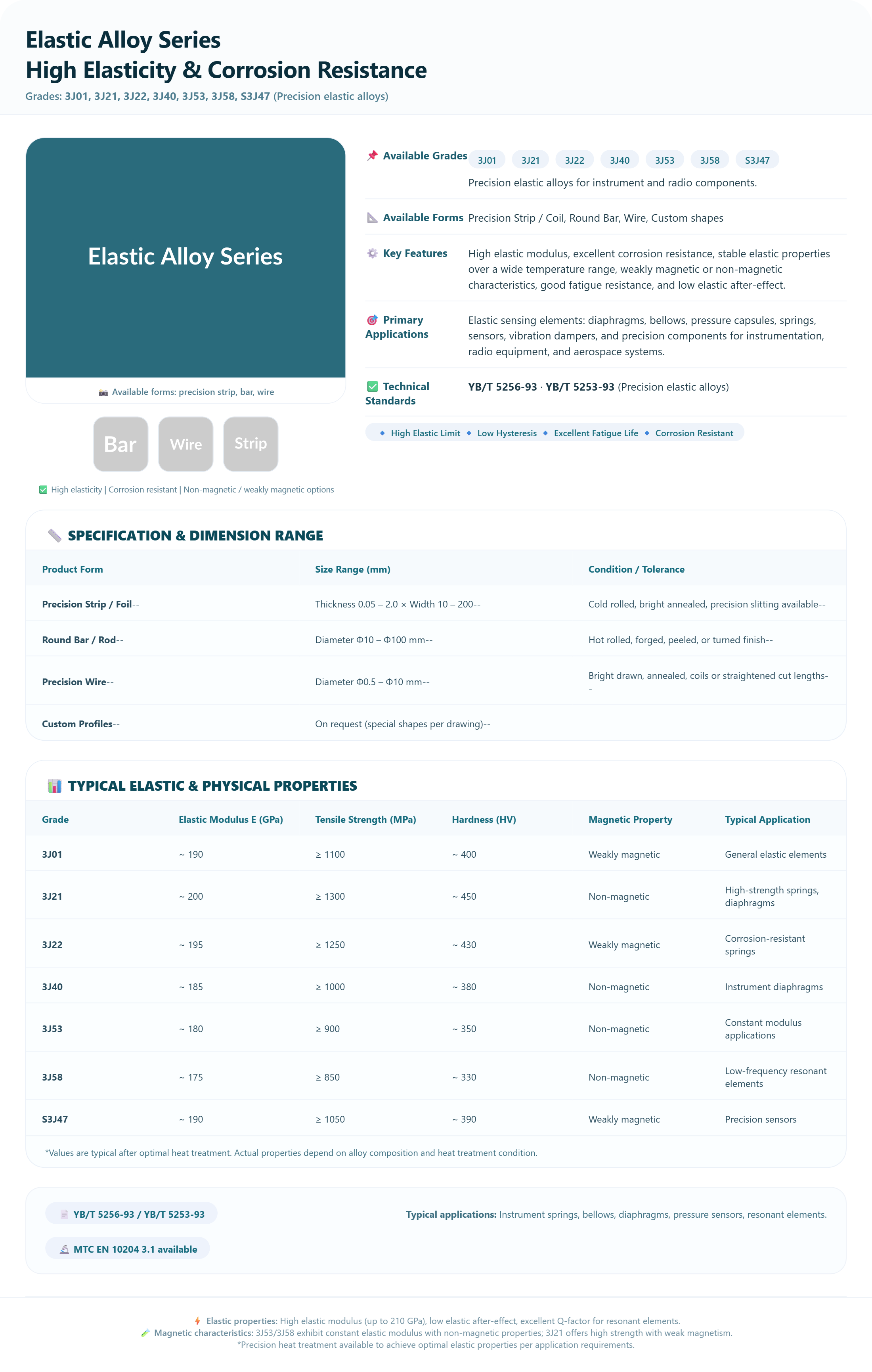
Elastic Alloy Series (grades 3J01, 3J21, 3J22, 3J40, 3J53, 3J58, S3J47) offer high elasticity, corrosion resistance, and stable properties. Ideal for instrument springs, diaphragms, sensors, and aerospace systems.
Elastic Alloy Series
High-Elasticity, High-Strength and Corrosion-Resistant Alloys for Precision Applications
Hefei Ke Ningman New Energy Materials Technology Co., Ltd. supplies elastic alloys for applications requiring controlled elastic recovery, high strength, fatigue resistance, corrosion resistance and dimensional stability.
Elastic alloys are specialized metallic materials designed to maintain predictable elastic behavior under repeated loading, deformation and operating conditions. Depending on the alloy system, they can be used for precision springs, electrical contacts, sensors, relays, diaphragms, precision instruments, aerospace components, automotive systems and other demanding applications.
Our elastic alloy series can be supplied in different material grades, product forms and dimensions according to technical specifications and application requirements.
Request an Elastic Alloy Quote
What Is an Elastic Alloy?
An elastic alloy is a metallic alloy engineered to provide controlled elastic deformation and reliable recovery after loading.
Compared with ordinary structural metals, elastic alloys are selected not simply for strength, but for a combination of:
Elastic recovery
High fatigue resistance
Stable spring properties
High strength
Controlled elastic modulus
Corrosion resistance
Dimensional stability
Temperature resistance
Electrical and mechanical performance
These properties make elastic alloys particularly useful for components that repeatedly deform and return to their original shape.
Typical examples include:
Springs
Spring contacts
Electrical contacts
Sensors
Diaphragms
Relays
Precision instruments
Aerospace components
Automotive components
Medical and electronic devices
Key Properties of Elastic Alloys
High Elasticity
The primary characteristic of an elastic alloy is its ability to withstand elastic deformation and recover its original shape.
For precision applications, engineers may evaluate:
Elastic modulus
Yield strength
Elastic limit
Spring-back behavior
Recovery after repeated loading
Fatigue performance
The appropriate material should be selected according to the required deformation range and operating conditions.
High Strength
Many elastic alloys can achieve high strength through alloy design, cold working and/or heat treatment.
High strength allows smaller components to withstand repeated mechanical loads without permanent deformation.
This is particularly important for:
Miniature springs
Precision contacts
Aerospace components
Instrument components
High-cycle mechanical parts
Actual strength depends on alloy grade, product form, processing and heat-treatment condition.
Fatigue Resistance
Elastic components often experience thousands, millions or even billions of loading cycles.
For these applications, fatigue resistance can be more important than static tensile strength.
Elastic alloy selection should consider:
Stress amplitude
Number of cycles
Surface finish
Component geometry
Operating temperature
Corrosive environment
Manufacturing process
For high-cycle spring applications, surface quality and dimensional control are especially important.
Corrosion Resistance
Many elastic alloys are designed to provide useful corrosion resistance in demanding industrial environments.
This can extend component service life and reduce the risk of performance degradation caused by:
Moisture
Oxidation
Chemicals
Salt exposure
Industrial atmospheres
Temperature cycling
The actual corrosion resistance depends on alloy composition and service environment.
Dimensional Stability
Precision elastic components often require stable dimensions after repeated loading and temperature changes.
Elastic alloys can be selected for applications requiring:
Low permanent deformation
Stable spring force
Controlled thermal behavior
Repeatable mechanical response
Long-term dimensional stability
Elastic Alloy Types
Elastic alloys can be grouped according to their primary alloy systems and performance requirements.
Nickel-Based Elastic Alloys
Nickel-based elastic alloys can provide a useful combination of:
High strength
Corrosion resistance
Fatigue resistance
Temperature resistance
Stable elastic properties
They are used in demanding industrial, aerospace and precision applications.
Iron-Based Elastic Alloys
Iron-based elastic alloys can provide a balance between:
Elastic properties
Strength
Corrosion resistance
Cost efficiency
Manufacturing flexibility
They can be used for industrial springs, precision components and other elastic applications.
Copper-Based Elastic Alloys
Copper-based elastic alloys are often selected when electrical conductivity and elastic performance are both important.
Potential applications include:
Electrical contacts
Connectors
Switches
Relays
Electronic components
Conductive springs
Nickel-Chromium Elastic Alloys
Nickel-chromium alloy systems can be considered when components require:
High strength
Corrosion resistance
Oxidation resistance
Stable performance at elevated temperatures
How to Choose the Right Elastic Alloy
There is no single elastic alloy that is optimal for every application.
Material selection should consider the following factors.
1. Required Elasticity
Determine the required:
Elastic modulus
Elastic limit
Spring force
Deflection
Recovery rate
2. Required Strength
Consider:
Tensile strength
Yield strength
Hardness
Permanent deformation
3. Fatigue Requirements
For cyclic applications, determine:
Operating stress
Frequency
Number of cycles
Expected service life
4. Operating Temperature
Temperature can influence:
Elastic modulus
Strength
Fatigue behavior
Permanent deformation
Corrosion resistance
5. Corrosion Environment
Specify whether the component will be exposed to:
Humidity
Salt spray
Chemicals
High temperature
Vacuum
Marine environments
6. Electrical Requirements
For electrical components, evaluate:
Electrical conductivity
Contact resistance
Magnetic properties
Thermal conductivity
7. Manufacturing Process
The alloy should be compatible with the intended process:
Stamping
Forming
Rolling
Drawing
Bending
Machining
Heat treatment
Welding
Elastic Alloy vs Conventional Metal
Elastic alloys should not be selected solely based on tensile strength.
| Property | Conventional Structural Metal | Elastic Alloy |
|---|---|---|
| Elastic Recovery | Application dependent | Designed for controlled elastic recovery |
| Spring Performance | Limited for some grades | Primary design consideration |
| Fatigue Resistance | Grade dependent | Often optimized for cyclic loading |
| Strength | Moderate to high | Can be high |
| Dimensional Stability | Application dependent | Important design characteristic |
| Corrosion Resistance | Grade dependent | Depends on alloy system |
| Precision Applications | Application dependent | Common use |
| Springs | General applications | Precision and demanding applications |
The appropriate material depends on the actual design and service requirements.
Elastic Alloy Product Forms
Depending on alloy grade and specification, elastic alloys can be supplied in different forms.
Elastic Alloy Strip
Elastic alloy strip is commonly used for:
Precision springs
Electrical contacts
Stamping components
Electronic components
Spring clips
Important purchasing parameters include:
Thickness
Width
Coil length
Flatness
Surface finish
Temper
Mechanical properties
Elastic Alloy Sheet
Elastic alloy sheet can be used for:
Precision components
Diaphragms
Stamped parts
Instrument components
Industrial assemblies
Elastic Alloy Wire
Elastic alloy wire is suitable for:
Springs
Fine wires
Electrical contacts
Precision components
Sensors
Wire specifications normally include:
Diameter
Diameter tolerance
Tensile strength
Elongation
Surface condition
Heat-treatment condition
Elastic Alloy Bar
Elastic alloy bar can be used for machined components requiring controlled mechanical properties.
Potential applications include:
Precision shafts
Pins
Mechanical components
Instrument components
Industrial parts
Elastic Alloy Applications
Precision Springs
Elastic alloys are widely considered for springs requiring:
Stable spring force
High fatigue resistance
Small dimensions
Repeated loading
Corrosion resistance
Electrical Contacts
Some elastic alloys combine mechanical spring properties with suitable electrical characteristics.
Potential applications include:
Switch contacts
Connectors
Relays
Contact springs
Electronic assemblies
Sensors
Elastic alloy components can be used in selected sensors where predictable deformation and dimensional stability are required.
Diaphragms
Thin elastic alloy sheets can be used for precision diaphragms where controlled deformation is required.
Applications may include:
Pressure sensing
Valves
Instrumentation
Precision control systems
Aerospace Components
Aerospace applications may require materials that combine:
High strength
Fatigue resistance
Corrosion resistance
Temperature stability
Low weight or compact design
Elastic alloys can be considered for selected aerospace springs, contacts, sensing components and precision mechanisms.
Automotive Components
Potential applications include:
Sensors
Electrical contacts
Springs
Connectors
Precision mechanisms
The appropriate alloy depends on temperature, fatigue, corrosion and electrical requirements.
Precision Instruments
Elastic alloys are useful in selected:
Measuring instruments
Mechanical sensors
Instrument springs
Precision mechanisms
Control devices
Elastic Alloy Technical Data
For each specific alloy grade, technical data should be provided according to the applicable standard.
Recommended technical parameters include:
| Parameter | Specification |
|---|---|
| Alloy Grade | Specify actual grade |
| Standard | ASTM / AMS / GB / EN / other applicable standard |
| Product Form | Sheet / strip / wire / bar / tube |
| Thickness / Diameter | Project requirement |
| Tensile Strength | Grade and condition dependent |
| Yield Strength | Grade and condition dependent |
| Elongation | Grade and condition dependent |
| Elastic Modulus | Grade dependent |
| Hardness | Grade and condition dependent |
| Electrical Resistivity | Grade dependent |
| Corrosion Resistance | Application dependent |
| Surface Finish | Project requirement |
| Heat Treatment | Grade dependent |
Important: Replace the generic fields above with the actual values from your technical datasheets.
Elastic Modulus and Spring Performance
When designing an elastic component, tensile strength alone does not determine its spring performance.
Engineers may need to evaluate:
Elastic Modulus + Yield Strength + Geometry + Applied Stress + Fatigue Life
For example, two materials can have similar tensile strength but behave differently in a spring application because of differences in elastic modulus, work-hardening behavior and fatigue performance.
For precision spring design, the material should therefore be selected together with:
Component geometry
Required deflection
Spring force
Operating temperature
Number of cycles
Surface condition
Elastic Alloy Manufacturing and Processing
Depending on the alloy grade, manufacturing processes may include:
Melting → Casting → Hot Working → Cold Rolling/Drawing → Heat Treatment → Precision Processing → Surface Finishing → Inspection
For thin strip and wire products, cold working and heat treatment can have a significant effect on mechanical and elastic properties.
Important process-control parameters may include:
Reduction rate
Rolling schedule
Drawing reduction
Annealing
Aging
Surface treatment
Final temper
Dimensional tolerance
The final processing route should be selected according to the alloy grade and required properties.
Quality Control for Elastic Alloys
Elastic alloy products require more than dimensional inspection.
Depending on the application, quality control may include:
Chemical Composition
Verification of the alloy composition according to the applicable specification.
Mechanical Properties
Testing may include:
Tensile strength
Yield strength
Elongation
Hardness
Elastic Properties
For specified applications, testing may evaluate:
Elastic modulus
Spring properties
Permanent deformation
Recovery behavior
Fatigue Testing
For high-cycle applications, fatigue performance may be evaluated according to the customer's requirements.
Dimensional Inspection
Inspection can include:
Thickness
Width
Diameter
Flatness
Straightness
Tolerance
Surface Inspection
Surface quality is particularly important for spring and fatigue-sensitive applications because surface defects can become stress-concentration points.
How to Buy Elastic Alloy
When requesting an elastic alloy quotation, provide as much technical information as possible.
Material
Specify the required alloy grade.
Product Form
For example:
Strip
Sheet
Wire
Bar
Tube
Dimensions
Provide:
Thickness
Width
Diameter
Length
Mechanical Requirements
Specify:
Tensile strength
Yield strength
Hardness
Elongation
Elastic Requirements
Specify:
Elastic modulus
Spring force
Deflection
Recovery requirement
Surface Requirements
Specify:
Surface finish
Roughness
Cleanliness
Coating
Quantity
Provide:
Trial quantity
Production quantity
Annual demand
Certification
Specify whether you require:
MTR
Chemical composition report
Mechanical test report
Heat-treatment report
Third-party inspection
Quality certificate
Elastic Alloy Supplier
Hefei Ke Ningman New Energy Materials Technology Co., Ltd. supplies elastic alloy materials for industrial, electronic, precision and engineering applications.
Our material supply can support requirements for:
Elastic alloy strip
Elastic alloy sheet
Elastic alloy wire
Elastic alloy bar
Precision elastic materials
Spring materials
Custom material dimensions
Bulk industrial orders
Technical documentation
Quality inspection
If you are sourcing elastic alloys for springs, sensors, electrical contacts, precision instruments, aerospace components or industrial applications, provide your required alloy grade, dimensions, quantity, mechanical properties and applicable standard.
Request an Elastic Alloy Quote →
Frequently Asked Questions
What is an elastic alloy?
An elastic alloy is a metallic material engineered to provide controlled elastic deformation and recovery under mechanical loading.
What are elastic alloys used for?
Elastic alloys can be used for precision springs, electrical contacts, sensors, diaphragms, relays, aerospace components, automotive components and precision instruments.
What properties are important for elastic alloys?
Important properties can include elastic modulus, yield strength, tensile strength, fatigue resistance, corrosion resistance, dimensional stability and temperature performance.
What is the difference between an elastic alloy and spring steel?
Spring steel is a broad category of steels designed for spring applications. Elastic alloys include a wider range of alloy systems, including nickel-, iron- and copper-based materials, selected according to elasticity, fatigue, corrosion, electrical and temperature requirements.
Can elastic alloys be used for electrical contacts?
Yes. Some elastic alloys can combine spring properties with suitable electrical characteristics and can therefore be considered for electrical contacts, connectors, relays and switches.
Can elastic alloy be supplied as strip?
Yes. Elastic alloy strip can be supplied for precision springs, electrical contacts and stamped components, subject to the specific alloy and dimensional requirements.
Can you supply custom elastic alloy materials?
Yes. Custom dimensions, product forms and technical requirements can be discussed according to drawings and applicable material specifications.
Can you provide material test certificates?
Material test reports and quality documentation can be supplied according to the applicable specification and customer requirements.
Request an Elastic Alloy Quote
Looking for high-elasticity alloy materials for a precision or industrial application?
Send us:
Alloy grade
Product form
Thickness / diameter
Width / length
Quantity
Required mechanical properties
Elastic requirements
Surface finish
Applicable ASTM / AMS / GB / EN standard
Inspection requirements
Our technical team can review your specifications and recommend a suitable elastic alloy material for your application.
Get a Quote → Contact Us