



Previous
Next
4J43 Dumet Core Alloy Manufacturer | 42% Ni-Fe Wire Core
- 4J43 alloy
- 4J43 sealing alloy
- 4J43 expansion alloy
- 4J43 nickel iron alloy
- 4J43 Ni-Fe alloy
- 4J43 alloy manufacturer
- 4J43 Dumet core alloy manufacturer
- 4J43 alloy for Dumet wire
Description
4J43 Dumet Core Alloy is a controlled expansion alloy for copper-clad wire (Dumet wire) manufacturing. Ideal for glass-to-metal seals in semiconductor packaging, lamp bulbs, and vacuum electronics. YB/T 5236-93 compliant.
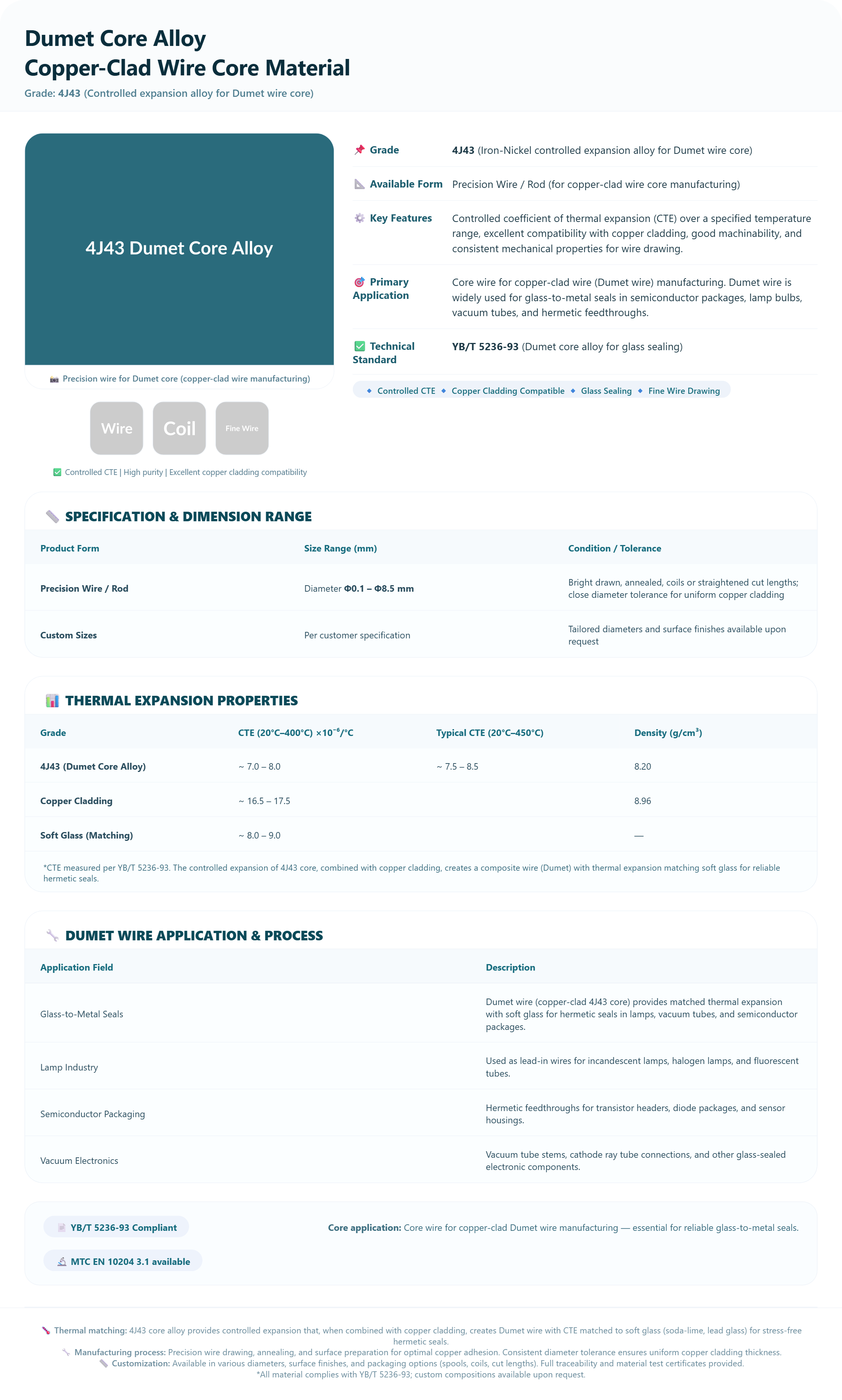
4J43 Dumet Core Alloy | 42% Nickel-Iron Core for Copper-Clad Wire
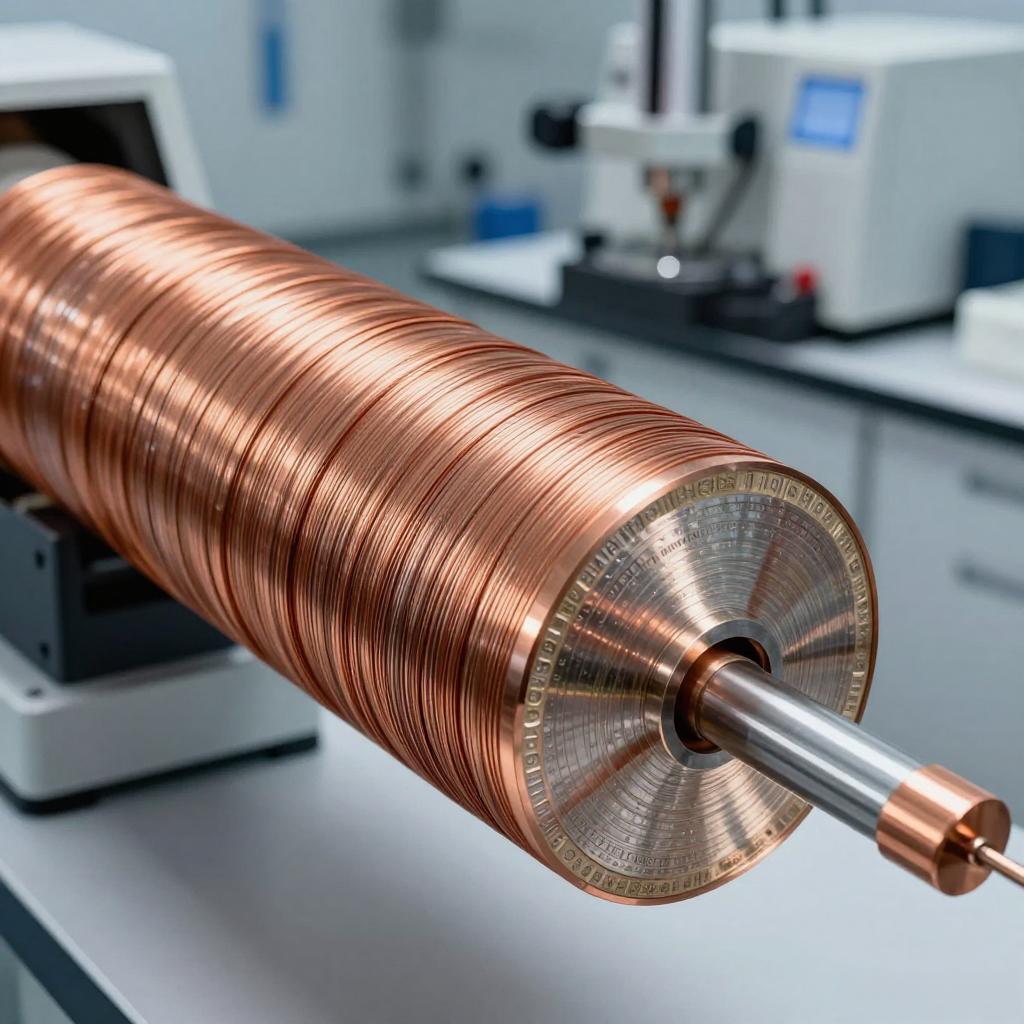
4J43 Dumet core alloy is a controlled-expansion iron-nickel alloy used as the core material for copper-clad Dumet wire and other glass-to-metal sealing applications.
With a nominal nickel content in the range of approximately 41–43%, 4J43 provides the low and controlled thermal expansion required for the core of Dumet wire. When combined with a copper sheath, the composite wire can provide a thermal expansion behavior suitable for sealing through selected soft glass systems.
Hefei Ke Ningman New Energy Materials Technology Co., Ltd. supplies 4J43 nickel-iron alloy in wire, rod and other customized forms for Dumet wire manufacturing, electrical lead applications and precision glass-to-metal sealing.
4J43 Dumet Core Alloy at a Glance
| Property | 4J43 |
|---|---|
| Alloy designation | 4J43 |
| Alloy family | Iron-nickel controlled expansion alloy |
| Main alloy system | Fe-Ni |
| Nickel content | 41–43% |
| Core material application | Dumet wire |
| Composite structure | Nickel-iron core + copper sheath |
| Main sealing application | Soft glass-to-metal sealing |
| Typical function | Controlled thermal expansion core |
| Product forms | Wire, rod, bar and customized forms |
| Standard references | GB/T / YB/T precision alloy specifications |
| Material certification | Available according to order requirements |
Chemical composition, thermal expansion characteristics and product condition should be confirmed against the applicable material specification.
What Is 4J43 Alloy?
4J43 is a 42% nickel-iron controlled expansion alloy commonly used as a core material for Dumet wire.
The alloy belongs to the iron-nickel precision expansion alloy family. Its controlled thermal expansion characteristics make it suitable for applications where the metal must be thermally compatible with glass during a heating and cooling cycle.
Published material data list approximately:
Ni: 41–43%
Mn: 0.75–1.25%
Si: ≤0.30%
C: ≤0.20%
P: ≤0.02%
S: ≤0.02%
Fe: Balance
The exact chemical composition should be controlled according to the applicable specification and the customer's purchasing requirements.
4J43 as Dumet Wire Core Material
The most important application of 4J43 is its use as the nickel-iron core of Dumet wire.
Dumet wire is not simply 4J43 wire.
Instead, it is a composite conductor consisting of:
4J43 Fe-Ni Core → Copper Cladding → Surface Oxide / Borate Treatment → Dumet Wire
The low-expansion Fe-Ni core controls the basic thermal expansion behavior, while the copper sheath provides electrical conductivity and contributes to the radial expansion behavior required for glass sealing.
This combination allows Dumet wire to provide a practical balance between:
Controlled thermal expansion
Electrical conductivity
Glass wettability
Mechanical strength
Hermetic sealing performance
ASTM F29 defines Dumet as round copper-coated approximately 42% nickel-iron wire intended primarily for sealing to soft glass. The standard also addresses core composition, copper coating, oxide coating, thermal expansion, dimensions and workmanship.
How 4J43 Works in Dumet Wire
The performance of Dumet wire depends on the interaction between the Fe-Ni core and copper sheath.
Step 1 — 4J43 Provides the Controlled-Expansion Core
The 4J43 core has a much lower thermal expansion than copper.
Step 2 — Copper Provides Electrical Conductivity
Copper has high electrical and thermal conductivity, making it suitable as the conductive outer layer.
Step 3 — Copper and Core Work as a Composite
The relative dimensions and material properties of the core and copper sheath influence the overall radial thermal expansion behavior of the Dumet wire.
Step 4 — Surface Treatment Supports Glass Sealing
Dumet wire can receive an oxide or borate-based surface treatment to improve interaction with molten glass during sealing.
Step 5 — The Composite Wire Forms the Glass Seal
During sealing, the wire and glass are heated and subsequently cooled under controlled conditions.
The goal is to obtain a stable interface with controlled residual stress.
4J43 Thermal Expansion
Thermal expansion is the key reason 4J43 is used as a Dumet core material.
A glass-to-metal seal must accommodate thermal expansion during:
Heating → Glass Softening → Sealing → Cooling → Final Operating Condition
If the metal and glass have excessive thermal expansion mismatch, tensile stress can develop in the glass during cooling.
This can result in:
Glass cracking
Seal failure
Leakage
Loss of hermeticity
Interface separation
Reduced thermal-cycle reliability
The 4J43 core therefore provides the controlled expansion foundation for the Dumet composite.
For final Dumet-wire design, however, engineers should evaluate the thermal expansion of the complete copper-clad wire, not only the CTE of the 4J43 core.
Published Dumet specifications and technical references evaluate thermal expansion over defined temperature ranges and material conditions.
4J43 vs Dumet Wire
4J43 and Dumet wire are related but not identical.
| Item | 4J43 | Dumet Wire |
|---|---|---|
| Material type | Fe-Ni alloy | Composite wire |
| Main structure | Nickel-iron alloy | 4J43-type Fe-Ni core + copper sheath |
| Copper layer | No | Yes |
| Electrical conductivity | Lower than copper-clad wire | High |
| Thermal expansion | Controlled core expansion | Composite radial expansion |
| Primary function | Core material | Finished glass-sealing conductor |
| Glass sealing | Indirect / core material | Direct application |
| Typical application | Dumet manufacturing | Soft glass sealing |
This distinction is important when specifying materials for manufacturing.
If you are purchasing material to manufacture Dumet wire, you may require 4J43 core alloy.
If you are purchasing the finished conductor for glass sealing, you may instead require Dumet wire manufactured to ASTM F29 or another applicable specification.
4J43 for Soft Glass Sealing
4J43 is primarily associated with the core material used in Dumet wire for sealing through suitable soft glass.
The complete sealing system depends on:
4J43 core composition
Copper sheath thickness
Finished wire diameter
Radial CTE
Axial CTE
Surface oxidation
Borate coating
Glass composition
Glass CTE
Sealing temperature
Heating rate
Cooling rate
The exact glass should therefore be selected together with the complete Dumet wire specification.
Dumet wire is widely associated with sealing copper electrical leads through soda-lime and lead glass systems.
4J43 Copper-Clad Wire Core
The copper-clad construction is fundamental to Dumet wire.
A simplified cross-section is:
Copper Sheath
↓
4J43 Fe-Ni Core
↓
Copper Sheath
The core provides controlled thermal expansion and mechanical support, while copper provides electrical conductivity.
The relative proportion of core and copper must be controlled because changing the copper sheath thickness can affect the thermal and mechanical behavior of the finished wire.
For this reason, Dumet wire manufacturers need consistent:
Core diameter
Copper thickness
Core-to-sheath ratio
Finished diameter
Surface condition
Oxide coating
Drawing condition
4J43 Core Alloy for Glass-to-Metal Sealing
Glass-to-metal sealing requires a controlled relationship between:
Metal CTE ↔ Glass CTE ↔ Sealing Temperature ↔ Cooling Rate
The metal should be selected based on the actual glass system.
For Dumet applications, the design objective is not simply to match the axial expansion of the metal and glass.
The composite structure is designed so that the radial expansion behavior of the copper-clad wire is appropriate for the glass sealing system.
Technical descriptions of Dumet wire explain that the copper sheath and low-expansion Fe-Ni core work together to produce a radial thermal expansion compatible with soft glass while limiting harmful tensile stress at the interface.
4J43 Applications
1. Dumet Wire Manufacturing
The primary application is the production of copper-clad Dumet wire.
4J43 provides the controlled-expansion Fe-Ni core required for the composite conductor.
2. Glass-Sealed Electrical Leads
Dumet wire is commonly used as an electrical lead passing through a glass seal.
Applications may include:
Lamps
Diodes
Thermistors
Vacuum electronic devices
Glass-sealed electrical components
Dumet wire is specifically used in glass-sealed thermistors and similar components because the Fe-Ni core helps bring the thermal expansion behavior closer to the glass system.
3. Lighting Components
Dumet wire has historically been used for electrical leads in lamps and other glass-enclosed lighting components.
4. Electronic Components
Dumet-based glass-to-metal sealing can be used for selected electronic components requiring reliable electrical feedthroughs.
5. Hermetic Electrical Feedthroughs
Dumet wire can be used where an electrical conductor must pass through a glass barrier while maintaining a reliable seal.
6. Vacuum Electronic Components
Selected vacuum devices use Dumet-type glass-to-metal seals for electrical lead-through structures.
4J43 Chemical Composition
A representative 4J43 composition is:
| Element | Composition |
|---|---|
| Nickel (Ni) | 41–43% |
| Manganese (Mn) | 0.75–1.25% |
| Silicon (Si) | ≤0.30% |
| Carbon (C) | ≤0.20% |
| Phosphorus (P) | ≤0.02% |
| Sulfur (S) | ≤0.02% |
| Iron (Fe) | Balance |
The composition should be confirmed against the applicable 4J43 material standard and the customer's purchasing specification. Published reference data identify 4J43 as an approximately 42% nickel-iron controlled expansion alloy.
4J43 Product Forms
4J43 can be supplied according to the requirements of the intended manufacturing process.
Potential product forms include:
4J43 wire
4J43 rod
4J43 bar
Precision-drawn wire
Core wire for Dumet production
Customized lengths
Customized diameters
For Dumet-wire manufacturing, important parameters may include:
Core diameter
Diameter tolerance
Straightness
Surface condition
Mechanical properties
Chemical composition
Thermal expansion characteristics
Batch consistency
4J43 Manufacturing Process
A typical 4J43 precision-alloy manufacturing route may include:
Raw Material Preparation
Selected Fe, Ni and alloying materials are verified before melting.
Controlled Melting
The alloy is melted under controlled conditions to achieve the required composition.
Casting
The molten alloy is cast into an appropriate intermediate form.
Homogenization
Thermal treatment may be used to improve chemical and structural uniformity.
Hot Working
The alloy is processed into intermediate wire or rod dimensions.
Cold Drawing
Precision drawing is used to achieve the required core diameter and dimensional tolerance.
Annealing
Intermediate or final annealing may be applied to control hardness, residual stress and workability.
Surface Treatment
The surface is cleaned and finished according to the requirements of the intended Dumet manufacturing process.
Final Inspection
Finished material is inspected for chemical composition, dimensions, surface quality and other agreed specifications.
Dumet Wire Manufacturing with 4J43 Core
When 4J43 is used as the core material for Dumet wire, the manufacturing process typically continues beyond the production of the Fe-Ni core.
A simplified Dumet production route is:
4J43 Core Wire
↓
Copper Cladding
↓
Bonding / Welding
↓
Drawing
↓
Diameter Control
↓
Surface Treatment
↓
Oxidation / Borating
↓
Inspection
↓
Finished Dumet Wire
The exact production method depends on the customer's Dumet specification.
Industry technical references describe copper cladding, drawing and surface treatment as key stages in producing Dumet wire. Surface treatment may involve oxidation, borating or nickel plating depending on the application.
4J43 Quality Control
For Dumet core applications, material consistency is critical.
Quality control can include:
Chemical Composition
Verify:
Ni
Mn
Si
C
P
S
Fe
Dimensional Inspection
Measure:
Diameter
Diameter tolerance
Ovality
Length
Straightness
Surface Inspection
Check for:
Cracks
Scratches
Oxide defects
Pitting
Surface contamination
Drawing defects
Thermal Expansion Testing
The thermal expansion characteristics can be evaluated over the required temperature range.
Mechanical Testing
Where specified:
Tensile strength
Elongation
Hardness
Metallographic Inspection
Microstructural inspection can be used when required by the specification.
Material Traceability
Production batches can be linked to inspection records and material certificates.
ASTM F29 includes thermal expansion, copper analysis, metallography, dimensional and surface-related requirements for finished Dumet wire, illustrating the importance of controlling both the core and the finished composite conductor.
4J43 vs 4J42
4J43 and 4J42 are both Fe-Ni controlled expansion alloys, but they should not be treated as automatically interchangeable.
| Factor | 4J43 | 4J42 |
|---|---|---|
| Alloy family | Fe-Ni | Fe-Ni |
| Typical Ni | 41–43% | 41.5–42.5% |
| Main application direction | Dumet core / sealing | Glass sealing / controlled expansion |
| Product use | Core wire and precision material | Sealing components and precision alloy |
| Selection basis | Dumet construction and CTE | Glass/ceramic CTE and sealing design |
The correct material should be selected according to the customer's specification, glass system and required thermal expansion behavior.
4J43 vs 4J29 Kovar
4J43 and 4J29 are fundamentally different alloy systems.
| Factor | 4J43 | 4J29 / Kovar |
|---|---|---|
| Main system | Fe-Ni | Fe-Ni-Co |
| Ni | ~41–43% | ~28.5–29.5% |
| Co | Not the primary alloying element | ~16.8–17.8% |
| Typical application | Dumet core / soft glass sealing systems | Hard-glass and ceramic-related sealing |
| Main product | Core wire / precision alloy | Wire, strip, sheet and components |
| Primary selection factor | Dumet and glass-sealing requirements | Glass/ceramic CTE matching |
4J29/Kovar should therefore not be substituted for 4J43 simply because both are controlled-expansion sealing alloys.
4J43 Material Standards and Specifications
When purchasing 4J43 for Dumet-core applications, the specification should clearly identify:
Alloy designation
Chemical composition
Product form
Diameter
Dimensional tolerance
Thermal expansion requirement
Heat-treatment condition
Surface condition
Mechanical properties
Inspection requirements
Certification requirements
For finished Dumet wire, ASTM F29 is an important international reference because it specifically covers copper-coated approximately 42% nickel-iron wire intended primarily for soft-glass sealing.
The finished Dumet wire specification should not automatically be applied to the bare 4J43 core material. Core material and finished composite wire should be specified separately.
How to Select 4J43 Dumet Core Alloy
Before purchasing 4J43 core material, manufacturers should confirm:
1. Finished Dumet Wire Diameter
The final wire diameter determines the required core dimensions.
2. Copper Sheath Ratio
The copper-to-core ratio affects electrical and thermal performance.
3. Glass Grade
Provide the exact glass grade whenever possible.
4. Glass CTE
The glass thermal expansion coefficient is essential for sealing design.
5. Sealing Temperature
Specify the actual sealing temperature and thermal cycle.
6. Core Diameter
The required 4J43 core diameter should be specified before copper cladding.
7. Surface Condition
Specify whether the core requires bright, cleaned, annealed or another surface condition.
8. Mechanical Properties
Specify tensile strength, elongation or hardness if required.
9. Certification
Specify whether you require:
Material certificate
Chemical analysis
Thermal expansion report
Mechanical test report
Inspection report
Batch traceability
Why Choose 4J43 from Greenergy Materials?
Hefei Ke Ningman New Energy Materials Technology Co., Ltd. supplies precision special alloys for industrial applications.
For 4J43 Dumet-core projects, we can support customers with:
4J43 core alloy
Precision wire supply
Customized diameter
Customized dimensions
Material specification review
Chemical composition control
Thermal expansion requirements
Batch traceability
Material certification
Export packaging
Technical support for customized projects
For a new Dumet-wire project, provide the finished wire diameter, core diameter, copper ratio, glass grade, sealing temperature and required material standard.
4J43 Dumet Core Alloy FAQ
What is 4J43 alloy?
4J43 is an Fe-Ni controlled expansion alloy containing approximately 41–43% nickel. It is widely used as a core material for Dumet wire and other precision sealing applications.
What is 4J43 used for?
The main application of 4J43 is as the nickel-iron core of copper-clad Dumet wire used for soft glass-to-metal sealing.
Is 4J43 a Dumet wire?
No. 4J43 is the Fe-Ni core alloy. Dumet wire is a copper-clad composite conductor incorporating a nickel-iron core.
Why is 4J43 used as a Dumet core?
4J43 provides controlled thermal expansion and mechanical support, while the copper sheath provides high electrical conductivity and contributes to the thermal expansion behavior of the finished Dumet wire.
What is the nickel content of 4J43?
Published material data indicate a nickel content of approximately 41–43%. Exact limits should be confirmed against the applicable specification.
What is the difference between 4J43 and Dumet wire?
4J43 is a single Fe-Ni alloy used as the core. Dumet wire is a composite wire consisting of a nickel-iron core and copper sheath, generally designed for soft-glass sealing.
Is 4J43 suitable for soft glass sealing?
4J43 is commonly used as the core material of Dumet wire intended for soft glass sealing. The finished wire and glass system must be evaluated together.
What standard covers Dumet wire?
ASTM F29 covers round copper-coated approximately 42% nickel-iron wire, commonly known as Dumet, intended primarily for sealing to soft glass.
Can 4J43 be supplied as wire?
Yes. 4J43 can be supplied as precision wire and other forms according to dimensional and application requirements.
Can you supply 4J43 for Dumet wire manufacturing?
Yes. 4J43 can be supplied as core material for manufacturers producing copper-clad Dumet wire.
Can 4J43 dimensions be customized?
Yes. Core diameter, wire dimensions, tolerances, heat-treatment condition and other requirements can be discussed according to the production specification.
Can you provide a material certificate?
Material certificates and inspection documentation can be provided according to the agreed specification and order requirements.
Request a Quote for 4J43 Dumet Core Alloy
Looking for a reliable 4J43 Dumet core alloy manufacturer or supplier?
Please provide:
4J43 specification
Core wire diameter
Finished Dumet wire diameter
Copper sheath ratio
Glass grade
Glass CTE
Sealing temperature
Required thermal expansion range
Product quantity
Dimensional tolerance
Surface condition
Material certificate requirements
Hefei Ke Ningman New Energy Materials Technology Co., Ltd. can review your requirements and provide 4J43 Fe-Ni core alloy for Dumet wire and precision glass-to-metal sealing applications.
Request a quotation for 4J43 Dumet core alloy today.