




Previous
Next
4J47 Sealing Alloy Manufacturer | Fe-Ni-Cr Soft Glass Alloy
- 4J47 Sealing Alloy
- 4J47 Alloy
- 4J47 Glass Sealing Alloy
- 4J47 Soft Glass Sealing Alloy
- 4J47 Expansion Alloy
- Fe-Ni-Cr Sealing Alloy
- 4J47 Alloy Manufacturer
Description
S4J47 FeNiCu sealing alloy offers precisely controlled CTE for matched ceramic-to-metal and glass sealing. Ideal for hermetic packages, semiconductor devices, aerospace, and medical electronics. MTC EN 10204 3.1 available.
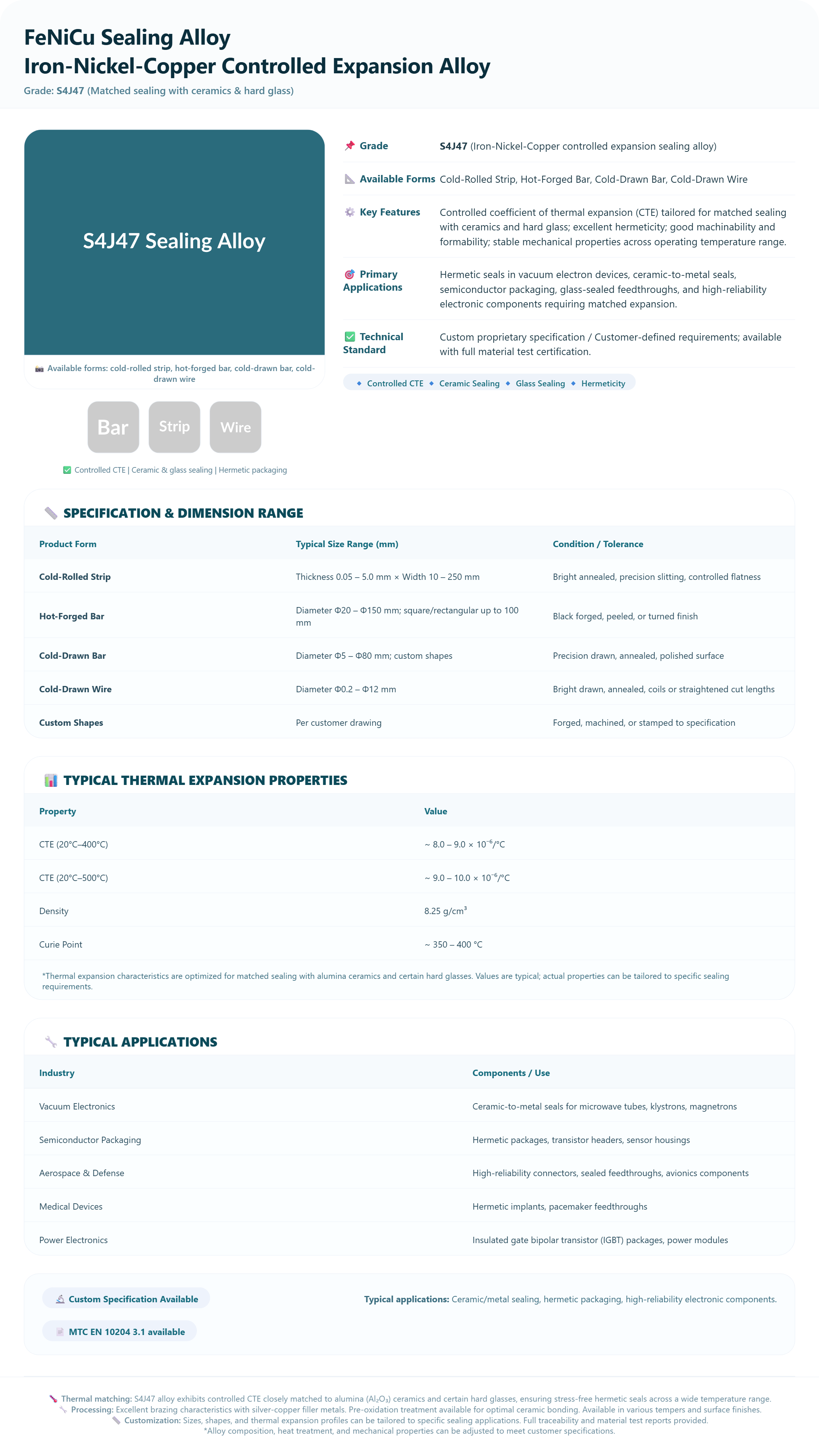
4J47 Fe-Ni-Cr Sealing Alloy for Soft Glass
4J47 sealing alloy is a controlled-expansion Fe-Ni-Cr precision alloy designed for matched sealing with suitable soft glass and selected ceramic materials. With a controlled coefficient of thermal expansion, good glass wettability after appropriate oxidation treatment, and stable dimensional performance, 4J47 is widely used for glass-to-metal sealing, vacuum electronic components, electrical components, and precision hermetic sealing structures.
Hefei Ke Ningman New Energy Materials Technology Co., Ltd. supplies 4J47 alloy in customized wire, strip, sheet, bar and other forms, according to application requirements, dimensions, surface condition and material specifications.
4J47 Sealing Alloy at a Glance
| Property | 4J47 |
|---|---|
| Alloy designation | 4J47 |
| Alloy family | Fe-Ni-Cr controlled expansion alloy |
| Common product name | 4J47 Sealing Alloy / Alloy 47 |
| Main alloy system | Iron-Nickel-Chromium |
| Ni content | 46.8–47.8% |
| Cr content | 0.8–1.4% |
| Fe | Balance |
| Typical sealing application | Soft glass-to-metal sealing |
| Typical temperature range for expansion matching | Approximately 20–400°C |
| Standard | YB/T 5235 / GB/T 15018 |
| Product forms | Wire, strip, sheet, bar, tube and customized forms |
| Manufacturing option | Customized dimensions and surface conditions |
Chemical composition and physical properties should be confirmed against the applicable material standard and customer specification.
What Is 4J47 Alloy?
4J47 is an iron-nickel-chromium controlled expansion alloy belonging to the precision expansion alloy family.
Its thermal expansion characteristics are controlled so that the alloy can be matched with suitable soft glass in the required temperature range. This reduces thermal stress during heating and cooling and helps manufacturers produce reliable glass-to-metal sealing structures.
According to published material data, 4J47 contains approximately 46.8–47.8% nickel and 0.8–1.4% chromium, with iron as the balance. Carbon, manganese, silicon, phosphorus and sulfur are controlled at relatively low levels.
The alloy is covered by Chinese standards including YB/T 5235 and GB/T 15018 for expansion/sealing alloy applications.
4J47 Chemical Composition
The typical chemical composition of 4J47 is shown below.
| Element | Typical / Standard Range |
|---|---|
| C | ≤ 0.05% |
| Si | ≤ 0.30% |
| Mn | ≤ 0.40% |
| P | ≤ 0.020% |
| S | ≤ 0.020% |
| Cr | 0.80–1.40% |
| Ni | 46.80–47.80% |
| Fe | Balance |
For production orders, the final chemical composition should be controlled according to the applicable standard, customer drawing and purchasing specification.
4J47 Thermal Expansion and CTE
The main reason manufacturers select 4J47 is its controlled thermal expansion behavior.
Published technical data indicate that 4J47 has an average linear expansion coefficient in the approximate range of 8.1–8.7 × 10⁻⁶/K over 20–400°C, depending on the specified heat-treatment condition and test method.
Representative published values include:
| Temperature Range | Representative Average CTE |
|---|---|
| 20–100°C | ~8.1 × 10⁻⁶/K |
| 20–200°C | ~8.6 × 10⁻⁶/K |
| 20–300°C | ~8.3 × 10⁻⁶/K |
| 20–400°C | ~8.3 × 10⁻⁶/K |
| 20–500°C | ~9.1 × 10⁻⁶/K |
| 20–600°C | ~10.0 × 10⁻⁶/K |
These values are representative reference data rather than a universal guaranteed specification. Actual CTE depends on alloy chemistry, heat treatment, product condition, test method and temperature interval.
For critical glass-to-metal sealing projects, we recommend confirming the required temperature range, target glass, thermal expansion curve and heat-treatment condition before material selection.
Why Use 4J47 for Soft Glass Sealing?
4J47 is particularly useful when a sealing design requires controlled thermal expansion and compatibility with a suitable soft glass.
1. Controlled Thermal Expansion
The controlled expansion behavior of 4J47 helps reduce the thermal mismatch between the metal and glass during manufacturing and temperature cycling.
2. Good Glass Wettability
After suitable oxidation treatment, chromium in the alloy can contribute to the formation of a dense oxide layer that promotes bonding and wettability with compatible soft glass.
This characteristic helps manufacturers obtain a strong sealing interface when the alloy, glass composition and sealing process are properly matched.
3. Suitable for Hermetic Sealing
4J47 can be used in structures where reliable gas-tight sealing is required, particularly in electrical and vacuum-related applications.
4. Stable Material Performance
Controlled alloy chemistry and appropriate heat treatment help maintain predictable thermal expansion characteristics, which is important when the material is integrated into precision glass-to-metal assemblies.
4J47 Glass-to-Metal Sealing
The performance of a glass-to-metal seal depends on more than simply selecting a metal with a low CTE.
Engineers should evaluate:
Metal thermal expansion curve
Glass softening and sealing temperature
Glass composition
Oxidation condition
Surface cleanliness
Sealing atmosphere
Heating and cooling rate
Joint geometry
Metal thickness
Residual thermal stress
For this reason, 4J47 should be selected together with the actual glass composition and sealing process, rather than selected solely according to its nominal CTE.
A typical process may include:
Material preparation → cleaning → forming/machining → controlled oxidation → glass assembly → heating/sealing → controlled cooling → leak testing → dimensional and visual inspection
For high-reliability applications, the final sealing process should be validated using the customer's actual glass and component design.
4J47 Applications
4J47 sealing alloy can be considered for applications where controlled thermal expansion and glass-to-metal compatibility are required.
Vacuum Electronics
4J47 can be used for sealing structures in electric vacuum components where hermetic glass-to-metal joints are required.
Electrical Components
Its controlled expansion characteristics make it suitable for selected electrical components requiring reliable sealing interfaces.
Glass-to-Metal Feedthroughs
4J47 can be processed into wire, strip or other precision forms for electrical feedthrough and hermetic connection applications.
Hermetic Electronic Packaging
The alloy can be used in selected electronic packaging structures where metal-to-glass thermal compatibility is important.
Precision Sealing Components
4J47 may be suitable for precision sealing parts, housings, terminals and other components where dimensional stability during thermal cycling is important.
Vacuum and Specialized Equipment
For vacuum and specialized equipment, 4J47 can be evaluated when the sealing glass and operating temperature range are compatible with the alloy's thermal expansion characteristics.
4J47 Product Forms
We can supply 4J47 according to application-specific requirements.
Available forms may include:
4J47 wire
4J47 strip
4J47 sheet
4J47 plate
4J47 bar
4J47 rod
4J47 tube
Precision-cut components
Customized sealing parts
Typical supply parameters can be customized according to:
Thickness
Width
Diameter
Length
Surface finish
Dimensional tolerance
Heat-treatment condition
Packaging requirements
For precision applications, please provide the drawing, required dimensions and material specification when requesting a quotation.
4J47 Manufacturing Process
For precision expansion alloys, controlling chemistry alone is not enough. Manufacturing and heat treatment can significantly influence the final thermal expansion characteristics.
A typical production route includes:
1. Raw Material Selection
High-purity alloying materials are selected according to the required chemical composition.
2. Vacuum Melting
Controlled melting is used to achieve the required Fe-Ni-Cr chemistry and minimize undesirable impurities.
3. Homogenization
Appropriate thermal processing helps improve chemical and microstructural uniformity.
4. Hot and Cold Working
The material is processed into wire, strip, sheet, bar or other required forms.
5. Intermediate Annealing
Annealing may be applied during processing to control hardness, residual stress and workability.
6. Final Heat Treatment
Controlled heat treatment is particularly important for precision expansion alloys because the resulting microstructure and stress condition can affect thermal expansion behavior.
7. Surface Treatment
Depending on the application, surface cleaning, bright finishing or controlled oxidation may be required before glass sealing.
8. Final Inspection
Finished products are inspected for:
Chemical composition
Dimensions
Surface quality
Mechanical properties where specified
Thermal expansion characteristics
Product condition
Packaging and traceability
4J47 vs Other Glass Sealing Alloys
Selecting the correct sealing alloy depends primarily on the glass or ceramic material, thermal expansion curve, sealing temperature and component design.
| Alloy | Main Alloy System | Typical Sealing Direction | Main Selection Consideration |
|---|---|---|---|
| 4J47 | Fe-Ni-Cr | Suitable soft glass | Controlled expansion |
| 4J28 | Fe-Cr | Soft glass | Higher Cr Fe-Cr sealing system |
| 4J29 / Kovar | Fe-Ni-Co | Hard glass | Matched expansion with hard glass |
| 4J42 | Fe-Ni | Soft glass / ceramic applications | Approximately 42% Ni expansion system |
| 4J50 | Fe-Ni | Selected glass/ceramic applications | Approximately 50% Ni expansion system |
| 4J33 / 4J34 | Fe-Ni-Co | Alumina ceramic | Ceramic-to-metal matching |
The table is intended as a material-selection starting point. Final alloy selection should be based on the actual glass/ceramic CTE curve and sealing process.
4J47 vs 4J29 Kovar
4J47 and 4J29 are both used in sealing-related applications, but they should not be treated as interchangeable materials.
4J47 is an Fe-Ni-Cr controlled expansion alloy associated with soft-glass sealing applications.
4J29, commonly known as Kovar, is an Fe-Ni-Co alloy widely used for matched sealing with suitable hard glass.
The correct choice depends on:
Glass type
Glass CTE
Sealing temperature
Thermal cycling requirements
Component geometry
Required hermeticity
Surface oxidation behavior
If you are unsure whether 4J47 or 4J29 is appropriate, provide the glass grade or glass CTE and we can help evaluate the material selection.
4J47 Quality Control
For precision sealing applications, material consistency is critical.
Our quality-control process can include:
Chemical Analysis
Verification of Ni, Cr, Fe and controlled impurity elements.
Dimensional Inspection
Measurement of thickness, width, diameter, length and dimensional tolerance.
Surface Inspection
Inspection for scratches, cracks, oxidation defects, inclusions and other surface conditions.
Thermal Expansion Testing
Verification of the coefficient of thermal expansion according to the agreed test temperature range and applicable standard.
Mechanical Testing
Tensile strength, elongation or hardness testing can be performed when required by the customer's specification.
Material Traceability
Production batches can be identified and linked to inspection and material documentation.
4J47 Material Standards
4J47 is referenced in Chinese precision-alloy standards including:
GB/T 15018
YB/T 5235
YB/T 5235 covers sealed iron-nickel-chromium and iron-nickel alloys with permanent expansion, including 4J47, for matching and sealing with soft glass or ceramic materials on electrical components.
For international projects, customers should specify the required standard, equivalent designation, chemical composition, CTE range and product condition in the purchase specification.
How to Choose the Right 4J47 Sealing Alloy
Before ordering 4J47, engineers and purchasing teams should confirm the following:
1. What glass are you sealing?
The glass composition and CTE are the starting point for alloy selection.
2. What is the sealing temperature?
The alloy should be evaluated across the actual processing temperature range rather than using a single CTE number.
3. What is the operating temperature?
The service temperature range may be different from the glass sealing temperature.
4. What product form do you need?
Wire, strip, sheet, tube and precision components may require different processing conditions.
5. What dimensional tolerance is required?
Precision sealing components often require tighter dimensional tolerances than standard industrial material.
6. Do you require thermal expansion testing?
For critical sealing applications, specify the test range and applicable standard before production.
7. Do you need material certification?
If required, specify the material certificate and inspection requirements in the purchase order.
Why Source 4J47 from Greenergy Materials?
For B2B precision-alloy sourcing, the material itself is only one part of the purchasing decision.
Greenergy Materials focuses on special alloys and customized material supply for industrial applications.
We can support customers with:
4J47 alloy sourcing
Customized product dimensions
Wire and strip supply
Precision material requirements
Material specification review
Thermal expansion requirements
Batch traceability
Quality inspection
Export packaging
Technical communication for custom projects
For a new glass-to-metal sealing project, we recommend sending your glass grade, glass CTE, sealing temperature, operating temperature, product form and required dimensions so that the material can be evaluated against the application.
Frequently Asked Questions About 4J47 Sealing Alloy
What is 4J47 alloy?
4J47 is an Fe-Ni-Cr controlled expansion precision alloy designed for applications requiring controlled thermal expansion, particularly matched sealing with suitable soft glass.
What is 4J47 used for?
4J47 is used for selected glass-to-metal sealing, vacuum electronic components, electrical components, hermetic sealing structures and other precision applications where controlled thermal expansion is required.
Is 4J47 a Fe-Ni-Cr alloy?
Yes. 4J47 is classified as an iron-nickel-chromium expansion/sealing alloy. Typical published composition is approximately 46.8–47.8% Ni and 0.8–1.4% Cr, with Fe as the balance.
Is 4J47 suitable for soft glass sealing?
4J47 is specifically used for matching and sealing with suitable soft glass because its thermal expansion characteristics can be matched to the required glass system.
What is the CTE of 4J47?
Published data report representative average linear expansion values of approximately 8.1–8.7 × 10⁻⁶/K over 20–400°C, depending on heat-treatment and test conditions. The exact certified value should be confirmed for the specified material condition and test range.
What is the chemical composition of 4J47?
The typical composition includes 46.8–47.8% Ni, 0.8–1.4% Cr, with Fe as the balance. C, Mn, Si, P and S are controlled according to the applicable specification.
Is 4J47 the same as Kovar?
No. 4J47 and Kovar/4J29 are different alloy systems. 4J47 is an Fe-Ni-Cr alloy, while Kovar/4J29 is an Fe-Ni-Co alloy. Their glass-sealing applications and thermal expansion characteristics should be evaluated separately.
Can 4J47 be supplied as wire?
Yes. 4J47 can be supplied in wire and other forms such as strip, sheet, bar and tube, subject to size and production requirements.
Can you provide customized 4J47 dimensions?
Yes. Customized dimensions can be discussed according to the customer's drawing, application and required tolerance.
Can you provide material certificates?
Material documentation and inspection certificates can be discussed according to the customer's purchasing specification and order requirements.
Request a 4J47 Sealing Alloy Quote
Looking for a reliable 4J47 sealing alloy manufacturer or supplier?
Send us your requirements for:
Alloy grade
Product form
Thickness / diameter
Width / length
Dimensional tolerance
Required standard
Glass or ceramic grade
Sealing temperature
Operating temperature
Required CTE range
Quantity
Material certification requirements
Our technical team can evaluate your application and recommend a suitable 4J47 Fe-Ni-Cr controlled expansion alloy specification.
Request a quotation for 4J47 sealing alloy today.