



Previous
Next
4J28 Glass Sealing Alloy Manufacturer | Fe-Ni-Cr Soft Glass Alloy
- Fe-Ni-Cr Glass Sealing Alloys
- Fe-Cr Glass Sealing Alloy
- 4J28 alloy
- 4J28 glass sealing alloy
- 4J28 soft glass sealing alloy
- 4J28 expansion alloy
Description
Fe-Ni-Cr glass sealing alloys (grades 4J06, 4J47, 4J49, 4J6A, 4J6B, 4J49A) offer controlled CTE matched to soft glass. Ideal for CRT/display components, vacuum electronics, and hermetic seals. YB/T 5235-93 compliant.
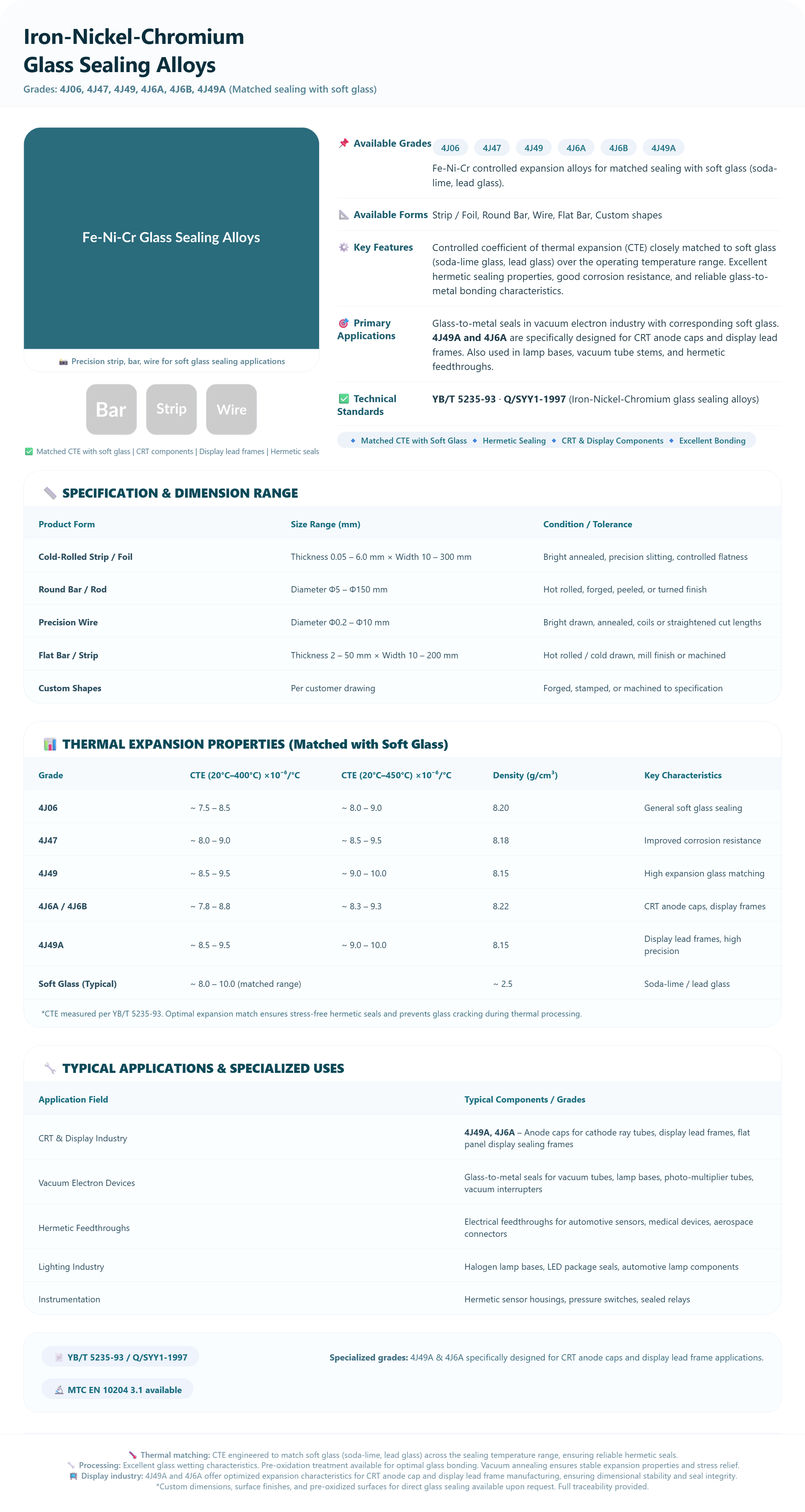
4J28 Fe-Ni-Cr Glass Sealing Alloy for Soft Glass
Hefei Ke Ningman New Energy Materials Technology Co., Ltd. supplies 4J28 Fe-Ni-Cr glass sealing alloy for matched-expansion sealing with selected soft glass systems.
4J28 is a chromium-based controlled expansion alloy designed to provide a thermal expansion behavior compatible with corresponding sealing glass over a specified temperature range. It is primarily used in glass-to-metal sealing, particularly in electrical vacuum components and other applications requiring reliable thermal expansion matching.
The alloy is also known as Alloy 27, and public material references associate 4J28 with GB/T 15018-1994 and related international designation systems. The nominal chromium content is approximately 27–29%, with iron as the balance and nickel maintained at a low level.
Typical applications include vacuum electronic components, electrical feedthroughs, electronic packages, battery terminals and other precision assemblies where the metal must be thermally compatible with the sealing glass.
What Is 4J28 Glass Sealing Alloy?
4J28 is a Fe-Cr controlled expansion alloy developed for glass-to-metal sealing applications.
Unlike Fe-Ni-Co alloys such as 4J29 Kovar, 4J28 uses a chromium-rich iron-based composition to achieve a thermal expansion behavior suitable for selected soft glass sealing systems.
The key engineering requirement is the relationship between:
4J28 Alloy CTE ↔ Glass CTE ↔ Sealing Temperature ↔ Cooling Rate
During glass-to-metal sealing, the metal and glass are heated to the required processing temperature and then cooled.
If their thermal expansion behavior is poorly matched, residual thermal stress may develop at the interface.
This can contribute to:
Glass cracking
Interface separation
Leakage
Loss of hermeticity
Dimensional distortion
Reduced thermal-cycle reliability
Proper material selection therefore requires the CTE of the alloy and the specific glass to be evaluated together.
A representative composition according to published Chinese precision-alloy data is:
| Element | Typical / Standard Range |
|---|---|
| Chromium (Cr) | 27.0–29.0% |
| Nickel (Ni) | ≤0.50% |
| Carbon (C) | ≤0.12% |
| Silicon (Si) | ≤0.70% |
| Manganese (Mn) | ≤1.00% |
| Phosphorus (P) | ≤0.02% |
| Sulfur (S) | ≤0.02% |
| Iron (Fe) | Balance |
These values correspond to published 4J28 data associated with GB/T 15018-1994. The applicable chemical composition should always be confirmed against the material standard and certified mill test report for the ordered product.
Why Is 4J28 Used for Soft Glass Sealing?
The primary reason is thermal expansion matching.
4J28 is described in material references as a glass-sealing iron-chromium alloy whose linear thermal expansion can be close to that of corresponding soft glass within a specified temperature range. It is mainly used in the electric vacuum industry for matched sealing with suitable soft glass.
The basic sealing principle is:
Heating → Thermal Expansion → Glass Wetting / Bonding → Controlled Cooling → Stable Sealed Interface
A properly matched alloy helps reduce excessive thermal stress generated during cooling.
This is particularly important for small electrical terminals, feedthroughs and hermetic components where even a small crack or leakage path can compromise the entire assembly.
4J28 Thermal Expansion and CTE
The coefficient of thermal expansion (CTE) is one of the most important specifications for a glass sealing alloy.
Published 4J28 data report an average linear expansion coefficient of approximately:
| Temperature Range | Average Linear Expansion Coefficient |
|---|---|
| 20–200°C | ~10.0 × 10⁻⁶/K |
| 20–300°C | ~10.5 × 10⁻⁶/K |
| 20–400°C | ~10.8 × 10⁻⁶/K |
| 20–500°C | ~11.1 × 10⁻⁶/K |
| 20–600°C | ~11.2 × 10⁻⁶/K |
| 20–700°C | ~11.6 × 10⁻⁶/K |
| 20–800°C | ~11.6 × 10⁻⁶/K |
A separate published reference reports a standard average coefficient of linear expansion of approximately 10.8–11.4 × 10⁻⁶/K over 20–530°C for 4J28 under a specified heat-treatment condition.
These values are reference data and should not be treated as guaranteed production values for every material condition. For engineering procurement, the CTE requirement should be specified by temperature range and verified using certified test data.
4J28 Soft Glass Sealing
4J28 is primarily intended for matching with appropriate soft sealing glass.
The exact glass should be selected according to:
Glass composition
Glass CTE
Glass transition temperature
Softening temperature
Sealing temperature
Required hermeticity
Operating temperature
Thermal cycling requirements
The phrase “soft glass” alone is not sufficient to establish compatibility.
A reliable glass-to-metal sealing design requires comparison of the complete thermal expansion curves of the alloy and glass.
4J28 vs 4J29 Kovar for Glass Sealing
4J28 and 4J29 are both used in glass sealing, but they belong to different alloy systems and should not be treated as interchangeable materials.
| Factor | 4J28 | 4J29 / Kovar |
|---|---|---|
| Main Alloy System | Fe-Cr | Fe-Ni-Co |
| Cr Content | Approx. 27–29% | Low / controlled |
| Ni Content | ≤0.5% | Approx. 28.5–29.5% |
| Typical Glass Application | Selected soft glass | Selected hard glass |
| Primary Function | Controlled expansion | Controlled expansion |
| Typical CTE | Higher than Kovar | Very low controlled expansion |
| Typical Applications | Vacuum/electrical glass sealing | Hermetic electronic packages |
| Key Selection Factor | Soft-glass CTE matching | Hard-glass CTE matching |
4J28 is specifically documented for matched sealing with corresponding soft glass, while 4J29/Kovar is widely associated with selected hard-glass sealing applications.
Therefore:
Soft Glass → Evaluate 4J28
Hard Glass → Evaluate 4J29/Kovar
The final selection should always be based on the actual glass specification and CTE data.
4J28 vs Fe-Ni Glass Sealing Alloys
Fe-Ni glass sealing alloys such as 4J42, 4J45, 4J50 and related grades are based primarily on iron and nickel.
4J28 is fundamentally different because its controlled expansion behavior is achieved through a chromium-rich Fe-Cr composition.
| Material Family | Main Alloy System | Typical Sealing Direction |
|---|---|---|
| 4J28 | Fe-Cr | Selected soft glass |
| 4J29 | Fe-Ni-Co | Selected hard glass |
| 4J33 / 4J34 | Fe-Ni-Co | 95% Al₂O₃ ceramic |
| 4J42 / 4J45 | Fe-Ni | Selected glass |
| 4J50 / 4J52 | Fe-Ni | Selected glass |
This distinction is important when selecting a material for a glass-to-metal sealing assembly.
Glass-to-Metal Sealing with 4J28
A typical glass-to-metal sealing process may include:
Metal Preparation → Cleaning → Glass Preparation → Assembly → Heating → Sealing → Controlled Cooling → Inspection → Hermeticity Testing
The exact process depends on the glass and component design.
Important process variables may include:
Sealing temperature
Heating rate
Holding time
Atmosphere
Surface condition
Glass viscosity
Cooling rate
Seal geometry
Metal-to-glass interface design
The objective is to create a mechanically stable interface while minimizing residual thermal stress.
4J28 Applications
1. Electric Vacuum Components
4J28 is primarily associated with electric vacuum applications requiring matched sealing with suitable soft glass.
Potential components include:
Vacuum tube components
Electronic tube terminals
Anode caps
Lead-through components
Sealed electrical terminals
Published 4J28 references specifically identify applications in the electric vacuum industry and soft-glass matching.
2. Electrical Feedthroughs
4J28 can be used in electrical feedthrough structures where a metal conductor or terminal must be sealed through a glass insulator.
Typical requirements include:
Electrical insulation
Hermeticity
Thermal stability
Dimensional accuracy
Reliable glass-to-metal bonding
3. Electronic Packaging
Glass-sealed electronic components require controlled thermal expansion to prevent excessive stress during manufacturing and operation.
4J28 can be considered for selected electronic packaging applications where the glass CTE is compatible.
4. High-Power Rectifier Components
Published 4J28 application information includes outgoing leads of high-power rectifier diodes.
5. Battery Terminals
Glass-to-metal sealing alloys can be used in selected battery terminal structures where a hermetic electrical connection is required.
4J28 has been discussed in connection with battery terminals for lithium thionyl chloride battery systems, where glass sealing provides electrical insulation and sealing between the terminal and metal housing.
6. Precision Electrical Components
4J28 can be considered for:
Sealed connectors
Electrical terminals
Hermetic feedthroughs
Electronic components
Precision glass-metal assemblies
Corrosion Resistance of 4J28
One of the practical advantages of the chromium-rich Fe-Cr composition is its corrosion resistance.
Published material references specifically identify 4J28 as having corrosion resistance in addition to its controlled thermal expansion behavior.
However, corrosion resistance should always be evaluated against the actual service environment.
Factors include:
Temperature
Humidity
Electrolytes
Vacuum environment
Chemical exposure
Surface condition
Sealing glass chemistry
The alloy should not be selected solely on the basis of nominal chromium content.
4J28 Product Forms
Depending on alloy grade, dimensions and production requirements, 4J28 may be supplied in forms including:
4J28 sheet
4J28 strip
4J28 plate
4J28 wire
4J28 rod
4J28 bar
4J28 foil
Precision stamping material
Custom components
Typical procurement specifications may include:
Thickness
Width
Diameter
Length
Dimensional tolerance
Surface finish
Heat-treatment condition
Hardness
CTE
Chemical composition
Custom dimensions can be evaluated according to engineering drawings and production requirements.
4J28 Manufacturing Process
A controlled manufacturing process is important because small changes in composition and heat treatment can affect thermal expansion behavior.
A typical production flow may include:
Raw Material Verification
↓
Melting and Alloying
↓
Chemical Composition Control
↓
Casting
↓
Hot Working
↓
Cold Rolling / Drawing
↓
Intermediate Annealing
↓
Final Heat Treatment
↓
Surface Finishing
↓
Dimensional Inspection
↓
CTE Testing
↓
Final Quality Inspection
For glass sealing applications, the final material condition should be controlled according to the required standard and customer specification.
Quality Control for 4J28 Glass Sealing Alloy
Important quality-control items may include:
Chemical Composition
Verify Cr, Ni, C, Si, Mn, P and S according to the applicable specification.
Thermal Expansion
Test CTE over the temperature range specified by the customer.
Dimensional Accuracy
Check:
Thickness
Width
Diameter
Length
Flatness
Straightness
Tolerance
Surface Quality
Inspect for:
Cracks
Scratches
Oxidation
Scale
Pitting
Laminations
Mechanical Properties
Depending on the product form and standard, inspection may include:
Tensile strength
Yield strength
Elongation
Hardness
Material Traceability
Each production batch should be traceable to the relevant material certificate and inspection records.
4J28 Material Standard
4J28 is associated with GB/T 15018-1994 in published Chinese precision-alloy references.
Published comparison data also associate 4J28 with designation systems such as:
Alloy 27
ASTM F256
UNS K92801
Glass Sealing 28
Cr28
26Cr-Fe
However, international designation equivalence should be confirmed against the exact material specification before procurement.
For export orders, customers should specify the required:
Material standard
Product form
Chemical composition
CTE range
Heat-treatment condition
Dimensional tolerance
Inspection certificate
4J28 vs Alloy 27
4J28 is commonly associated with the designation Alloy 27 in international material references.
The designation is related to the chromium-rich Fe-Cr controlled expansion composition.
However, when ordering material internationally, it is better to provide the exact specification rather than relying only on a commercial or historical alloy name.
Recommended procurement description:
4J28 / Alloy 27 Fe-Cr Glass Sealing Alloy
followed by:
Standard
Dimensions
CTE requirement
Product condition
Quantity
Inspection requirements
How to Select the Right Glass Sealing Alloy
Before purchasing a glass sealing alloy, procurement engineers should provide the following information.
1. Glass Grade
Provide the exact glass manufacturer and grade if available.
2. Glass CTE
This is one of the most important inputs.
3. Sealing Temperature
The alloy and glass must remain compatible throughout the thermal cycle.
4. Required Hermeticity
Specify the target leak rate and test method where applicable.
5. Operating Temperature
The alloy should remain suitable throughout the actual service temperature range.
6. Product Geometry
Provide:
Sheet dimensions
Strip thickness
Wire diameter
Rod diameter
Component drawing
7. Quantity
Order quantity can influence production route, minimum order quantity and available product form.
4J28 Glass Sealing Alloy FAQ
What is 4J28 alloy?
4J28 is a chromium-rich Fe-Cr controlled expansion alloy used primarily for matched glass-to-metal sealing with corresponding soft glass systems.
What is 4J28 used for?
Typical applications include electric vacuum components, electrical feedthroughs, electronic components, selected battery terminals and other glass-to-metal sealing assemblies.
Is 4J28 a glass sealing alloy?
Yes. 4J28 is specifically classified in published precision-alloy references as a glass-sealing iron-chromium alloy.
What glass is 4J28 used with?
4J28 is primarily intended for matched sealing with corresponding soft glass. The exact glass must be selected according to its CTE, sealing temperature and chemical characteristics.
What is the chemical composition of 4J28?
4J28 contains approximately 27–29% chromium, with iron as the balance and nickel maintained at a low level. Exact limits should be verified against the applicable material standard.
What is the CTE of 4J28?
Published data indicate an average linear expansion coefficient around 10.8–11.4 × 10⁻⁶/K over 20–530°C under a specified heat-treatment condition. Other reference tables report approximately 10.8 × 10⁻⁶/K over 20–400°C.
Is 4J28 the same as Kovar?
No. 4J28 is a chromium-rich Fe-Cr glass sealing alloy, while Kovar/4J29 is an Fe-Ni-Co controlled expansion alloy. They are used with different glass systems and should not be substituted without checking CTE and sealing requirements.
What is the difference between 4J28 and 4J29?
4J28 is primarily associated with selected soft-glass sealing, while 4J29/Kovar is widely associated with selected hard-glass sealing. Their alloy systems and thermal expansion characteristics are different.
Is 4J28 suitable for hard glass?
4J28 should not be selected simply because it is a glass sealing alloy. The glass CTE must be compared with the alloy's CTE. For many hard-glass applications, 4J29/Kovar may be more appropriate.
Can 4J28 be used for battery terminals?
4J28 has been reported in glass-sealed battery terminal applications, including lithium thionyl chloride battery terminal structures.
Can 4J28 be supplied as wire or strip?
Depending on dimensions and production requirements, 4J28 can be supplied in product forms such as strip, sheet, wire, rod and bar.
Can you provide a material certificate?
Material certification and inspection documentation can be supplied according to the agreed material standard and order requirements.
Request a Quote for 4J28 Soft Glass Sealing Alloy
Looking for 4J28 Fe-Ni-Cr glass sealing alloy, Alloy 27 or soft glass sealing material?
Please provide:
Glass grade
Glass CTE
Required alloy grade
Material standard
Sealing temperature
Operating temperature
Product form
Dimensions
Tolerances
Quantity
Application
Inspection certificate requirements
Hefei Ke Ningman New Energy Materials Technology Co., Ltd. can review your requirements and provide a suitable 4J28 glass sealing alloy specification for your application.