



Previous
Next
Fe-Ni-Co Glass Sealing Alloys | 4J29 Kovar for Hard Glass
- Fe-Ni-Co Glass Sealing Alloys
- Fe-Ni-Co sealing alloys
- Fe-Ni-Co controlled expansion alloys
- glass sealing alloys
- glass-to-metal sealing alloys
- hard glass sealing alloy
Description
Fe-Ni-Co glass sealing alloys (4J29 Kovar, 4J44) offer controlled CTE matched to hard glass. Ideal for vacuum tubes, hermetic packaging, and high-reliability electronics. YB/T 5231-93 compliant, MTC EN 10204 3.1 available.
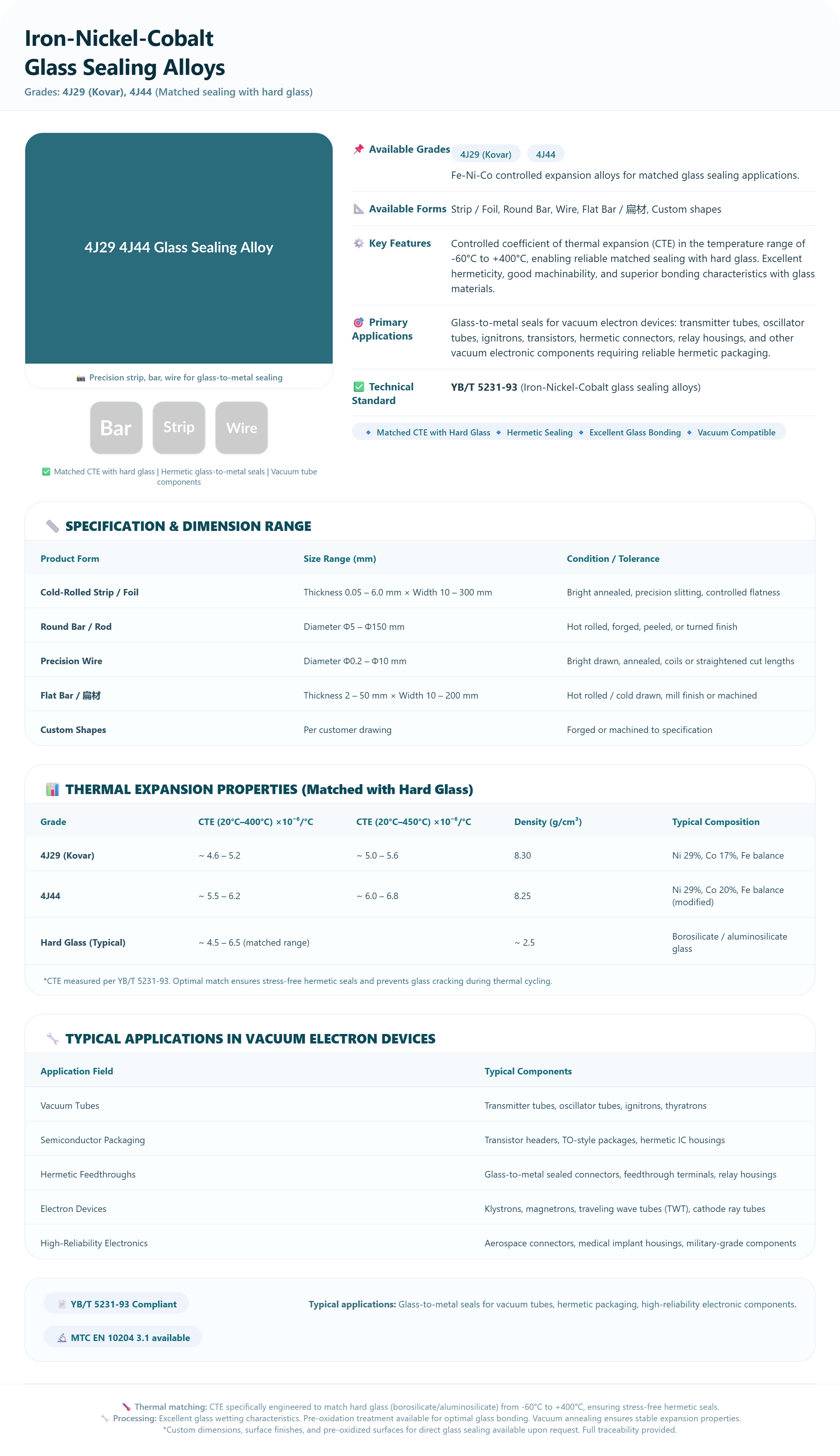
Fe-Ni-Co Glass Sealing Alloys for Hard Glass and Hermetic Sealing
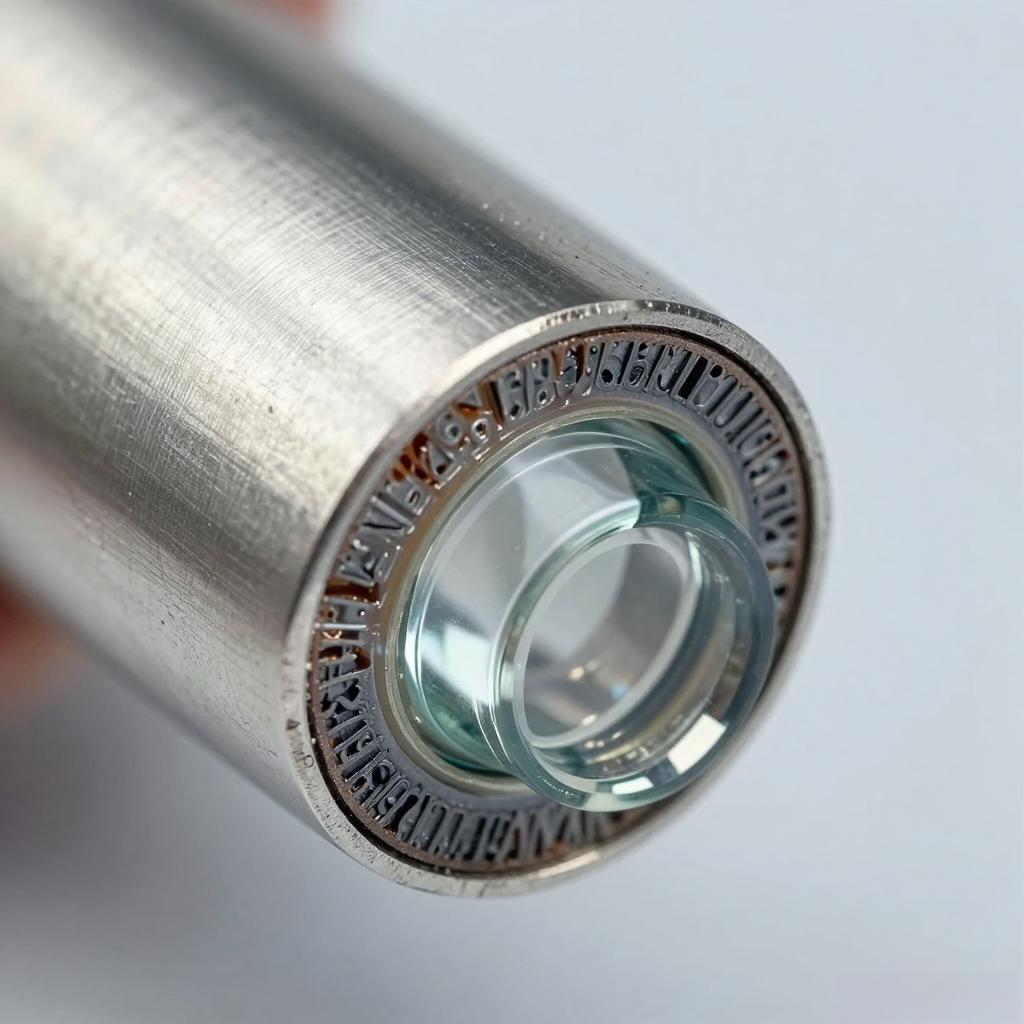
Hefei Ke Ningman New Energy Materials Technology Co., Ltd. supplies Fe-Ni-Co glass sealing alloys for matched-expansion glass-to-metal sealing applications. Our Fe-Ni-Co controlled expansion alloy solutions are primarily used where the thermal expansion of the metal must be compatible with hard glass, borosilicate glass or other specified sealing glasses.
The most widely recognized grade in this alloy family is 4J29 Kovar, an iron-nickel-cobalt alloy designed for controlled thermal expansion and widely used in glass-to-metal hermetic sealing.
These alloys are suitable for electronic packages, vacuum electronic devices, electrical feedthroughs, hermetic components, relays, sensors, aerospace electronics and other precision assemblies where thermal expansion compatibility between metal and glass is critical.
What Are Fe-Ni-Co Glass Sealing Alloys?
Fe-Ni-Co glass sealing alloys are controlled expansion alloys based on iron, nickel and cobalt. They are designed to provide a thermal expansion behavior that can closely match selected glass materials.
During a glass-to-metal sealing process, the metal and glass are heated and subsequently cooled. If their thermal expansion behavior differs significantly, thermal stresses can develop at the interface.
These stresses may result in:
Glass cracking
Interface separation
Leakage
Loss of hermeticity
Mechanical failure
Reduced thermal-cycle reliability
A properly selected Fe-Ni-Co sealing alloy helps control this thermal mismatch.
For this reason, Fe-Ni-Co alloys such as 4J29 Kovar are widely used for matched-expansion glass-to-metal seals. Technical literature describes Kovar as an Fe-Ni-Co alloy whose expansion behavior is close to that of selected hard glasses and suitable for hermetic glass-to-metal applications.
4J29 Kovar Glass Sealing Alloy
4J29, commonly known as Kovar, is an iron-nickel-cobalt controlled expansion alloy.
Typical nominal composition is approximately:
Nickel: 28.5–29.5%
Cobalt: 16.8–17.8%
Iron: balance
Other elements are controlled according to the applicable material specification.
The combination of nickel and cobalt gives 4J29 its characteristic controlled thermal expansion behavior.
Kovar is widely associated with glass-to-metal sealing because its coefficient of thermal expansion can be matched to selected hard and borosilicate-type glasses. Industry references identify 4J29/Kovar as a glass-sealing and controlled-expansion alloy.
Why Is 4J29 Suitable for Hard Glass Sealing?
The key reason is thermal expansion matching.
Hard glasses, including certain borosilicate and alkali-borosilicate glasses, have relatively low coefficients of thermal expansion compared with many conventional metals.
4J29 Kovar is engineered to have a comparable expansion behavior over relevant temperature ranges.
For example, published experimental data comparing 4J29 Kovar with DM305 electronic glass reported average CTE values of approximately 5.1–5.5 × 10⁻⁷/°C for Kovar and 4.8–5.0 × 10⁻⁷/°C for the tested glass over the reported range. The actual material selection must still be based on the specific glass, temperature range and sealing process.
The engineering principle is:
Glass CTE ↔ Alloy CTE ↔ Sealing Temperature ↔ Cooling Cycle
The closer and more appropriate the thermal expansion relationship, the easier it is to control thermal stress in the sealed assembly.
Hard Glass vs Soft Glass for Metal Sealing
Glass sealing alloys should not be selected solely according to the words “hard glass” or “soft glass.”
The actual glass composition and coefficient of thermal expansion should be evaluated.
Hard Glass
Hard glass commonly includes borosilicate or alkali-borosilicate glass systems with relatively low thermal expansion.
4J29 Kovar is widely used for matched-expansion sealing with selected hard glass systems.
Soft Glass
Soft glass generally has different thermal expansion and processing characteristics.
A different metal alloy or sealing approach may therefore be required.
The correct material should be selected based on:
Glass composition
Glass CTE
Sealing temperature
Operating temperature
Sealing method
Required hermeticity
Component geometry
Fe-Ni-Co Glass Sealing Alloy Grade
The most important commercial grade for this page is:
| Grade | Common Name | Alloy System | Main Application |
|---|---|---|---|
| 4J29 | Kovar | Fe-Ni-Co | Hard glass-to-metal sealing |
| 4J44 | Fe-Ni-Co controlled expansion alloy | Fe-Ni-Co | Controlled expansion / sealing applications |
| Other customer-specified grades | Application dependent | Fe-Ni-Co | Special glass matching requirements |
The exact grade should be selected according to the required thermal expansion characteristics and applicable material standard.
For 4J29/Kovar, commonly published equivalent designations include UNS K94610 and Werkstoff Nr. 1.3981, although equivalence should be verified against the applicable specification before procurement.
Kovar 4J29 Technical Properties
Typical technical properties associated with 4J29 Kovar include:
| Property | Typical / Reference Information |
|---|---|
| Alloy System | Fe-Ni-Co |
| Nickel | Approx. 28.5–29.5% |
| Cobalt | Approx. 16.8–17.8% |
| Iron | Balance |
| Density | Approx. 8.2–8.3 g/cm³ |
| Curie Temperature | Around 430°C |
| Primary Function | Controlled thermal expansion |
| Main Application | Glass-to-metal sealing |
| Typical Glass | Selected hard / borosilicate-type glass |
| Product Forms | Sheet, strip, wire, bar, rod, tube, foil |
Published supplier and technical data give a typical 4J29 density of around 8.2–8.3 g/cm³ and a Curie temperature around 430°C. Exact values depend on specification and material condition.
4J29 Kovar Coefficient of Thermal Expansion
CTE is one of the most important specifications when purchasing a glass sealing alloy.
Representative published Kovar data show average linear expansion coefficients around:
| Temperature Range | Representative CTE |
|---|---|
| 20–200°C | ~5.9 × 10⁻⁶/°C |
| 20–300°C | ~5.3 × 10⁻⁶/°C |
| 20–400°C | ~5.1 × 10⁻⁶/°C |
| 20–450°C | ~5.3 × 10⁻⁶/°C |
| 20–500°C | ~6.2 × 10⁻⁶/°C |
| 20–600°C | ~7.8 × 10⁻⁶/°C |
These values are representative reference data rather than universal guaranteed values. The applicable CTE should always be taken from the selected alloy specification, heat-treatment condition and certified test results.
Why CTE Matching Matters in Glass-to-Metal Sealing
Coefficient of thermal expansion describes how a material changes dimension as temperature changes.
In a glass-to-metal seal:
Heating → Expansion
Sealing → Bond Formation
Cooling → Contraction
If the metal contracts significantly differently from the glass during cooling, residual stress can develop.
Potential consequences include:
Cracks in the glass
Poor interface bonding
Leakage
Loss of hermeticity
Mechanical instability
Failure during thermal cycling
For this reason, the correct glass sealing alloy should be selected by comparing the alloy's thermal expansion curve with that of the mating glass.
Matched Expansion vs Compression Sealing
There are different approaches to glass-to-metal sealing.
Matched Expansion Sealing
The metal and glass have relatively similar thermal expansion behavior.
4J29 Kovar is widely used for this type of application with selected hard glass systems.
Compression Sealing
The metal and glass have a deliberately different expansion relationship so that the cooling process places the glass under a favorable compressive stress.
The appropriate sealing design depends on:
Glass type
Metal alloy
Seal geometry
Temperature cycle
Mechanical loading
Required hermeticity
Therefore, “low CTE” does not automatically mean “best sealing alloy.”
Applications of Fe-Ni-Co Glass Sealing Alloys
1. Vacuum Electronic Devices
Kovar and related Fe-Ni-Co alloys are widely used in vacuum electronic components requiring reliable glass-to-metal seals.
Applications can include:
Vacuum tubes
Power tubes
X-ray tubes
Magnetrons
Electronic feedthroughs
Vacuum housings
Kovar is historically used as a sealing material for electric vacuum devices because its expansion behavior can be matched to suitable hard glass.
2. Hermetic Electronic Packages
Fe-Ni-Co alloys are suitable for selected hermetic packages where electrical insulation, mechanical integrity and thermal expansion compatibility are required.
Typical components include:
Hermetic headers
Package housings
Sealed terminals
Feedthroughs
Electronic connectors
3. Electrical Feedthroughs
Kovar-type glass sealing alloys can provide a controlled-expansion metal interface for electrical feedthroughs.
This is particularly important when the feedthrough must maintain sealing integrity across repeated temperature changes.
4. Relays and Electronic Components
Glass-to-metal seals are used in selected relays, switches and electronic components where the metal and glass must maintain a stable hermetic interface.
5. Aerospace Electronics
Aerospace electronic systems can experience wide temperature variations.
Fe-Ni-Co controlled expansion alloys may be used in selected sealed electronic assemblies where dimensional stability and hermeticity are important.
6. Sensors and Precision Instruments
Glass-sealed sensors and precision instruments can benefit from controlled expansion alloys when thermal mismatch could affect sealing reliability or dimensional accuracy.
7. Hermetic Packaging
Hermetic packages require the sealed interface to remain intact under environmental and thermal cycling.
Kovar-type Fe-Ni-Co alloys are widely associated with hermetic glass-to-metal packaging. Recent research also continues to investigate Kovar in hermetic electronic packages, vacuum feedthroughs and aerospace/optical applications.
Kovar vs Invar: What Is the Difference?
Kovar and Invar are both Fe-Ni-based specialty low-expansion materials, but they serve different primary engineering purposes.
| Factor | Kovar / 4J29 | Invar / 4J36 |
|---|---|---|
| Alloy System | Fe-Ni-Co | Fe-Ni |
| Primary Purpose | Controlled expansion / sealing | Very low thermal expansion |
| Main Application | Glass-to-metal sealing | Dimensional stability |
| Typical Mating Material | Selected glass | Precision structures |
| Typical Applications | Hermetic packages, feedthroughs | Metrology, optical systems, aerospace |
| Key Selection Factor | Glass CTE matching | Minimum dimensional change |
If the main requirement is hard glass-to-metal sealing, Kovar/4J29 is generally a more relevant material family to evaluate.
If the primary requirement is minimum dimensional change, an Invar-type alloy may be more appropriate.
The final choice should always be based on the actual application and CTE requirements.
Kovar vs 4J33: What Is the Difference?
Kovar/4J29 and 4J33 are both Fe-Ni-Co controlled expansion alloys, but they are associated with different sealing requirements.
4J29 / Kovar
Primarily associated with:
Hard glass sealing
Borosilicate-type glass
Glass-to-metal sealing
Hermetic electronic packages
4J33
Primarily associated with:
95% Al₂O₃ ceramic
Ceramic-to-metal sealing
Electronic and vacuum ceramic packages
Therefore, your mating material should be identified before choosing between these alloy families.
For a 95% alumina ceramic sealing application, refer to the dedicated Fe-Ni-Co ceramic sealing alloy solution rather than automatically selecting Kovar.
How to Select a Fe-Ni-Co Glass Sealing Alloy
Selecting the correct alloy requires more than choosing a grade from a catalog.
Step 1: Identify the Glass
Provide the glass grade, manufacturer or chemical composition.
Step 2: Determine the Glass CTE
The glass coefficient of thermal expansion is one of the most important selection parameters.
Step 3: Define the Sealing Temperature
The metal and glass must remain compatible throughout the entire sealing cycle.
Step 4: Determine the Seal Type
Identify whether the design uses:
Matched expansion
Compression sealing
Glass solder
Direct glass-to-metal sealing
Other specialized sealing processes
Step 5: Define Operating Conditions
Specify:
Operating temperature
Thermal cycling
Vacuum level
Pressure
Mechanical loading
Corrosion environment
Step 6: Select Product Form
Depending on grade and manufacturing requirements, Fe-Ni-Co sealing alloys can be supplied in:
Sheet
Strip
Plate
Wire
Rod
Bar
Tube
Foil
Coil
Custom components
Manufacturing and Quality Control
For glass sealing applications, controlling the material condition is critical.
A typical production process may include:
Raw Material Verification → Melting → Chemical Composition Control → Hot Working → Cold Rolling / Drawing → Heat Treatment → Surface Finishing → Dimensional Inspection → CTE Testing → Final Inspection
Quality-control items may include:
Chemical composition
CTE
Thickness
Width
Diameter
Dimensional tolerance
Surface condition
Tensile strength
Yield strength
Hardness
Microstructure
Heat-treatment condition
Material traceability
Inspection certificate
For critical sealing applications, customers should also evaluate the final glass-to-metal assembly through appropriate hermeticity, thermal cycling and leak testing.
Surface Preparation for Glass Sealing
The condition of the metal surface can influence the quality of a glass-to-metal seal.
Depending on the sealing process, important considerations may include:
Surface cleanliness
Oxide condition
Surface roughness
Degreasing
Pre-oxidation
Metallurgical compatibility
Sealing atmosphere
Published Kovar sealing studies demonstrate that pre-oxidation and controlled sealing conditions can influence the quality of the Kovar/glass interface.
The specific surface-treatment process should be determined according to the selected glass, sealing method and production conditions.
Available Fe-Ni-Co Glass Sealing Alloy Products
Depending on grade and manufacturing requirements, we can support:
Kovar 4J29 sheet
Kovar 4J29 strip
Kovar 4J29 wire
Kovar 4J29 rod
Kovar 4J29 bar
Kovar 4J29 tube
Kovar foil
Precision stamping material
Custom sealing alloy components
Customized dimensions, tolerances, surface conditions and delivery states can be discussed according to engineering drawings and purchasing specifications.
Material Standards and Documentation
For international procurement, customers should specify the required material standard and documentation before production.
Depending on the selected alloy and order requirements, documentation may include:
Material certificate
Chemical composition report
Mechanical property report
CTE test report
Dimensional inspection report
Heat-treatment record
EN 10204 inspection documentation
Product traceability information
The exact standard and certification requirements should be confirmed for each grade and application.
Why Choose Our Fe-Ni-Co Glass Sealing Alloys?
Hefei Ke Ningman New Energy Materials Technology Co., Ltd. supplies specialty alloys for precision, electronic and high-performance applications.
For Fe-Ni-Co glass sealing alloy projects, we can support customers with:
4J29 / Kovar material supply
Controlled expansion alloy selection
Glass CTE matching support
Customized product dimensions
Sheet, strip, wire, rod and other product forms
Technical specification review
Quality inspection
Material documentation
International B2B supply
If you are developing a hard-glass-to-metal seal, provide the glass grade, target CTE, sealing temperature, product dimensions, required alloy grade and application.
Our technical team can evaluate the appropriate Fe-Ni-Co glass sealing alloy specification.
Fe-Ni-Co Glass Sealing Alloy FAQ
What are Fe-Ni-Co glass sealing alloys?
Fe-Ni-Co glass sealing alloys are controlled expansion alloys designed to provide thermal expansion compatibility with selected glass materials during glass-to-metal sealing.
What is Kovar 4J29?
4J29, commonly known as Kovar, is an Fe-Ni-Co controlled expansion alloy widely used for matched-expansion glass-to-metal sealing with selected hard and borosilicate-type glasses.
Why is Kovar used for hard glass sealing?
Kovar has a controlled thermal expansion behavior that can be matched to selected hard glass systems, helping reduce thermal stress during heating and cooling.
What is the CTE of Kovar?
The CTE of Kovar depends on temperature range, heat treatment and specification. Representative published values are around 5.1 × 10⁻⁶/°C over 20–400°C and about 5.3 × 10⁻⁶/°C over 20–450°C. Certified project values should be taken from the applicable specification and test report.
Is Kovar the same as 4J29?
4J29 is a commonly used designation for Kovar-type Fe-Ni-Co controlled expansion alloy. Exact equivalence should be verified against the required material standard before procurement.
What glass can Kovar seal?
Kovar can be used with selected hard, borosilicate and alkali-borosilicate glass systems when their thermal expansion characteristics and sealing conditions are appropriately matched.
What is the difference between Kovar and Invar?
Kovar/4J29 is primarily used for controlled expansion and glass-to-metal sealing, while Invar/4J36 is primarily selected for very low thermal expansion and dimensional stability.
Can Kovar be used for ceramic sealing?
Kovar can be used in certain ceramic sealing applications, but the alloy should not automatically be selected for every ceramic. The ceramic CTE, sealing process and thermal stress requirements must be evaluated.
What is the difference between 4J29 and 4J33?
4J29 is commonly associated with hard glass-to-metal sealing, while 4J33 is commonly used for matched sealing with 95% Al₂O₃ ceramic. The appropriate grade depends on the mating material and thermal expansion requirements.
Can Fe-Ni-Co glass sealing alloys be customized?
Depending on the alloy grade and production requirements, customized dimensions, tolerances, product forms and material conditions can be discussed.
Request a Quote for 4J29 Kovar Glass Sealing Alloy
Looking for 4J29 Kovar, Fe-Ni-Co glass sealing alloy or hard-glass-to-metal sealing material?
Please send us:
Glass grade
Glass CTE
Required alloy grade
Sealing temperature
Operating temperature
Product form
Dimensions and tolerances
Quantity
Application
Material standard
Inspection certificate requirements
We can review your requirements and provide a suitable Fe-Ni-Co glass sealing alloy solution and quotation.