




Previous
Next
Iron-Nickel Glass Sealing Alloys Manufacturer | 4J42, 4J50 & 4J52
- iron nickel sealing alloys
- iron nickel glass sealing alloy
- glass sealing alloys
- Fe-Ni glass sealing alloys
- low expansion sealing alloys
- controlled expansion alloys
Description
Iron-nickel glass sealing alloys (4J42, 4J45, 4J50, 4J52, 4J54) offer controlled CTE for soft glass/ceramic matching. Ideal for vacuum electronics, semiconductor packaging, and hermetic seals. YB/T 5235-93 compliant.
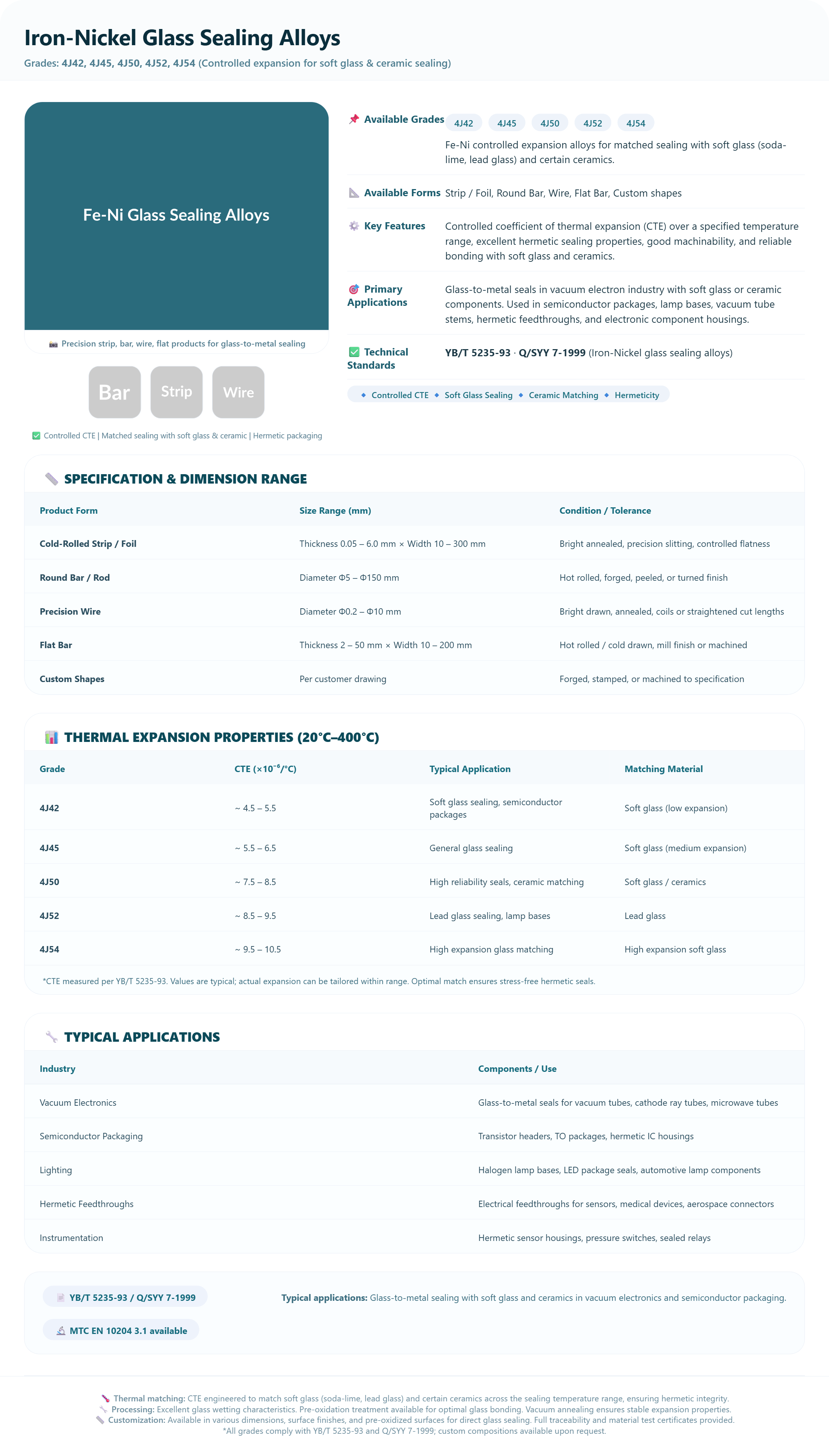
Iron-Nickel Glass Sealing Alloys for Glass-to-Metal and Hermetic Sealing
Hefei Ke Ningman New Energy Materials Technology Co., Ltd. supplies iron-nickel glass sealing alloys designed for controlled thermal expansion and reliable glass-to-metal sealing. Our Fe-Ni sealing alloy range includes 4J42, 4J45, 4J50, 4J52 and 4J54 grades for applications requiring controlled coefficient of thermal expansion (CTE), dimensional compatibility and stable sealing performance.
These alloys are used in electronic components, vacuum devices, semiconductor packaging, hermetic packages, electrical feedthroughs, glass-to-metal assemblies and other precision applications where the thermal expansion of the metal must be compatible with the surrounding glass or ceramic material.
What Are Iron-Nickel Glass Sealing Alloys?
Iron-nickel glass sealing alloys are specialty Fe-Ni alloys engineered to provide controlled thermal expansion for joining metallic components with glass.
When a metal and glass are heated or cooled together, a difference in their coefficients of thermal expansion can generate internal stress. Excessive mismatch may lead to cracking, leakage, deformation or loss of hermeticity.
Iron-nickel sealing alloys are therefore selected according to the thermal expansion characteristics of the glass and the required sealing temperature range.
ASTM F30 historically covered iron-nickel alloys intended primarily for sealing to glass in electronic applications and addressed characteristics including chemical composition, surface finish, temper, grain size and thermal expansion. ASTM F30 was withdrawn in 2024, so the applicable current material standard should be confirmed for each project rather than treating F30 as a current standard.
Iron-Nickel Glass Sealing Alloy Grades
Our iron-nickel glass sealing alloy product range includes:
| Alloy Grade | Alloy Type | Main Characteristic | Typical Applications |
|---|---|---|---|
| 4J42 | Fe-Ni | Controlled thermal expansion | Glass-to-metal sealing, electronic components |
| 4J45 | Fe-Ni | Controlled CTE | Electronic and precision sealing applications |
| 4J50 | Fe-Ni | Controlled thermal expansion | Hermetic packages and electronic components |
| 4J52 | Fe-Ni | Higher controlled expansion range | Glass-to-metal sealing and electronic applications |
| 4J54 | Fe-Ni | Controlled expansion | Precision sealing applications |
The exact thermal expansion characteristics depend on alloy composition, processing condition, heat treatment and test temperature. For this reason, material selection should be based on the required CTE over the actual operating or sealing temperature range rather than alloy designation alone.
4J42 Glass Sealing Alloy
4J42 is an iron-nickel controlled expansion alloy used where the thermal expansion of the metal needs to be compatible with a selected glass.
Typical applications include:
Glass-to-metal seals
Electronic components
Hermetic packages
Electrical feedthroughs
Vacuum electronic devices
Precision metal-glass assemblies
When selecting 4J42, engineers should compare its thermal expansion curve with the glass material and evaluate the complete sealing temperature cycle.
4J45 Glass Sealing Alloy
4J45 is another Fe-Ni controlled expansion alloy designed for applications requiring predictable thermal expansion characteristics.
It may be considered for:
Electronic packaging
Glass-to-metal sealing
Hermetic components
Electrical terminals
Precision sealing assemblies
The appropriate grade should be selected according to the required CTE, glass composition, sealing process and component geometry.
4J50 Glass Sealing Alloy
4J50 is an iron-nickel controlled expansion alloy used for applications requiring a defined thermal expansion relationship between metal and glass.
Potential applications include:
Electronic components
Hermetic packages
Glass-to-metal seals
Electrical feedthroughs
Vacuum devices
Precision electronic assemblies
For high-reliability applications, the compatibility between the alloy, glass and sealing process should be verified before mass production.
4J52 Glass Sealing Alloy
4J52 is an Fe-Ni controlled expansion alloy used where a higher coefficient of thermal expansion is required than some lower-expansion Fe-Ni sealing grades.
It can be considered for applications including:
Glass-to-metal sealing
Electronic components
Hermetic packages
Precision assemblies
Electrical and vacuum components
The correct selection depends on the CTE of the mating glass, sealing temperature and required mechanical and dimensional performance.
4J54 Glass Sealing Alloy
4J54 belongs to the iron-nickel family of controlled expansion alloys and can be selected for applications requiring a specified thermal expansion relationship between the metal and glass.
For engineering projects, the required grade should be determined from the target CTE, temperature range, glass composition, sealing method and component dimensions.
How Do Iron-Nickel Alloys Work in Glass-to-Metal Sealing?
The fundamental principle is thermal expansion compatibility.
During a glass-to-metal sealing process, both materials are exposed to elevated temperatures and then cooled. Because glass and metal may have different thermal expansion behavior, cooling can generate stress at the interface.
A suitable Fe-Ni sealing alloy helps control this mismatch.
The selection process should therefore consider:
Glass CTE → Alloy CTE → Sealing Temperature → Cooling Cycle → Residual Stress → Hermeticity
A properly matched system can reduce thermal stress and improve the reliability of the glass-to-metal joint.
Soft Glass vs Hard Glass Sealing
The term “soft glass” generally refers to glasses with different thermal expansion characteristics from hard borosilicate-type glasses.
The sealing alloy must be selected according to the actual glass composition rather than simply choosing a material because it is described as a “glass sealing alloy.”
For this reason, customers should provide the glass grade or composition whenever possible.
The required alloy can then be evaluated based on:
Glass coefficient of thermal expansion
Sealing temperature
Operating temperature
Required sealing method
Required hermeticity
Component geometry
Mechanical requirements
Iron-Nickel Sealing Alloys vs Fe-Ni-Co Sealing Alloys
Iron-nickel and iron-nickel-cobalt alloys are both used for controlled expansion and sealing applications, but they are not interchangeable in every application.
Iron-Nickel Glass Sealing Alloys
Typical characteristics:
Fe-Ni alloy system
Controlled thermal expansion
Suitable for selected glass-to-metal sealing applications
Used in electronic and precision assemblies
Available in several CTE ranges
Fe-Ni-Co Glass Sealing Alloys
Fe-Ni-Co alloys such as Kovar-type materials are commonly selected when their thermal expansion characteristics provide a suitable match with particular hard glasses or ceramics.
Kovar 4J29, for example, is an Fe-Ni-Co alloy commonly used for matched-expansion glass-to-metal seals.
Therefore, the best material depends on the glass or ceramic material being joined rather than simply choosing the alloy family with the lowest CTE.
Applications of Iron-Nickel Glass Sealing Alloys
Electronic Packaging
Fe-Ni sealing alloys can be used in electronic packages where metal components must be joined to glass while maintaining dimensional and thermal compatibility.
Hermetic Packaging
Controlled expansion alloys are used in hermetic assemblies where the integrity of a sealed enclosure must be maintained during temperature cycling.
Semiconductor Packaging
Fe-Ni and related controlled expansion alloys may be used in selected semiconductor packages, feedthroughs and electronic components where thermal expansion compatibility is important.
Vacuum Electronic Devices
Glass-to-metal sealing has historically been important in vacuum electronic devices and other components requiring sealed glass envelopes or feedthroughs.
Electrical Feedthroughs
Iron-nickel sealing alloys can provide a controlled-expansion metallic interface for electrical feedthrough assemblies.
Glass-to-Metal Sealing
The core application is joining metal and glass while controlling thermal mismatch during heating and cooling.
Key Properties of Iron-Nickel Glass Sealing Alloys
Depending on grade and processing condition, important material characteristics include:
Controlled coefficient of thermal expansion
Thermal expansion compatibility with selected glass
Good dimensional stability
Suitable mechanical strength
Good forming performance for selected grades
Controlled surface condition
Compatibility with precision sealing processes
Stable performance in electronic and hermetic assemblies
For engineering applications, the CTE should always be specified together with the temperature range because thermal expansion behavior is temperature dependent.
How to Select the Right Glass Sealing Alloy
Choosing a glass sealing alloy should start with the mating glass rather than the metal.
Step 1: Identify the Glass
Provide the glass manufacturer, glass grade or chemical composition whenever available.
Step 2: Determine the Glass CTE
The coefficient of thermal expansion of the glass is one of the most important parameters for alloy selection.
Step 3: Define the Sealing Temperature
The thermal expansion relationship must be evaluated over the relevant heating and cooling range.
Step 4: Select the Appropriate Fe-Ni Grade
Potential grades include:
4J42
4J45
4J50
4J52
4J54
Step 5: Consider Hermeticity Requirements
For vacuum and electronic applications, the sealing process should be evaluated together with the required leak rate and long-term thermal cycling requirements.
Step 6: Define Product Form and Dimensions
Depending on the grade and production route, material may be supplied as:
Sheet
Strip
Plate
Wire
Rod
Bar
Foil
Coil
Custom components
Manufacturing and Quality Control
Reliable glass sealing depends not only on alloy composition but also on material condition, surface quality and processing.
A typical quality-control process may include:
Raw Material Verification → Melting → Chemical Composition Control → Hot Working → Cold Rolling / Drawing → Heat Treatment → Surface Finishing → Dimensional Inspection → CTE Testing → Final Inspection
Important inspection items may include:
Chemical composition
CTE / thermal expansion characteristics
Thickness and dimensional tolerance
Surface condition
Mechanical properties
Hardness
Microstructure
Heat-treatment condition
Material traceability
Inspection certificates
For critical sealing applications, customers should provide the required alloy grade, glass material, CTE range, sealing temperature, dimensions, tolerances and applicable material specification.
Available Product Forms
Depending on alloy grade and manufacturing requirements, we can support customized supply in forms such as:
Iron-nickel alloy sheet
Iron-nickel alloy strip
Iron-nickel alloy plate
Iron-nickel alloy wire
Iron-nickel alloy rod
Iron-nickel alloy bar
Iron-nickel alloy foil
Custom precision components
Product dimensions, tolerances, surface condition and delivery condition should be confirmed before production.
Why Choose Our Iron-Nickel Glass Sealing Alloys?
Hefei Ke Ningman New Energy Materials Technology Co., Ltd. supplies specialty alloys for demanding industrial and electronic applications.
For iron-nickel glass sealing alloy projects, we can support customers with:
Alloy grade selection
CTE-based material recommendations
Customized dimensions
Product form selection
Technical specification review
Production coordination
Quality inspection
Material documentation
International B2B supply
If you are developing a glass-to-metal seal and are unsure whether 4J42, 4J45, 4J50, 4J52 or 4J54 is appropriate, send us the glass grade, target CTE, sealing temperature, component dimensions and application.
Our technical team can help evaluate a suitable Fe-Ni sealing alloy.
Iron-Nickel Glass Sealing Alloy FAQ
What are iron-nickel glass sealing alloys?
Iron-nickel glass sealing alloys are Fe-Ni specialty alloys designed to provide controlled thermal expansion for glass-to-metal sealing and related hermetic applications.
What is 4J42 alloy used for?
4J42 is a controlled expansion Fe-Ni alloy that can be used in selected glass-to-metal sealing and electronic applications where thermal expansion compatibility is required.
What is 4J50 alloy?
4J50 is an iron-nickel controlled expansion alloy used in applications such as electronic components, hermetic packages and glass-to-metal assemblies.
4J52 is an Fe-Ni controlled expansion alloy used for selected glass-to-metal and electronic sealing applications where a defined thermal expansion relationship is required.
What is the difference between 4J42 and Kovar?
4J42 is an Fe-Ni alloy, while Kovar 4J29 is an Fe-Ni-Co alloy. The appropriate material depends on the thermal expansion characteristics of the glass or ceramic being sealed and the required sealing conditions.
What is a glass-to-metal sealing alloy?
A glass-to-metal sealing alloy is a specialty metal selected to provide appropriate thermal expansion compatibility with a glass material during the sealing and cooling process.
Can iron-nickel sealing alloys be customized?
Yes. Depending on the alloy grade and production requirements, customized dimensions, product forms, tolerances and material conditions can be discussed.
How do I choose an iron-nickel sealing alloy?
Start with the glass grade, glass CTE, sealing temperature, operating temperature, component dimensions and hermeticity requirements. These parameters help determine whether 4J42, 4J45, 4J50, 4J52, 4J54 or another controlled expansion alloy is appropriate.
Request a Quote for Iron-Nickel Glass Sealing Alloys
Looking for 4J42, 4J45, 4J50, 4J52 or 4J54 iron-nickel glass sealing alloys?
Send us your:
Glass grade or glass composition
Required CTE
Sealing temperature
Operating temperature
Alloy grade
Product form
Dimensions and tolerances
Required quantity
Application
We can review your requirements and provide a suitable iron-nickel glass sealing alloy solution and quotation.