



Previous
Next
Low Expansion Alloys | Invar 36 & Low Thermal Expansion Alloys
- Low Expansion Alloys
- low thermal expansion alloys
- low expansion alloy manufacturer
- low expansion alloy supplier
- low expansion metal alloys
- thermal expansion alloys
Description
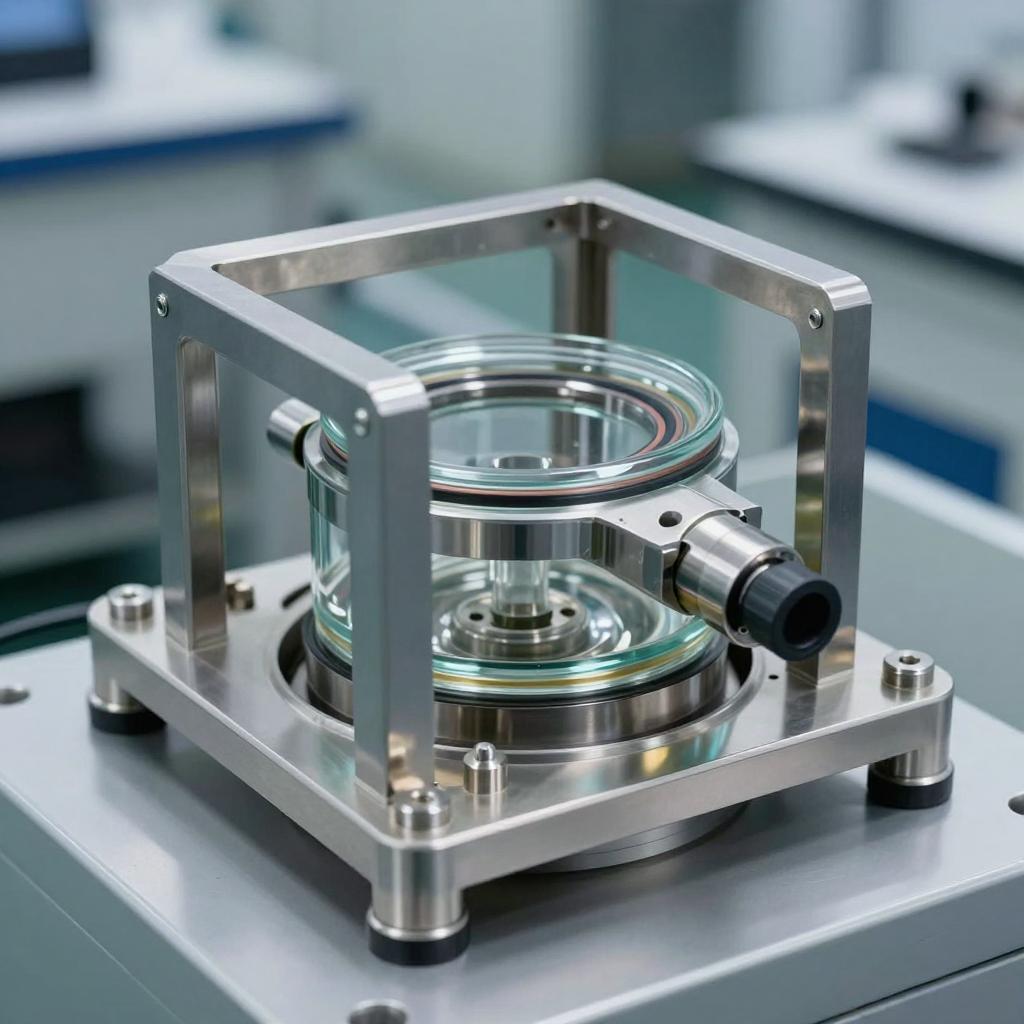
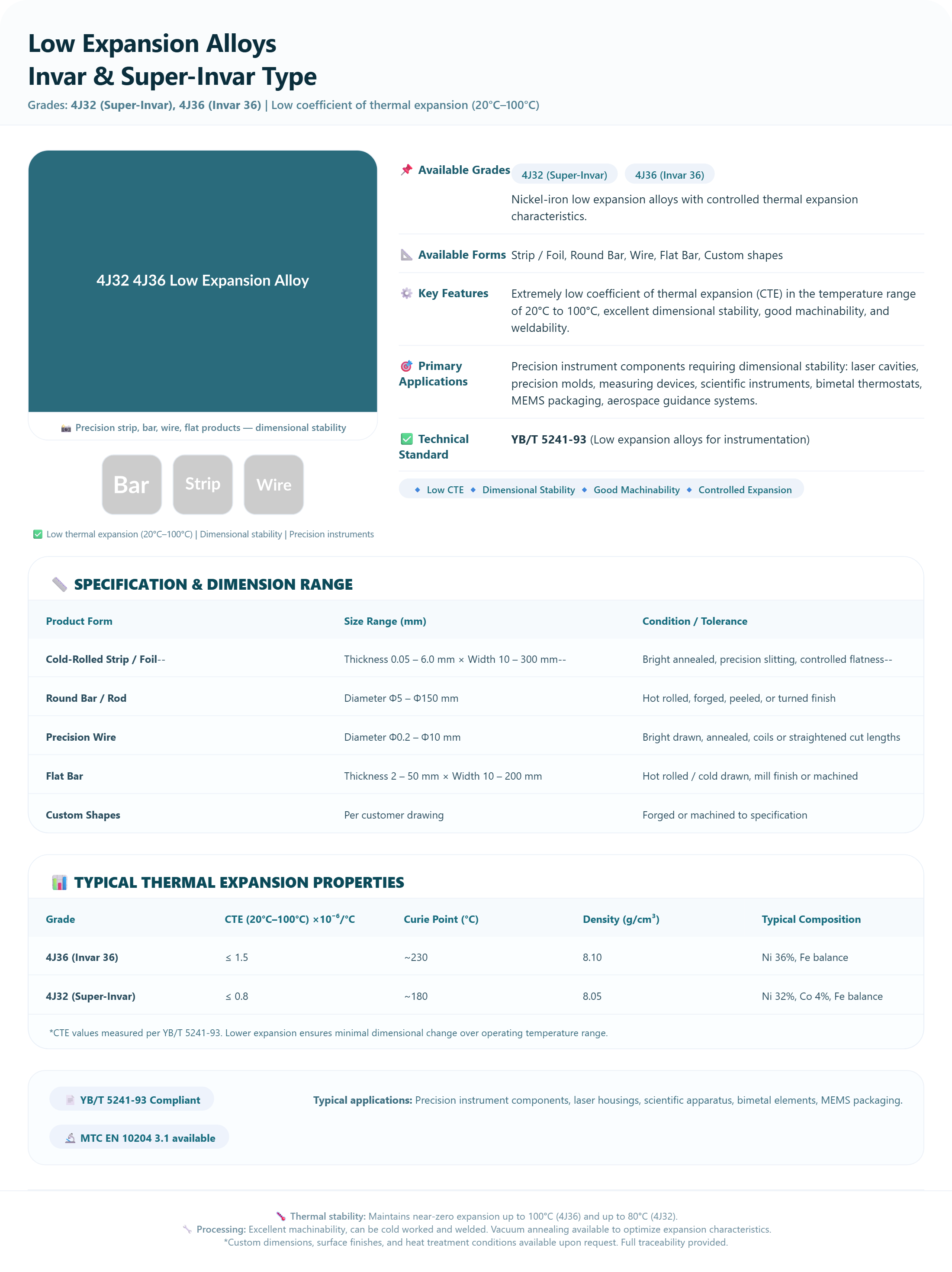
4J32 (Super-Invar) and 4J36 (Invar 36) low expansion alloys offer ultra-low CTE for precision instruments. Ideal for laser cavities, scientific devices, and aerospace guidance systems. YB/T 5241-93 compliant.
Low Expansion Alloys for Dimensional Stability and Precision Applications
Greenergy Materials supplies low expansion alloys engineered to minimize dimensional changes caused by temperature fluctuations. These specialty alloys are primarily based on iron-nickel and related alloy systems and are selected for applications where a low coefficient of thermal expansion (CTE), thermal stability, and dimensional accuracy are critical.
Our low expansion alloy solutions are suitable for precision instruments, optical equipment, aerospace components, electronic and semiconductor applications, metrology systems, thermal bimetal components, and other precision-engineered assemblies.
Depending on your required coefficient of thermal expansion, operating temperature range, mechanical properties, magnetic requirements, and manufacturing process, we can recommend suitable low expansion alloy grades and product forms.
What Are Low Expansion Alloys?
Low expansion alloys are specialty metal alloys designed to exhibit a very low coefficient of thermal expansion within a specified temperature range.
When conventional metals are exposed to temperature changes, they expand when heated and contract when cooled. In precision equipment, even a small dimensional change can affect alignment, calibration, positioning, sealing, or measurement accuracy.
Low expansion alloys help minimize these temperature-related dimensional changes.
The most widely recognized materials in this category are iron-nickel alloys such as Invar 36. The low thermal expansion behavior of Invar-type alloys is associated with the interaction between lattice thermal expansion and magnetostrictive effects below the Curie temperature. This phenomenon is commonly referred to as the Invar effect.
Key Properties of Low Expansion Alloys
Depending on the alloy grade and processing condition, low expansion alloys can provide:
Very low coefficient of thermal expansion
Excellent dimensional stability
Reduced thermal deformation
Stable performance within specified temperature ranges
Good mechanical strength and machinability for selected grades
Controlled thermal expansion characteristics
Compatibility with precision manufacturing processes
Reliable performance in temperature-sensitive assemblies
For engineering applications, CTE should always be evaluated together with the required temperature range. Thermal expansion is not necessarily constant across all temperatures, so the material specification should define the applicable temperature interval.
Low Expansion Alloy Grades
Different applications require different combinations of CTE, mechanical properties, magnetic characteristics, and processing performance.
Common low and controlled expansion alloy families include:
| Alloy | Typical Composition / Type | Main Characteristic | Typical Applications |
|---|---|---|---|
| Invar 36 / 4J36 | Fe-Ni | Very low thermal expansion | Precision instruments, optical equipment, aerospace, metrology |
| Super Invar | Fe-Ni-Co | Extremely low thermal expansion in selected temperature ranges | Precision measurement and advanced optical systems |
| Kovar / 4J29 | Fe-Ni-Co | Controlled expansion matching glass and ceramics | Hermetic sealing, electronics, semiconductor packages |
| Alloy 42 / 4J42 | Fe-Ni | Controlled thermal expansion | Electronic components, lead frames, glass sealing |
| Alloy 52 / 4J52 | Fe-Ni | Controlled expansion for specific applications | Electronic and glass-to-metal sealing applications |
The exact alloy selection should be based on the required CTE curve rather than alloy name alone. For glass-to-metal or ceramic-to-metal sealing, the objective is generally to match the expansion behavior of the mating material. For precision structures, the primary objective may instead be minimizing dimensional change.
Invar 36 / 4J36 Low Expansion Alloy
Invar 36 is one of the best-known low thermal expansion alloys. It is an iron-nickel alloy containing approximately 36% nickel and is widely used where dimensional stability is more important than lightweight construction.
Its low thermal expansion characteristics make it suitable for applications in which temperature-induced dimensional changes can affect system accuracy.
Typical applications include:
Precision measuring instruments
Metrology equipment
Optical benches and optical systems
Laser equipment
Precision jigs and fixtures
Aerospace components
Satellite and navigation equipment
Electronic components
Cryogenic equipment
Thermal bimetal components
Invar 36 is not intended to provide zero thermal expansion under every temperature condition. Its CTE changes with temperature, so engineers should specify the required operating temperature range when selecting the material.
Low Expansion Alloys vs Controlled Expansion Alloys
Although the two terms are sometimes used interchangeably, they describe different engineering objectives.
Low Expansion Alloys
The main objective is to minimize dimensional change caused by temperature.
Typical applications include:
Precision instruments
Optical systems
Metrology
Precision mechanical structures
Aerospace instruments
Measurement equipment
Controlled Expansion Alloys
The objective is to achieve a specified or matched CTE.
These materials are particularly important when joining dissimilar materials such as metal and glass or metal and ceramic.
Typical applications include:
Glass-to-metal sealing
Ceramic-to-metal sealing
Semiconductor packages
Electronic packages
Hermetic feedthroughs
Vacuum devices
For example, Kovar-type alloys are commonly selected because their thermal expansion characteristics can closely match certain glasses and ceramics.
Why Coefficient of Thermal Expansion Matters
The coefficient of thermal expansion, or CTE, describes how much a material changes in dimension as its temperature changes.
For a precision component, the relevant question is not simply:
“Does this alloy have a low CTE?”
Instead, engineers should ask:
“What CTE does the alloy provide over my actual operating temperature range?”
This distinction is important because thermal expansion behavior can vary with temperature and alloy composition.
When two materials are joined together, differences in CTE can generate thermal stress during heating and cooling. Excessive mismatch may contribute to distortion, cracking, leakage, or premature failure in sensitive assemblies.
For this reason, controlled expansion alloys are widely used in glass, ceramic, electronic, semiconductor, and hermetic sealing applications.
Applications of Low Expansion Alloys
Precision Instruments and Metrology
Low expansion alloys help minimize temperature-related dimensional changes in measuring equipment, reference components, precision fixtures, and calibration systems.
Optical and Laser Equipment
Optical benches, frames, supports, and other precision structures may require high dimensional stability to maintain alignment when ambient temperature changes.
Aerospace and Space Systems
Aerospace and satellite components can experience significant temperature variations. Low expansion materials can help reduce thermal deformation in precision structures and instrumentation.
Electronics and Semiconductor Packaging
Controlled expansion alloys can be used where thermal compatibility between metallic components, glass, ceramics, and semiconductor packages is important.
Glass-to-Metal and Ceramic-to-Metal Sealing
Fe-Ni and Fe-Ni-Co alloys are widely considered for hermetic sealing applications because their thermal expansion can be engineered or selected to match the expansion characteristics of glass and ceramic materials.
Thermal Bimetal Components
Selected low expansion alloys can serve as the low-expansion component in temperature-sensitive bimetal assemblies.
How to Select the Right Low Expansion Alloy
Choosing a low expansion alloy should start with the engineering requirement rather than the material name.
1. Define the Required CTE
Specify the target coefficient of thermal expansion and the measurement temperature range.
2. Define the Operating Temperature
The CTE of an alloy can change with temperature. Always provide the minimum and maximum service temperatures when requesting material recommendations.
3. Determine Whether CTE Must Be Minimized or Matched
If the objective is maximum dimensional stability, an Invar-type low expansion alloy may be appropriate.
If the objective is matching glass or ceramic, a controlled expansion alloy such as Kovar or Alloy 42 may be more suitable.
4. Consider Mechanical Properties
Evaluate:
Tensile strength
Yield strength
Hardness
Ductility
Elastic modulus
Fatigue requirements
Machinability
Formability
5. Consider Magnetic Properties
Many Fe-Ni low expansion alloys have temperature-dependent magnetic characteristics. If magnetic performance is important to your application, it should be included in the material specification.
6. Select the Required Product Form
Depending on production requirements, low expansion alloys may be supplied in forms such as:
Sheet
Strip
Plate
Bar
Rod
Wire
Foil
Coil
Custom machined components
Available dimensions and product forms should be confirmed according to the selected alloy grade and manufacturing requirements.
Low Expansion Alloy Manufacturing and Quality Control
For precision alloy applications, chemical composition and thermal expansion behavior must be controlled carefully.
A suitable quality-control process may include:
Raw Material Inspection → Melting → Composition Control → Hot Working → Cold Rolling / Drawing → Heat Treatment → Surface Finishing → Dimensional Inspection → CTE Testing → Final Inspection
Key quality checks can include:
Chemical composition analysis
Thickness and dimensional inspection
Surface quality inspection
Mechanical property testing
Hardness testing
Thermal expansion / CTE testing
Microstructure analysis
Heat-treatment verification
Material traceability
Mill test certificate / inspection documentation
For high-precision applications, customers should specify the applicable standard, grade, CTE range, temperature range, dimensions, tolerances, and delivery condition before production.
Why Choose Greenergy Materials for Low Expansion Alloys?
Greenergy Materials specializes in high-performance special alloys and advanced material solutions for industrial and high-technology applications.
Our product portfolio includes expansion alloys, soft magnetic alloys, elastic alloys, high-resistance alloys, corrosion-resistant alloys, and other specialty materials.
For low expansion alloy projects, we can support customers with:
Material grade selection
Technical specification review
Custom dimensions
Material form selection
Application-based recommendations
Production coordination
Quality inspection
Material documentation
International B2B supply
If you are not sure which low expansion alloy is suitable for your application, provide your target CTE, operating temperature range, component dimensions, application, and required product form. Our technical team can help evaluate a suitable material direction.
Low Expansion Alloy FAQ
What are low expansion alloys?
Low expansion alloys are specialty alloys engineered to minimize dimensional changes caused by temperature variations within a specified temperature range. Invar-type Fe-Ni alloys are among the best-known examples.
What is Invar 36?
Invar 36, also known as 4J36 or Fe-Ni36, is a nickel-iron low expansion alloy recognized for its very low coefficient of thermal expansion and excellent dimensional stability.
What is the difference between Invar and Kovar?
Invar is primarily selected for very low thermal expansion and dimensional stability, while Kovar is commonly selected for controlled expansion and thermal compatibility with specific glasses and ceramics.
What is a low CTE alloy?
A low CTE alloy is a material designed to exhibit a relatively small change in dimensions as temperature changes. The exact CTE depends on the alloy composition, processing condition, and temperature range.
Where are low expansion alloys used?
Typical applications include precision instruments, metrology equipment, optical and laser systems, aerospace components, electronic packaging, semiconductor equipment, thermal bimetals, and other temperature-sensitive assemblies.
Can low expansion alloys be customized?
Yes. Depending on the alloy grade and manufacturing process, customized dimensions, product forms, specifications, and processing conditions may be available. Customers should provide their target CTE, temperature range, dimensions, application, and applicable standards for evaluation.
How do I choose the right low expansion alloy?
Start by defining the required CTE and temperature range. Then evaluate whether the application requires minimum expansion or CTE matching, followed by mechanical properties, magnetic requirements, product form, manufacturing process, and applicable standards.
Request a Low Expansion Alloy Quote
Looking for Invar 36, 4J36, Super Invar, or another low thermal expansion alloy?
Send us your material grade, target CTE, operating temperature, dimensions, product form, quantity, and application requirements.
Our team can review your requirements and recommend a suitable low expansion alloy solution.
Contact Greenergy Materials for a technical consultation and quotation.