



Previous
Next
Electrical Resistance Heating Alloys | High-Resistance Heating Materials
- electrical resistance alloy
- resistance heating alloy
- electric heating alloy
- high resistance alloy
- heating resistance alloy
- resistance wire alloy
- resistance heating wire
- NiCr resistance alloy
Description
High resistance electric heating alloys (Cr15Ni60, Cr20Ni35, Cr20Ni30, Cr20Ni80, Cr30Ni70) offer high resistivity, low TCR, and excellent oxidation resistance. Ideal for industrial furnaces, heaters, and precision resistors. GB/T 1234-1995 compliant.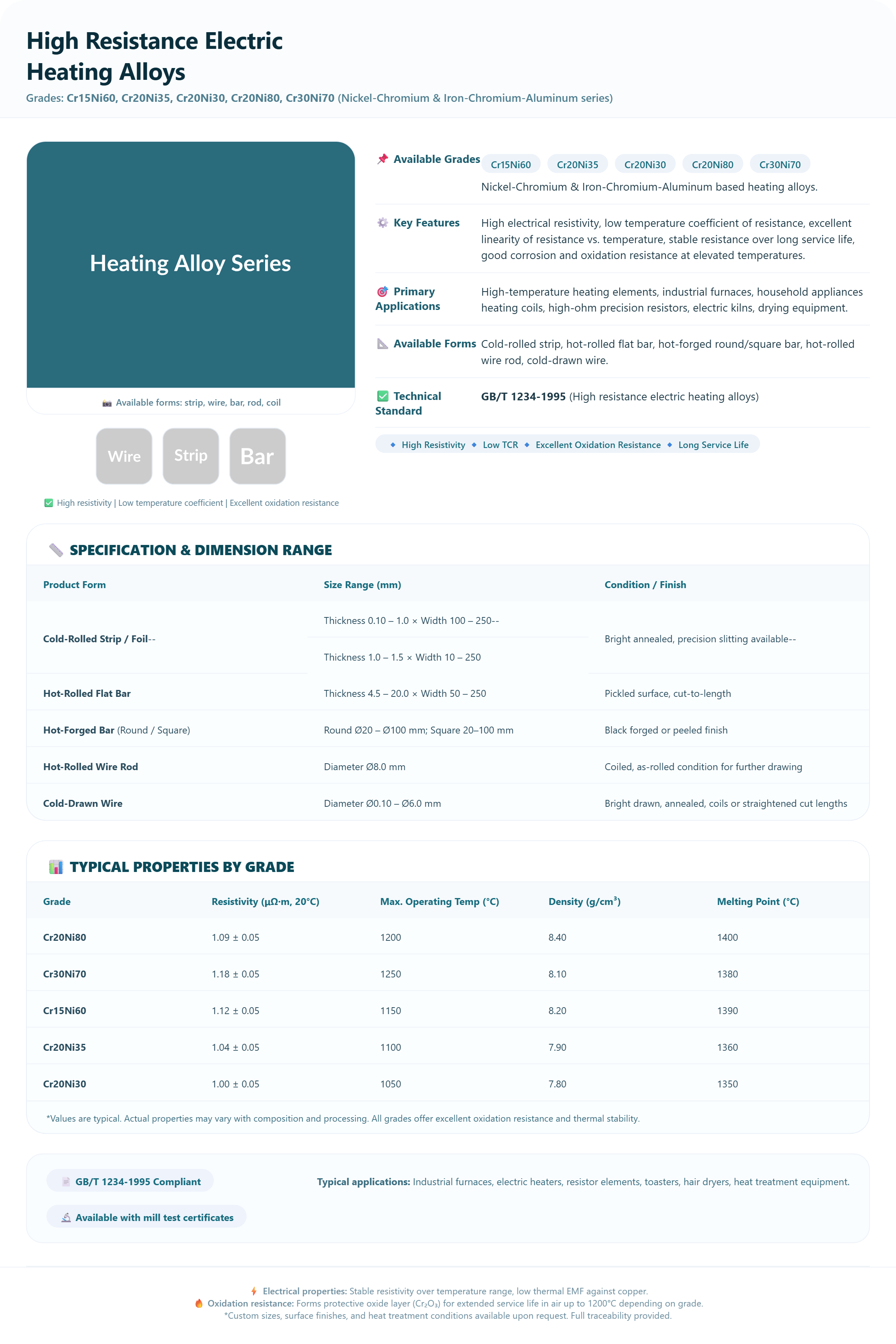
Electrical Resistance Heating Alloys
High-Resistance Materials for Heating Elements, Resistance Wire and High-Temperature Applications
Hefei Ke Ningman New Energy Materials Technology Co., Ltd. supplies electrical resistance heating alloys designed for applications requiring controlled electrical resistivity, high-temperature stability, oxidation resistance and reliable heating performance.
Electrical resistance alloys convert electrical energy into heat through controlled electrical resistance. They are widely used to manufacture heating elements, resistance wire, electric heaters, industrial furnace components, heating coils, resistance strips and other thermal processing components.
Depending on alloy composition and operating requirements, resistance heating materials can be supplied in different grades and product forms, including wire, strip, sheet, bar and other customized forms.
The appropriate alloy should be selected based on electrical resistivity, maximum operating temperature, oxidation resistance, mechanical strength, thermal cycling and the required heating-element design.
Request an Electrical Resistance Alloy Quote
What Are Electrical Resistance Heating Alloys?
Electrical resistance heating alloys are metallic alloys engineered to provide a controlled level of electrical resistance and generate heat when an electrical current passes through them.
When electrical current flows through a resistance alloy:
Electrical Energy → Electrical Resistance → Heat
The heating performance of the material depends on several factors, including:
Electrical resistivity
Alloy composition
Wire or strip dimensions
Operating temperature
Surface condition
Oxidation resistance
Heat dissipation
Heating cycle
Electrical current
For heating-element design, material selection should therefore be based on both electrical and thermal requirements.
Key Properties of Resistance Heating Alloys
High Electrical Resistivity
High electrical resistivity allows a heating element to generate the required heat using a practical wire or strip geometry.
Higher resistivity can allow designers to achieve the required electrical resistance with:
Smaller wire diameter
Shorter heating length
Compact heating elements
Controlled power density
Actual resistivity varies by alloy grade, temperature and material condition.
High-Temperature Performance
Heating elements can operate at temperatures significantly above ambient conditions.
Therefore, a suitable heating alloy must maintain adequate:
Mechanical stability
Electrical resistance
Oxidation resistance
Surface integrity
Service life
The maximum recommended operating temperature should always be determined according to the specific alloy, atmosphere, element design and operating conditions.
Oxidation Resistance
Heating elements operating in air can develop oxide layers during high-temperature service.
Oxidation resistance is therefore a major consideration when selecting heating alloys.
A suitable alloy can help reduce:
Excessive oxidation
Surface deterioration
Element thinning
Premature failure
The actual oxidation behavior depends on alloy chemistry, operating temperature, atmosphere and heating-cycle conditions.
Thermal Stability
Heating elements are often exposed to repeated:
Heating → Holding → Cooling → Reheating
Thermal cycling can create mechanical and metallurgical stresses.
A suitable resistance heating alloy should therefore provide stable performance under the expected thermal cycle.
Mechanical Strength
Although heating alloys are primarily selected for electrical and thermal performance, mechanical strength is also important.
The element may experience:
Thermal expansion
Vibration
Sagging
Mechanical stress
Installation deformation
High-temperature strength and creep resistance can therefore be important for larger heating elements and long-duration applications.
Types of Electrical Resistance Heating Alloys
Resistance heating alloys are commonly divided into different alloy systems according to their composition and performance.
Nickel-Chromium Resistance Alloys
Nickel-chromium (NiCr) alloys, commonly known as Nichrome-type resistance alloys, are widely used for electrical heating applications.
Typical characteristics may include:
High electrical resistivity
Good oxidation resistance
Good high-temperature performance
Stable heating characteristics
Good formability depending on grade
Potential applications include:
Electric heating elements
Heating coils
Resistance wire
Household heaters
Industrial heaters
Furnace elements
If your product range includes specific NiCr grades such as Cr20Ni80, list each grade separately and link to its individual product page.
Iron-Chromium-Aluminum Resistance Alloys
FeCrAl alloys are another important family of resistance heating materials.
They are commonly selected for high-temperature heating applications where oxidation resistance and temperature capability are important.
Potential applications include:
Industrial furnaces
Electric heating elements
Heating wire
Furnace coils
Thermal processing equipment
High-temperature heaters
Specific FeCrAl grades should be presented according to the actual standards and technical specifications supplied by your company.
Nickel-Based vs FeCrAl Heating Alloys
Material selection should depend on the application rather than simply choosing the alloy with the highest temperature rating.
| Property | NiCr Resistance Alloy | FeCrAl Resistance Alloy |
|---|---|---|
| Electrical Resistivity | Grade dependent | Grade dependent |
| Oxidation Resistance | Good to excellent | Excellent for suitable grades |
| High-Temperature Capability | High | High to very high depending on grade |
| Mechanical Properties | Grade dependent | Grade dependent |
| Formability | Generally good | Grade dependent |
| Typical Use | Heaters, coils, appliances | Furnaces, industrial heating |
| Product Forms | Wire / strip | Wire / strip / other forms |
The final choice should be based on operating temperature, atmosphere, element geometry, power density, service life and fabrication requirements.
Electrical Resistance Alloy Product Forms
Resistance Heating Wire
Resistance wire is one of the most common forms of electrical heating alloy.
It can be used for:
Heating coils
Electric heaters
Furnace elements
Heating appliances
Industrial thermal equipment
Important purchasing parameters include:
Wire diameter
Electrical resistivity
Tensile strength
Surface condition
Operating temperature
Coil geometry
Quantity
Resistance Heating Strip
Resistance alloy strip can be used to manufacture:
Flat heating elements
Furnace elements
Industrial heaters
Heating ribbons
Stamped heating components
Important specifications include:
Thickness
Width
Length
Resistivity
Surface condition
Maximum service temperature
Resistance Alloy Sheet
Sheet products can be considered for specialized heating elements and fabricated thermal components.
Electrical Resistance Heating Alloy Applications
Electric Heating Elements
Resistance alloys are widely used in electric heating elements.
Typical applications include:
Electric ovens
Industrial heaters
Furnaces
Heating plates
Air heaters
Laboratory equipment
Industrial Furnaces
High-temperature resistance alloys can be used in:
Heat-treatment furnaces
Ceramic kilns
Laboratory furnaces
Metallurgical furnaces
Industrial thermal processing equipment
Furnace-element selection should consider:
Furnace atmosphere
Operating temperature
Element loading
Furnace geometry
Heating cycle
Expected service life
Heating Coils
Resistance wire can be formed into coils to increase the effective heating length within a compact space.
Coil design parameters include:
Wire diameter
Coil diameter
Coil pitch
Heating length
Electrical resistance
Power rating
Household Electric Heaters
Resistance heating alloys are used in various heating products, including:
Space heaters
Hair dryers
Toasters
Ovens
Electric stoves
Heating appliances
Laboratory Heating Equipment
Resistance alloys can also be used in:
Laboratory furnaces
Heating chambers
Muffle furnaces
Test equipment
Controlled-temperature systems
How to Choose a Resistance Heating Alloy
Choosing a resistance alloy based only on its maximum temperature is not sufficient.
Engineers should consider the following.
1. Required Operating Temperature
Determine:
Normal operating temperature
Maximum temperature
Heating-cycle duration
Continuous or intermittent operation
2. Electrical Resistivity
Electrical resistivity affects:
Wire diameter
Heating length
Power density
Element geometry
The required resistance should be calculated according to the electrical system and heating design.
3. Atmosphere
Determine whether the heating element operates in:
Air
Vacuum
Inert gas
Reducing atmosphere
Controlled atmosphere
Atmosphere can significantly influence oxidation and service life.
4. Heating Cycle
Consider whether the element operates:
Continuously
Intermittently
Through rapid thermal cycling
With frequent start-stop cycles
5. Mechanical Load
For large or vertically mounted elements, consider:
Sagging
Creep
Vibration
Thermal expansion
Mechanical support
6. Element Geometry
The material must be compatible with the required:
Wire diameter
Strip thickness
Coil diameter
Element length
Power density
Resistance Heating Alloy Technical Specifications
The technical specification section should be based on your actual material data.
| Property | NiCr Resistance Alloy | FeCrAl Resistance Alloy |
|---|---|---|
| Electrical Resistivity | Grade dependent | Grade dependent |
| Oxidation Resistance | Good to excellent | Excellent for suitable grades |
| High-Temperature Capability | High | High to very high depending on grade |
| Mechanical Properties | Grade dependent | Grade dependent |
| Formability | Generally good | Grade dependent |
| Typical Use | Heaters, coils, appliances | Furnaces, industrial heating |
| Product Forms | Wire / strip | Wire / strip / other forms |
Do not use generic values if your company has certified technical data available.
Instead, publish the actual:
Chemical Composition + Resistivity + Temperature Capability + Mechanical Properties + Product Dimensions
This will make the page much stronger for industrial procurement searches.
Electrical Resistance Alloy Standards
Depending on the alloy grade and product form, applicable specifications may include:
ASTM standards
GB/T standards
EN standards
DIN standards
AMS standards
Customer-specific specifications
Each specific alloy should have its applicable standard clearly identified.
For example:
Alloy Grade → UNS / GB/T / EN → Product Form → Heat Treatment → Mechanical Properties → Electrical Resistivity
This makes the technical information easier for engineers and purchasing managers to verify.
Quality Control for Resistance Heating Alloys
Reliable heating-element materials require strict control of both chemical composition and electrical properties.
A typical quality-control process can include:
Raw Material Verification → Melting/Processing → Chemical Analysis → Dimensional Inspection → Electrical Resistivity Testing → Mechanical Testing → Surface Inspection → Final Quality Inspection
Depending on customer requirements, documentation may include:
Material Test Report
Chemical composition
Electrical resistivity
Tensile strength
Elongation
Hardness
Dimensional inspection
Surface inspection
Heat-treatment record
Third-party inspection
For industrial furnace and high-temperature applications, material traceability can be particularly important.
Electrical Resistance Alloy Failure: Common Causes
Heating elements can fail for reasons unrelated to the nominal alloy grade.
Common causes include:
Excessive Operating Temperature
Operating above the material's recommended temperature range can accelerate oxidation, creep and degradation.
Incorrect Wire Diameter
Incorrect element dimensions can cause excessive current density and localized overheating.
Poor Element Support
Long heating elements may sag or deform under high-temperature conditions.
Rapid Thermal Cycling
Repeated heating and cooling can cause thermal fatigue.
Incorrect Atmosphere
The actual service atmosphere may accelerate oxidation or corrosion.
Contamination
Surface contamination can negatively affect high-temperature performance.
Therefore, resistance heating alloy selection should always be considered together with element design and operating conditions.
Electrical Resistance Alloy Supplier
Hefei Ke Ningman New Energy Materials Technology Co., Ltd. supplies electrical resistance heating alloys for electric heating, industrial furnaces, heating elements and high-temperature applications.
Our material supply can support:
Resistance heating wire
Resistance heating strip
Electrical resistance alloys
NiCr heating alloys
FeCrAl heating alloys
Custom dimensions
Bulk industrial orders
Technical documentation
Material inspection
If you are sourcing resistance alloy for a heating element, provide:
Alloy grade
Wire / strip / sheet specification
Dimensions
Electrical resistivity requirement
Operating temperature
Heating atmosphere
Quantity
Applicable standard
Our technical team can review your requirements and recommend a suitable resistance heating material.
Request a Quote → Contact Us
Frequently Asked Questions
What is an electrical resistance heating alloy?
An electrical resistance heating alloy is a metal alloy engineered to generate heat when electrical current passes through it.
What are resistance heating alloys used for?
They are commonly used for electric heating elements, heating coils, industrial furnaces, laboratory equipment, electric heaters and thermal processing systems.
What is resistance wire?
Resistance wire is a wire made from an electrical resistance alloy. It is designed to provide a controlled electrical resistance and generate heat when energized.
What is Nichrome?
Nichrome is a general term commonly used for nickel-chromium resistance alloys used in heating applications. Specific NiCr grades should be identified by their applicable material specification.
What is FeCrAl heating alloy?
FeCrAl heating alloys are iron-chromium-aluminum resistance alloys designed for electrical heating applications and high-temperature service.
How do I choose resistance wire?
Consider electrical resistivity, operating temperature, wire diameter, heating length, power requirement, atmosphere, oxidation resistance and expected service life.
What is the difference between NiCr and FeCrAl heating alloys?
Both can be used for electrical heating, but their composition, resistivity, oxidation behavior, mechanical properties and maximum operating conditions differ. Selection should be based on the actual heating environment and design requirements.
Can you supply custom resistance heating wire?
Yes. Custom wire diameter, strip dimensions, alloy grade, quantity and applicable technical specifications can be discussed according to your heating-element requirements.
Request an Electrical Resistance Alloy Quote
Looking for resistance heating wire or high-temperature heating alloys?
Send us:
Alloy grade
Product form
Wire diameter / strip thickness
Width
Length
Electrical resistivity
Operating temperature
Heating atmosphere
Quantity
Applicable ASTM / GB/T / EN standard
Inspection requirements
Get a Quote →