



Previous
Next
Superalloys | Nickel-Based, Cobalt-Based & High-Temperature Alloys
- high temperature superalloy
- high temperature metal alloy
- high temperature corrosion resistant alloy
- nickel based superalloy
- high temperature alloy supplier
- aerospace superalloys
Description
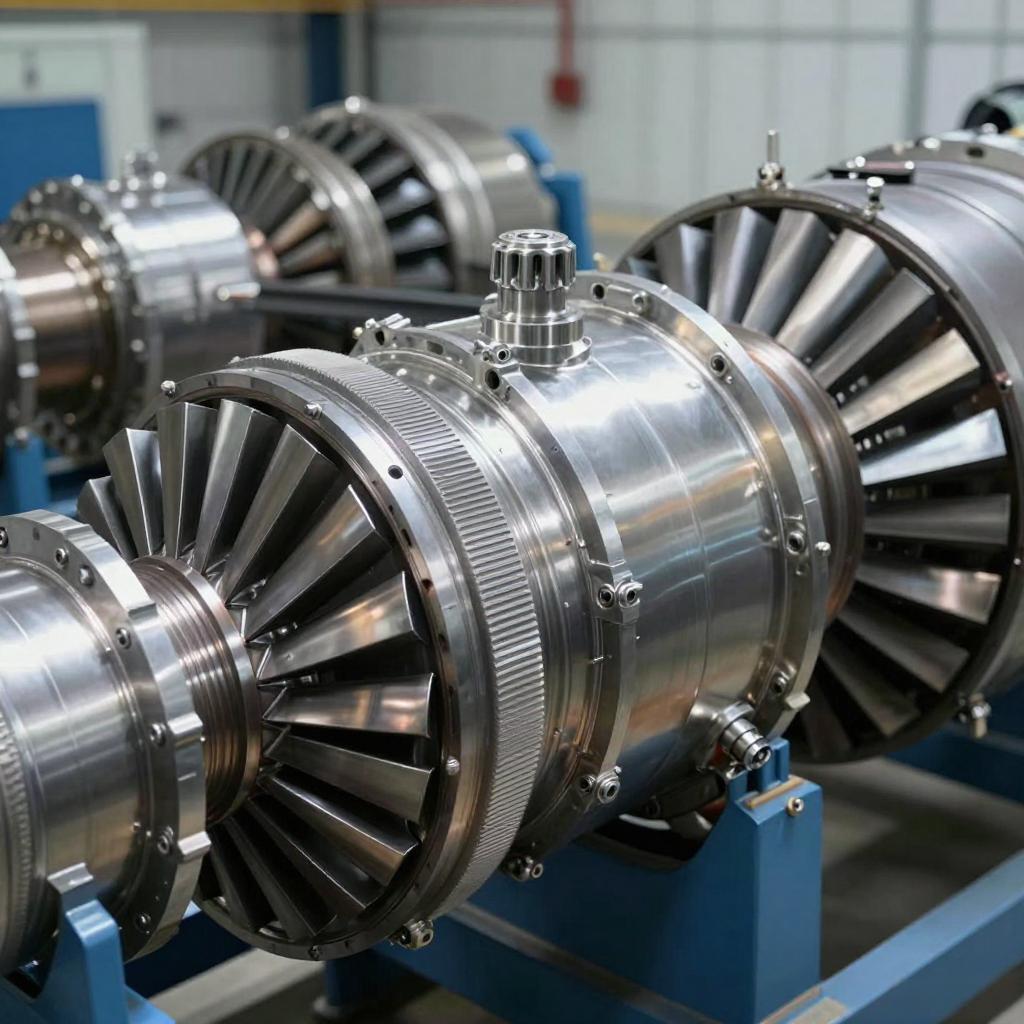
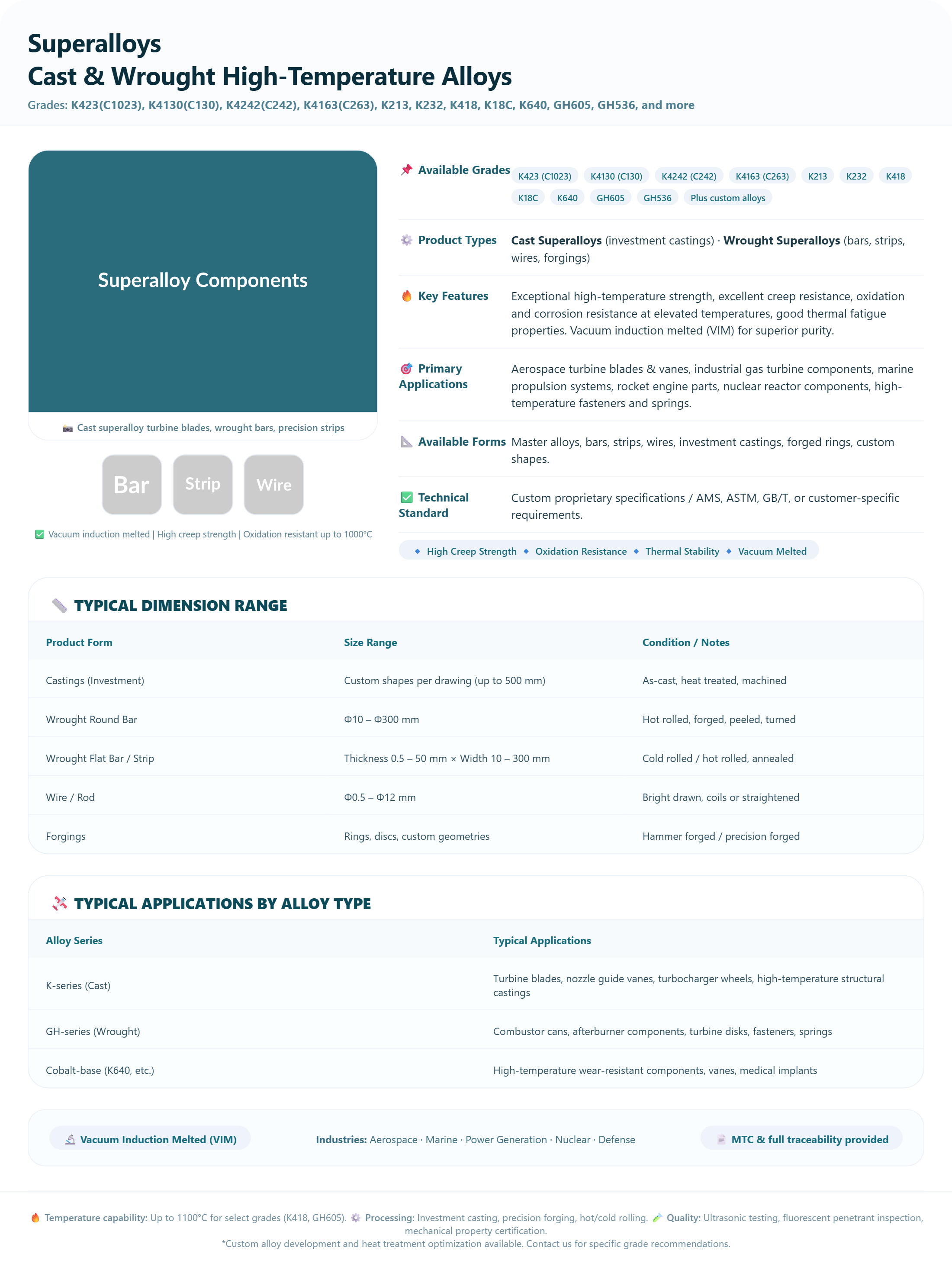
Cast & wrought superalloys (K-series, GH-series, cobalt-base) offer exceptional high-temperature strength, creep resistance, and oxidation resistance. Ideal for aerospace turbines, power generation, and nuclear components. Vacuum induction melted (VIM) for purity.
Superalloys
Nickel-Based, Cobalt-Based and High-Temperature Alloys for Demanding Industrial Applications
Hefei Ke Ningman New Energy Materials Technology Co., Ltd. supplies superalloys and high-temperature alloys for applications requiring high strength, creep resistance, oxidation resistance, corrosion resistance and stable mechanical performance at elevated temperatures.
Superalloys are advanced metallic materials engineered to maintain useful mechanical and environmental performance under demanding thermal conditions. They are widely used in aerospace engines, gas turbines, power generation equipment, petrochemical systems, industrial furnaces, heat-treatment equipment and other high-temperature applications.
Our superalloy product range can include nickel-based, cobalt-based and iron-nickel-based alloy systems, depending on the required grade, product form, applicable standard and application.
Available forms may include bar, rod, wire, sheet, plate, strip, tube and other customized forms, subject to alloy grade and manufacturing requirements.
Request a Superalloy Quote
What Are Superalloys?
Superalloys are high-performance alloys designed to retain strength and resist degradation at elevated temperatures.
Unlike ordinary engineering metals, superalloys are developed for environments where components may experience combinations of:
High temperature
Mechanical stress
Creep
Fatigue
Oxidation
Hot corrosion
Thermal cycling
Aggressive chemical environments
The exact performance of a superalloy depends on its alloy system, chemical composition, microstructure, heat treatment and manufacturing process.
For this reason, superalloy selection should be based on the actual operating environment rather than simply choosing a material with the highest nominal temperature rating.
Why Are Superalloys Used at High Temperatures?
At elevated temperatures, conventional metals can experience rapid loss of strength, creep deformation, oxidation and other forms of degradation.
Superalloys are designed to maintain useful properties under these conditions through carefully controlled alloy chemistry and microstructure.
Depending on the alloy family, important strengthening mechanisms may include:
Solid-solution strengthening
Precipitation strengthening
Carbide strengthening
Grain-boundary strengthening
Controlled microstructure
These mechanisms allow specific superalloys to provide a combination of high-temperature strength, creep resistance, fatigue resistance and corrosion or oxidation resistance.
Main Types of Superalloys
Superalloys are commonly classified into three major alloy systems.
Nickel-Based Superalloys
Nickel-based superalloys are among the most widely used superalloys for high-temperature applications.
They can provide a combination of:
High-temperature strength
Creep resistance
Oxidation resistance
Corrosion resistance
Fatigue resistance
Thermal stability
Nickel-based superalloys are widely considered for:
Gas turbine components
Jet engine components
Combustion systems
Turbine components
Aerospace hardware
Industrial heating equipment
Power generation systems
Specific grades should be identified by their applicable standards and technical specifications.
Cobalt-Based Superalloys
Cobalt-based superalloys can provide useful high-temperature strength, wear resistance, corrosion resistance and thermal stability.
They may be selected for applications involving:
High operating temperatures
Thermal cycling
Wear
Oxidizing environments
Combustion systems
Potential applications include:
Gas turbine components
High-temperature valves
Combustion components
Industrial furnace components
Wear-resistant high-temperature parts
The appropriate grade depends on temperature, atmosphere, stress and fabrication requirements.
Iron-Nickel-Based Superalloys
Iron-nickel-based superalloys can provide a balance of:
High-temperature strength
Corrosion resistance
Thermal stability
Mechanical performance
Manufacturing flexibility
They can be considered for selected:
Aerospace components
Power generation equipment
Heat exchangers
Industrial equipment
High-temperature structural components
Cast vs Wrought Superalloys
Superalloys can also be classified according to their manufacturing route.
| Type | Characteristics | Typical Applications |
|---|---|---|
| Cast Superalloys | Suitable for complex geometries and cast components | Turbine components, blades, complex high-temperature parts |
| Wrought Superalloys | Processed through forging, rolling or other deformation processes | Bars, sheets, plates, forgings, shafts and structural components |
| Powder Metallurgy Superalloys | Controlled powder-based manufacturing for selected demanding applications | Advanced aerospace and high-performance components |
The appropriate manufacturing route depends on the component geometry, required properties, production volume and performance requirements.
Key Properties of Superalloys
High-Temperature Strength
Superalloys are selected when components must retain useful strength at elevated temperatures.
Important mechanical parameters can include:
Tensile strength
Yield strength
Stress rupture strength
Creep strength
Fatigue strength
Actual values depend on alloy grade, heat treatment, product form and test temperature.
Creep Resistance
Creep is time-dependent deformation under sustained stress, particularly at elevated temperatures.
For turbine, furnace and power-generation components, creep resistance can be one of the most important material-selection criteria.
Factors affecting creep performance include:
Alloy chemistry
Microstructure
Grain structure
Heat treatment
Applied stress
Operating temperature
Exposure time
Oxidation Resistance
High-temperature exposure can cause oxidation and surface degradation.
Oxidation-resistant superalloys can help maintain component integrity in suitable environments.
Performance depends on:
Alloy composition
Temperature
Atmosphere
Exposure time
Thermal cycling
Surface condition
Hot Corrosion Resistance
Certain combustion and industrial environments can expose materials to corrosive deposits and gases at elevated temperatures.
Where hot-corrosion resistance is important, alloy selection should consider:
Fuel composition
Gas chemistry
Salt or deposit exposure
Operating temperature
Component location
Fatigue Resistance
High-temperature components can experience cyclic mechanical and thermal loading.
Superalloys may therefore be selected for applications requiring resistance to:
Thermal fatigue
Low-cycle fatigue
High-cycle fatigue
Mechanical cycling
Superalloy Applications
Aerospace Engines
Superalloys are widely used in demanding aerospace applications where components experience high temperature and mechanical stress.
Potential applications include:
Turbine components
Combustion components
Engine hardware
Exhaust-system components
High-temperature fasteners
Precision engine components
The exact material depends on the engine section, temperature, stress and manufacturing process.
Gas Turbines
Industrial gas turbines require materials capable of operating under high temperature, cyclic loading and corrosive combustion environments.
Superalloys may be used for:
Turbine components
Combustion components
Shafts
Fasteners
High-temperature structural parts
Material selection should consider operating temperature, stress, thermal cycling and environmental exposure.
Power Generation
Superalloys can be used in selected power-generation applications where conventional steels or stainless steels cannot provide the required high-temperature performance.
Potential applications include:
Gas turbines
Steam-system components
High-temperature piping components
Heat-treatment equipment
Power-generation machinery
Petrochemical and Chemical Processing
Some nickel-based superalloys can provide resistance to aggressive chemical and high-temperature environments.
Potential applications include:
Process equipment
Heat exchangers
Valves
Pumps
Furnace components
High-temperature piping
The alloy should be selected according to the specific chemical environment rather than general corrosion resistance alone.
Industrial Furnaces
High-temperature alloys can be considered for furnace and thermal-processing components exposed to:
High temperatures
Thermal cycling
Oxidizing atmospheres
Mechanical loading
Potential applications include:
Furnace components
Heat-treatment fixtures
Heating-system components
High-temperature supports
Thermal processing equipment
Superalloy Product Forms
Depending on the alloy grade and manufacturing route, superalloys can be supplied in multiple forms.
Superalloy Bar and Rod
Common applications include:
Shafts
Fasteners
Machined components
Structural parts
Turbine components
Important specifications include:
Diameter
Length
Tolerance
Heat-treatment condition
Mechanical properties
Surface finish
Superalloy Sheet and Plate
Sheet and plate products can be used for:
Aerospace components
Combustion components
Heat shields
Industrial equipment
Fabricated high-temperature parts
Key parameters include:
Thickness
Width
Length
Flatness
Surface condition
Mechanical properties
Superalloy Wire
Superalloy wire can be considered for:
Springs
Fasteners
Welding materials
High-temperature components
Precision applications
Superalloy Tube and Pipe
Depending on alloy and specification, tube products may be used in:
Heat exchangers
Process equipment
High-temperature systems
Aerospace applications
Chemical processing
How to Choose the Right Superalloy
Choosing a superalloy requires more than comparing maximum temperature ratings.
1. Operating Temperature
Define:
Normal operating temperature
Maximum temperature
Temperature fluctuations
Heating and cooling rate
2. Mechanical Stress
Determine:
Tensile load
Compressive load
Cyclic stress
Impact
Vibration
Sustained stress
3. Creep Requirements
For long-term high-temperature applications, determine:
Required service life
Applied stress
Operating temperature
Allowable deformation
4. Oxidation and Corrosion Environment
Consider:
Air
Combustion gas
Steam
Salt
Sulfur-containing environments
Chemical gases
Vacuum
Controlled atmosphere
5. Manufacturing Process
Specify whether the final component will be:
Forged
Rolled
Machined
Cast
Welded
Cold worked
Hot worked
The manufacturing process can influence the suitable alloy grade and heat-treatment condition.
6. Heat Treatment
Some superalloys depend heavily on heat treatment to achieve their required mechanical properties.
Relevant conditions may include:
Solution treatment
Aging
Stabilization
Annealing
Stress relieving
The actual treatment should follow the applicable material specification.
Superalloy Technical Specifications
For each specific alloy grade, provide verified technical information such as:
| Parameter | Specification |
| Alloy Grade | Specific grade |
| UNS Number | Applicable UNS |
| Alloy Family | Nickel / Cobalt / Iron-Nickel |
| Standard | ASTM / AMS / EN / GB/T / Other |
| Product Form | Bar / Sheet / Plate / Wire / Tube |
| Heat Treatment | Grade specific |
| Tensile Strength | Grade and condition dependent |
| Yield Strength | Grade and condition dependent |
| Elongation | Grade and condition dependent |
| Hardness | Grade and condition dependent |
| Creep Properties | Test-condition dependent |
| Oxidation Resistance | Application dependent |
| Surface Finish | Customer specification |
All numerical values should be taken from your actual technical datasheets and applicable standards.
Superalloy Standards and Specifications
Depending on the alloy grade and product form, applicable standards may include:
ASTM
AMS
ASME
EN
DIN
GB/T
UNS designations
Customer-specific aerospace or industrial specifications
For aerospace and power-generation applications, buyers should confirm:
Alloy Grade + UNS + Product Form + Heat Treatment + Applicable Standard + Inspection Requirement
before placing an order.
Superalloy Manufacturing Process
Depending on the alloy and final product form, manufacturing may involve:
Raw Material Selection → Melting → Refining → Casting → Homogenization → Hot Working → Cold Working → Heat Treatment → Machining / Finishing → Inspection
Different superalloys require different processing routes.
For demanding applications, process control can affect:
Grain structure
Precipitate distribution
Mechanical properties
Creep resistance
Fatigue behavior
Surface condition
Dimensional stability
Superalloy Quality Control
For high-performance applications, quality control should cover both material chemistry and final properties.
Typical inspections can include:
Chemical Composition
Verification against the applicable alloy specification.
Mechanical Testing
Depending on the grade:
Tensile strength
Yield strength
Elongation
Hardness
High-Temperature Testing
For selected applications:
Creep testing
Stress rupture testing
High-temperature tensile testing
Oxidation testing
Dimensional Inspection
Including:
Diameter
Thickness
Width
Length
Straightness
Tolerance
Surface Inspection
Depending on product form:
Visual inspection
Surface roughness
Defect inspection
Non-destructive testing
Material Documentation
Depending on customer requirements:
Material Test Report
Chemical composition report
Mechanical test report
Heat-treatment records
Inspection certificate
Third-party inspection
Superalloy vs Stainless Steel
Superalloys should not simply be viewed as “stronger stainless steel.”
They are designed for different performance requirements.
| Property | Stainless Steel | Superalloy |
| General Corrosion Resistance | Often excellent | Grade dependent |
| High-Temperature Strength | Grade dependent | Typically a primary design consideration |
| Creep Resistance | Grade dependent | Important for many grades |
| Oxidation Resistance | Grade dependent | Important for high-temperature grades |
| Cost | Generally lower | Generally higher |
| Typical Use | General industrial applications | Aerospace, turbines and demanding high-temperature applications |
| Material Selection | Environment + mechanical requirements | Temperature + stress + creep + environment + manufacturing |
The right choice depends on the actual operating conditions.
Superalloy Supplier
Hefei Ke Ningman New Energy Materials Technology Co., Ltd. supplies superalloys and high-temperature alloy materials for demanding industrial applications.
Our supply capabilities can support:
Nickel-based superalloys
Cobalt-based superalloys
Iron-nickel-based high-temperature alloys
Cast alloys
Wrought alloys
Bar
Rod
Sheet
Plate
Wire
Tube
Custom dimensions
Technical documentation
Material inspection
For aerospace, power generation, gas turbine, chemical processing and other high-temperature applications, we can review your material specification and application requirements.
Request a Superalloy Quote
How to Request a Superalloy Quote
To receive an accurate quotation, provide:
Alloy grade
UNS number
Product form
Dimensions
Quantity
Heat-treatment condition
Applicable ASTM / AMS / EN / GB/T specification
Mechanical requirements
Operating temperature
Application
Inspection requirements
Required certification
For custom requirements, drawings or technical specifications can be provided for review.
Frequently Asked Questions
What are superalloys?
Superalloys are high-performance alloys designed to retain useful mechanical and environmental properties at elevated temperatures.
What are superalloys used for?
Superalloys are commonly used in aerospace engines, gas turbines, power-generation equipment, industrial furnaces, chemical processing systems and other demanding high-temperature applications.
What are the main types of superalloys?
The main categories are nickel-based, cobalt-based and iron-nickel-based superalloys.
What is a nickel-based superalloy?
A nickel-based superalloy is a high-temperature alloy with nickel as the primary matrix element. These alloys can provide high-temperature strength, creep resistance and oxidation or corrosion resistance.
What is the difference between cast and wrought superalloys?
Cast superalloys are produced through casting and are useful for complex geometries, while wrought superalloys are processed through operations such as forging or rolling and are commonly supplied as bars, sheets, plates, forgings and other forms.
Are superalloys suitable for aerospace applications?
Yes. Specific superalloy grades are widely used in aerospace applications where components require high-temperature strength, creep resistance, fatigue resistance and environmental resistance.
What standards are available for superalloys?
Depending on the alloy and product form, specifications may include ASTM, AMS, ASME, EN, DIN, GB/T and UNS designations.
Can you supply custom superalloy materials?
Yes. Alloy grade, product form, dimensions, heat-treatment condition, technical specifications and inspection requirements can be discussed according to the application.
Request a Superalloy Quote
Need a high-temperature alloy for aerospace, gas turbine or industrial applications?
Send us your:
Alloy Grade + Product Form + Dimensions + Quantity + Operating Temperature + Applicable Standard
Our technical team can review your requirements and recommend a suitable superalloy material.