



Previous
Next
Thermal Bimetal Strip | Temperature-Sensitive Bimetal Alloy for Thermal Control
- thermal bimetal strip
- thermal bimetal strip material
- temperature sensitive bimetal strip
- bimetallic strip material
- bimetal strip for thermal switches
- thermal switch bimetal strip
Description
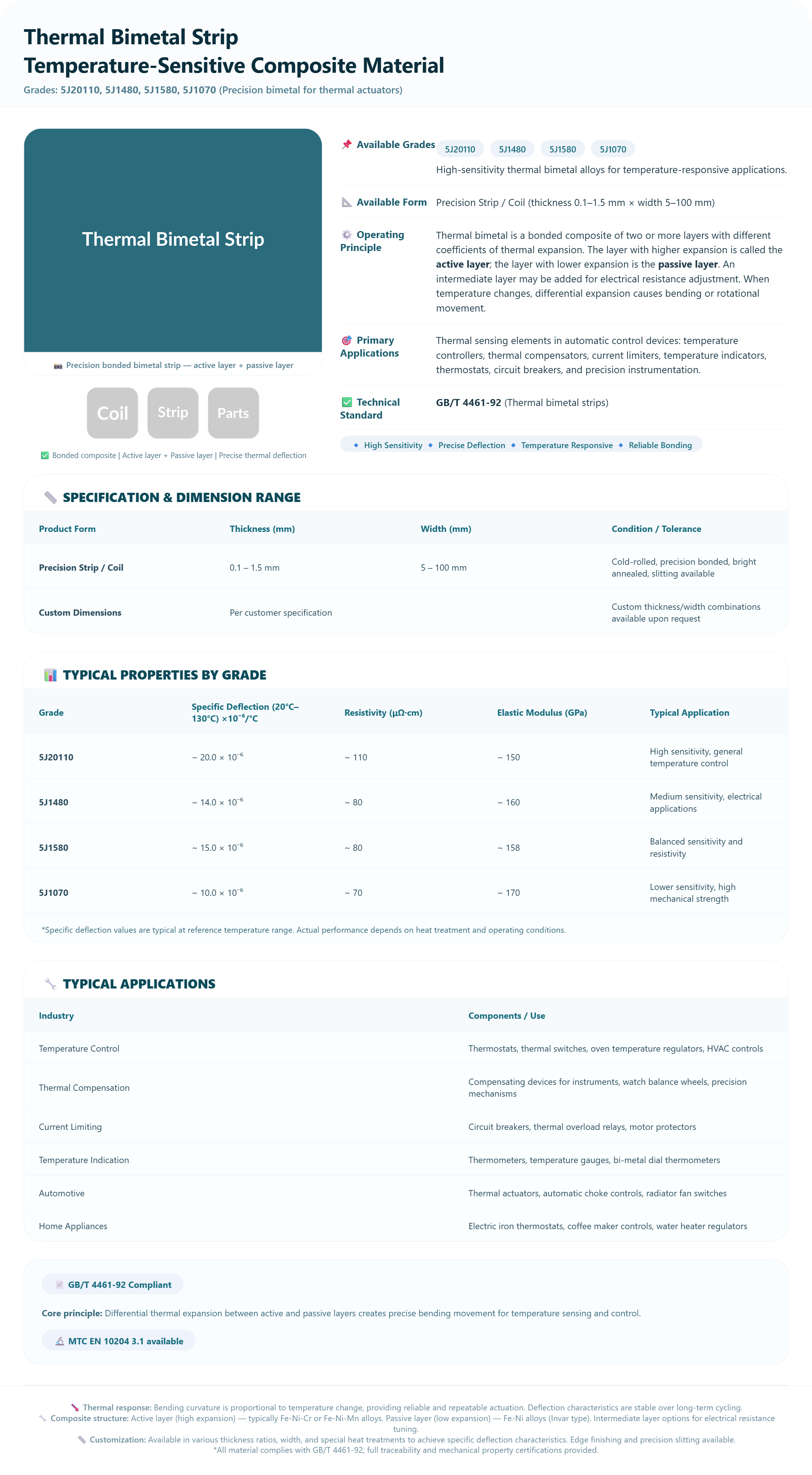
Thermal bimetal strips (grades 5J20110, 5J1480, 5J1580, 5J1070) offer precise temperature-sensitive deflection for thermostats, circuit breakers, and thermal actuators. GB/T 4461-92 compliant.
Thermal Bimetal Strip
Temperature-Sensitive Bimetal Material for Thermal Control, Switching and Sensing Applications
Hefei Ke Ningman New Energy Materials Technology Co., Ltd. supplies thermal bimetal strip, a temperature-sensitive composite material designed to produce controlled mechanical movement in response to temperature changes.
Thermal bimetal strip is manufactured by permanently bonding two or more metallic layers with different coefficients of thermal expansion. When temperature changes, the different expansion rates of the bonded layers cause the strip to bend or deflect.
This temperature-responsive behavior makes thermal bimetal strip suitable for thermal switches, thermostats, thermal relays, circuit breakers, temperature regulators, temperature indicators, current protection devices, measuring instruments and automatic control systems.
Depending on the required operating temperature, thermal sensitivity, electrical resistance, deflection and mechanical properties, different bimetal combinations and grades can be selected.
Request a Thermal Bimetal Strip Quote
What Is Thermal Bimetal Strip?
Thermal bimetal strip is a temperature-sensitive composite material consisting of two or more bonded metallic layers with different coefficients of thermal expansion.
When the temperature changes:
Temperature Change → Different Thermal Expansion → Bimetal Bending → Mechanical Movement
The resulting movement can be used to open or close an electrical contact, activate a mechanical mechanism, compensate for temperature changes or indicate a temperature condition.
Unlike a conventional single-metal strip, a thermal bimetal combines materials with different thermal expansion characteristics to create predictable temperature-dependent movement.
How Does Thermal Bimetal Strip Work?
A typical thermal bimetal consists of:
Active Layer
The active layer has a relatively higher coefficient of thermal expansion.
When temperature increases, this layer attempts to expand more strongly than the low-expansion layer.
Passive Layer
The passive layer has a lower coefficient of thermal expansion.
It restricts the expansion of the active layer and contributes to the controlled bending behavior of the composite strip.
Intermediate or Resistive Layer
For selected constructions, an intermediate metallic layer may be incorporated to modify electrical resistance, bonding or other functional characteristics.
The actual layer configuration depends on the specific bimetal grade and application.
Thermal Bimetal Strip Working Principle
When a thermal bimetal strip is heated, the high-expansion layer expands more than the low-expansion layer.
Because the two layers are permanently bonded together, they cannot expand independently.
The difference in thermal expansion therefore produces curvature.
When the temperature decreases, the expansion difference changes and the strip moves in the opposite direction.
This reversible temperature-dependent movement can be used as a sensing or actuating mechanism.
Key Properties of Thermal Bimetal Strip
Thermal Sensitivity
Thermal sensitivity determines how strongly the bimetal responds to a temperature change.
For applications requiring precise thermal actuation, the selected grade should be evaluated according to:
Operating temperature
Specific thermal curvature / flexivity
Required deflection
Element geometry
Mechanical loading
Coefficient of Thermal Expansion
The difference between the thermal expansion coefficients of the component layers is fundamental to bimetal operation.
A larger expansion difference can produce stronger thermal movement, depending on the material structure and element geometry.
Flexivity
Flexivity is an important performance parameter for thermal bimetal materials.
It describes the thermal curvature response of the material under specified test conditions.
Higher flexivity can be useful for applications requiring greater thermal movement, while lower-flexivity grades may be selected when a more controlled response is required.
Actual flexivity should be specified according to the applicable material standard and test method.
Electrical Resistivity
Some thermal bimetal applications involve electrical current, such as:
Thermal relays
Circuit breakers
Thermal switches
Overload protection devices
For these applications, electrical resistivity can be an important material-selection parameter.
Temperature Range
Different thermal bimetal grades are designed for different operating temperature ranges.
When selecting a material, consider:
Minimum operating temperature
Normal operating temperature
Actuation temperature
Maximum operating temperature
Thermal cycling conditions
The actual temperature range should always be based on the specific alloy grade and technical specification.
Bonding Strength
Because thermal bimetal relies on two or more metallic layers working together, the bond between the layers is critical.
Insufficient bonding can cause:
Delamination
Unstable thermal response
Mechanical failure
Reduced service life
Layer bonding should therefore be verified according to the applicable specification.
Thermal Bimetal Strip Material Structure
A typical thermal bimetal construction includes:
| Layer | Function |
|---|---|
| High-Expansion Layer | Provides greater thermal expansion |
| Low-Expansion Layer | Restricts expansion and controls curvature |
| Intermediate Layer | May adjust electrical or mechanical characteristics |
| Bonded Interface | Transfers stress between layers |
The exact alloy combination depends on the required temperature range, flexivity, resistivity and application.
Common Thermal Bimetal Alloy Combinations
Depending on the required properties, thermal bimetal systems can use combinations of:
Nickel-iron alloys
Nickel-chromium-iron alloys
Manganese-copper-nickel alloys
Copper-based alloys
Low-expansion alloys
High-expansion alloys
For example, specific bimetal systems may combine a high-expansion alloy with a low-expansion nickel-iron alloy.
Actual alloy combinations should be specified according to the grade supplied by the manufacturer.
Thermal Bimetal Strip Classification
Thermal bimetal materials can be classified according to several important characteristics.
Classification by Operating Temperature
Depending on the grade, products can be designed for:
Low-temperature applications
Medium-temperature applications
High-temperature applications
Classification by Thermal Sensitivity
Thermal bimetal can also be classified according to flexivity or thermal sensitivity.
Typical categories include:
High-sensitivity bimetal
Medium-sensitivity bimetal
Low-sensitivity bimetal
The actual classification should follow the applicable material standard.
Classification by Electrical Resistance
Depending on the electrical application, thermal bimetal materials may be available as:
Low-resistance series
Medium-resistance series
High-resistance series
This classification can be particularly relevant to electrically heated or current-responsive thermal components.
Thermal Bimetal Strip Product Specifications
The following parameters should be provided according to the actual grade:
| Parameter | Specification |
| Material Type | Thermal Bimetal |
| Alloy Grade | Specific Grade |
| High-Expansion Layer | Actual Alloy |
| Low-Expansion Layer | Actual Alloy |
| Intermediate Layer | If applicable |
| Thickness | Actual Range |
| Width | Actual Range |
| Coil / Roll ID | Actual Range |
| Flexivity | Grade dependent |
| Deflection | Grade dependent |
| Electrical Resistivity | Grade dependent |
| Operating Temperature | Grade dependent |
| Maximum Application Temperature | Grade dependent |
| Elastic Modulus | Grade dependent |
| Density | Grade dependent |
| Surface Condition | Customer specification |
All numerical specifications should be taken from your own technical datasheet and applicable material standards.
Thermal Bimetal Strip Dimensions
Thermal bimetal strip can be supplied according to customer requirements.
Typical dimensional parameters include:
Thickness
Specify:
Nominal thickness
Thickness tolerance
Total composite thickness
Width
Specify:
Standard width
Custom width
Width tolerance
Coil Dimensions
For coiled material, specify:
Inside diameter
Outside diameter
Coil weight
Coil length
Surface Condition
Depending on the product and manufacturing route:
Bright surface
Polished surface
Standard mill finish
Customized surface condition
Thermal Bimetal Strip Applications
Thermal Switches
Thermal bimetal can act as a temperature-sensitive switching element.
When a predetermined temperature is reached, the bimetal moves and changes the electrical contact state.
Applications include:
Thermal switches
Temperature controllers
Automatic protection devices
Heating equipment
Thermostats
Thermal bimetal strips can be used in thermostatic mechanisms to respond to temperature changes.
Potential applications include:
Household appliances
Heating equipment
Temperature control systems
Industrial equipment
Thermal Relays
Thermal bimetal can be used in overload protection mechanisms.
When electrical current produces excessive heating, the bimetal responds to the temperature increase and activates a protective mechanism.
Circuit Breakers and Overload Protection
Bimetal elements are used in selected circuit protection devices to provide thermal overload protection.
The thermal response can be designed to trigger mechanical movement when the element reaches a specified temperature condition.
Temperature Indicators
Thermal bimetal can convert temperature changes into mechanical displacement.
This makes it suitable for selected:
Temperature indicators
Temperature gauges
Mechanical indicators
Measuring instruments
Temperature Compensation
Thermal bimetal materials can also be used to compensate for temperature-induced dimensional or electrical changes in precision mechanisms.
Applications may include:
Measuring instruments
Electrical meters
Automatic control systems
Precision mechanisms
Automotive Applications
Depending on the grade and design, thermal bimetal can be used in selected automotive thermal-control and protection components.
Potential applications include:
Thermal switches
Temperature indicators
Circuit protection
Temperature control mechanisms
Industrial Automation
Thermal bimetal materials can be incorporated into automatic control devices where temperature changes must produce a predictable mechanical response.
How to Choose the Right Thermal Bimetal Strip
Selecting thermal bimetal should be based on the complete application rather than only the nominal operating temperature.
1. Determine the Operating Temperature
Identify:
Normal operating temperature
Actuation temperature
Maximum temperature
Minimum temperature
Thermal cycling range
2. Define the Required Thermal Sensitivity
Determine the required:
Flexivity
Deflection
Response sensitivity
Actuation displacement
3. Determine Electrical Requirements
For electrically active applications, evaluate:
Electrical resistivity
Current
Voltage
Contact configuration
Heating method
4. Determine Element Geometry
The final response depends on:
Strip thickness
Strip width
Element length
Curvature
Mounting configuration
5. Consider Mechanical Loading
The application may impose:
Contact force
Spring force
Vibration
Repeated movement
Mechanical constraint
These factors should be considered when selecting the bimetal grade.
6. Consider Thermal Cycling
For products repeatedly exposed to heating and cooling, evaluate:
Response repeatability
Hysteresis
Fatigue
Long-term stability
Stabilization requirements
Thermal Bimetal Strip Manufacturing Process
A typical manufacturing process may include:
Alloy Preparation → Layer Processing → Surface Preparation → Bonding → Rolling → Heat Treatment → Stabilization → Slitting → Dimensional Inspection → Thermal Testing → Final Inspection
The exact process depends on the bimetal construction and material specification.
Key manufacturing controls may include:
Layer thickness
Bonding quality
Total thickness
Surface condition
Thermal response
Electrical resistance
Dimensional tolerance
Thermal Bimetal Quality Control
Quality control is especially important because thermal bimetal performance depends on the relationship between multiple bonded layers.
Typical inspections may include:
Chemical Composition
Verify each alloy layer according to the applicable specification.
Dimensional Inspection
Check:
Thickness
Width
Length
Tolerance
Coil dimensions
Thermal Performance
Depending on the grade:
Flexivity
Deflection
Actuation temperature
Thermal response
Temperature stability
Electrical Properties
For applicable grades:
Electrical resistivity
Resistance consistency
Bonding Inspection
Verify the integrity of the bonded interface.
Surface Inspection
Check for:
Cracks
Delamination
Scratches
Oxidation
Surface defects
Material Documentation
Depending on customer requirements:
Material Test Report
Chemical composition
Dimensional inspection report
Thermal-property test report
Electrical-property report
Certificate of conformity
Thermal Bimetal Strip vs Conventional Metal Strip
| Property | Thermal Bimetal Strip | Conventional Metal Strip |
| Temperature Response | Designed for controlled thermal movement | Generally limited |
| Structure | Two or more bonded metallic layers | Usually one alloy |
| Thermal Expansion | Different expansion rates between layers | Single expansion behavior |
| Mechanical Actuation | Yes | Usually not designed for this |
| Thermal Switching | Suitable | Limited |
| Temperature Compensation | Suitable for selected designs | Limited |
| Typical Applications | Thermostats, switches, relays, protection | General structural or conductive applications |
Thermal Bimetal Strip Supplier
Hefei Ke Ningman New Energy Materials Technology Co., Ltd. supplies thermal bimetal strip materials for temperature-sensitive and automatic-control applications.
Our supply capabilities can support:
Thermal bimetal strip
Temperature-sensitive bimetal
High-sensitivity bimetal
Low-expansion / high-expansion bimetal combinations
Custom strip dimensions
Different electrical resistance ranges
Different thermal sensitivity requirements
Technical documentation
Custom material specifications
For a quotation, provide your required:
Alloy Grade + Thickness + Width + Thermal Range + Flexivity + Resistivity + Quantity + Application
Our technical team can evaluate the requirements and recommend an appropriate thermal bimetal material.
How to Request a Thermal Bimetal Strip Quote
Please provide:
Bimetal grade
Active layer material
Passive layer material
Intermediate layer, if required
Thickness
Width
Coil dimensions
Required thermal sensitivity
Operating temperature
Actuation temperature
Electrical resistivity
Application
Quantity
Applicable ASTM / GB/T / EN or customer specification
Inspection requirements
For customized applications, drawings and technical specifications can also be provided for review.
Request a Quote
Frequently Asked Questions
What is thermal bimetal strip?
Thermal bimetal strip is a composite material made by bonding two or more metals with different thermal expansion coefficients. Temperature changes cause the strip to bend or deflect.
How does thermal bimetal work?
When temperature changes, the bonded metal layers expand at different rates. This difference generates mechanical curvature that can be used for switching, sensing, compensation or temperature control.
What is thermal bimetal used for?
Thermal bimetal is used in thermostats, thermal switches, thermal relays, circuit breakers, overload protection devices, temperature indicators and automatic control systems.
What is the difference between thermal bimetal and ordinary bimetal?
Thermal bimetal is specifically engineered to produce predictable mechanical movement in response to temperature changes by combining materials with different thermal expansion characteristics.
What factors determine thermal bimetal sensitivity?
Important factors include the thermal expansion difference between the layers, material properties, layer thickness, total thickness, element geometry, temperature range and mechanical constraints.
What is flexivity in thermal bimetal?
Flexivity is a measure of the thermal curvature response of a bimetal material under specified conditions. It is an important parameter when selecting thermal bimetal for temperature-sensitive applications.
Can thermal bimetal strip be customized?
Yes. Depending on the material system and manufacturing capability, thickness, width, alloy combination, thermal characteristics, electrical resistance and other specifications can be customized.
What information should I provide when buying thermal bimetal strip?
Provide the required alloy grade, thickness, width, operating temperature, actuation temperature, thermal sensitivity, electrical resistivity, application and quantity.