



Previous
Next
Cast AlNiCo Permanent Magnets | AlNiCo 5, 8 & 9
- cast AlNiCo permanent magnets
- cast AlNiCo magnets
- AlNiCo permanent magnets
- AlNiCo 5 permanent magnet
- AlNiCo 8 permanent magnet
- AlNiCo 9 permanent magnet
- cast AlNiCo magnet manufacturer
- AlNiCo magnets for high temperature
Description
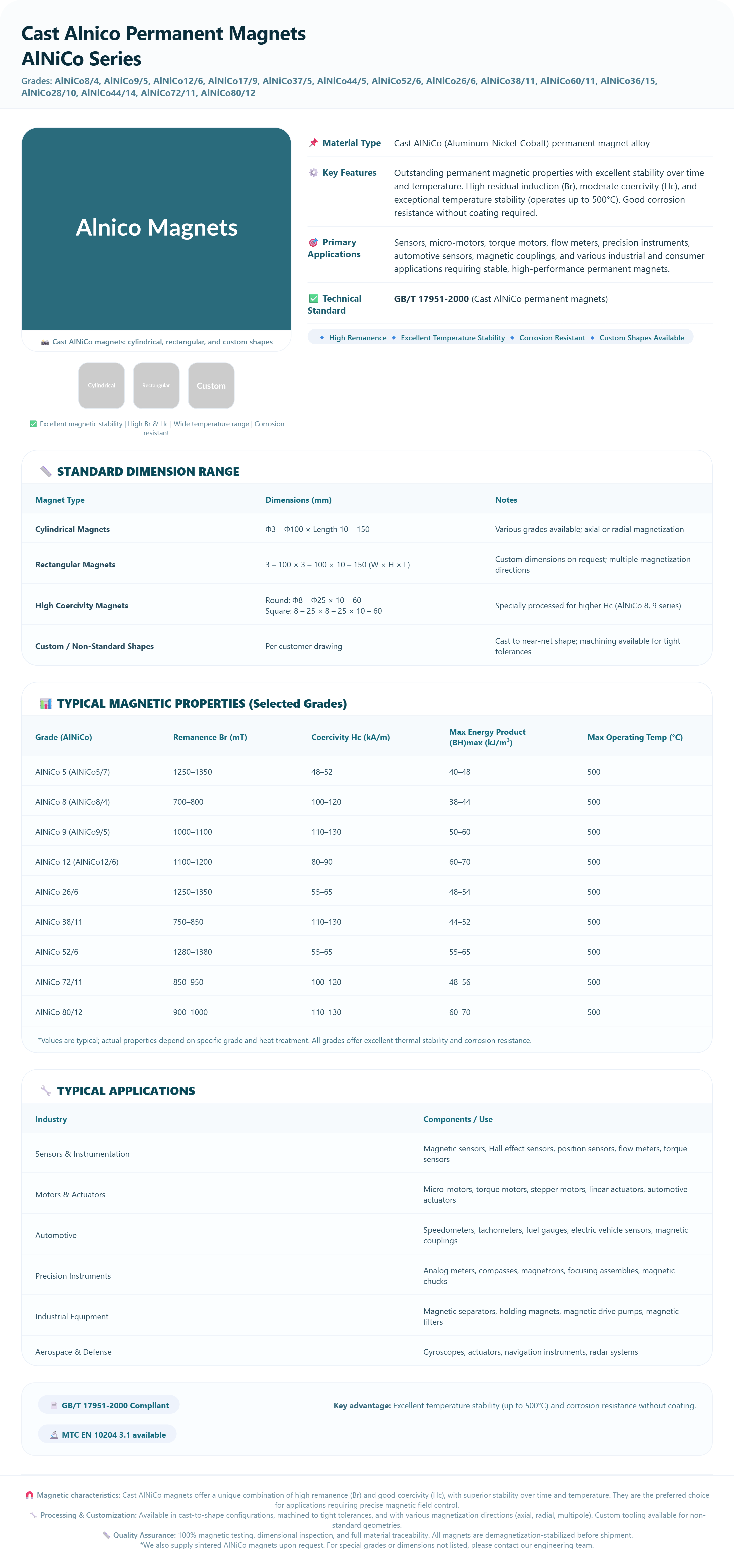
Cast AlNiCo permanent magnets (AlNiCo5, AlNiCo8, AlNiCo9, etc.) offer high remanence, excellent temperature stability (up to 500°C), and corrosion resistance. Ideal for sensors, motors, precision instruments, and automotive applications. GB/T 17951-2000 compliant.
Cast AlNiCo Permanent Magnets | AlNiCo 5, AlNiCo 8 & AlNiCo 9
Cast AlNiCo Permanent Magnets for High-Temperature, Industrial & Precision Applications
Cast AlNiCo permanent magnets are magnetically hard permanent magnet materials based primarily on aluminum, nickel, cobalt and iron, with selected additions such as copper and titanium depending on grade.
Compared with many modern rare-earth permanent magnets, cast AlNiCo magnets are particularly valued for their high-temperature stability, high remanent induction, good corrosion resistance and stable magnetic performance over a wide temperature range.
Hefei Ke Ningman New Energy Materials Technology Co., Ltd. supplies cast AlNiCo permanent magnets in commonly used grades such as AlNiCo 5, AlNiCo 8 and AlNiCo 9, with grade selection based on required remanence, coercivity, maximum energy product, temperature requirements, magnetization direction and application.
Cast AlNiCo magnets are widely used in electric motors, generators, sensors, magnetic instruments, measuring equipment, loudspeakers, ignition systems, automotive components and industrial magnetic assemblies.
Contact us with your required AlNiCo grade, dimensions, magnetization direction and magnetic properties for a customized quotation.
Key Features of Cast AlNiCo Permanent Magnets
Cast AlNiCo permanent magnet material
AlNiCo 5, AlNiCo 8, AlNiCo 9 and other grades available according to requirement
High residual induction
Excellent high-temperature stability
High Curie temperature
Good resistance to corrosion and oxidation compared with many other permanent magnet materials
Excellent dimensional stability at elevated temperatures
Available in isotropic and anisotropic grades
Directional magnetic properties can be developed through controlled processing
Suitable for complex cast magnet shapes
Suitable for motors, generators, sensors and precision instruments
Custom dimensions, tolerances and magnetization directions available
What Is Cast AlNiCo?
AlNiCo is a family of permanent magnet alloys whose principal elements are aluminum (Al), nickel (Ni), cobalt (Co) and iron (Fe). Depending on the grade, copper and titanium may also be added to modify magnetic properties and microstructure.
Cast AlNiCo magnets are produced through a casting route rather than powder sintering. This makes cast AlNiCo particularly useful when customers require larger magnet dimensions, complex geometries or specific directional magnetic properties.
AlNiCo grades can be broadly divided into isotropic and anisotropic materials. Lower-numbered grades such as AlNiCo 1–4 are generally isotropic, while grades such as AlNiCo 5, 6, 8 and 9 can provide stronger directional magnetic performance when processed appropriately.
The final magnetic properties depend not only on chemical composition but also on casting, heat treatment, orientation, machining, magnetization and testing conditions.
Cast AlNiCo Magnet Grades
The most commonly requested cast AlNiCo grades include:
| AlNiCo Grade | Magnetic Type | Main Characteristics | Typical Applications |
|---|---|---|---|
| AlNiCo 1 | Isotropic | Moderate magnetic performance, good temperature stability | Instruments, sensors |
| AlNiCo 2 | Isotropic | Higher magnetic output than AlNiCo 1 | Instruments, magnetic devices |
| AlNiCo 3 | Isotropic | Stable temperature performance | Sensors, instruments |
| AlNiCo 5 | Anisotropic | High remanence and high energy product | Motors, generators, sensors |
| AlNiCo 6 | Anisotropic | Balanced magnetic properties | Industrial magnetic assemblies |
| AlNiCo 8 | Anisotropic | Higher coercivity and good temperature stability | Motors, instruments, magnetic assemblies |
| AlNiCo 9 | Anisotropic | High energy product and coercivity | High-performance magnetic applications |
Grade availability should be confirmed according to the required specification, dimensions and magnetic properties.
Published technical references show that AlNiCo 5, 8 and 9 provide substantially different combinations of residual induction, coercivity and maximum energy product.
AlNiCo 5 vs AlNiCo 8 vs AlNiCo 9
For many industrial applications, customers compare AlNiCo 5, AlNiCo 8 and AlNiCo 9.
| Property | AlNiCo 5 | AlNiCo 8 | AlNiCo 9 |
|---|---|---|---|
| Magnetic orientation | Anisotropic | Anisotropic | Anisotropic |
| Typical Br | ~1.28 T | ~0.82 T | ~1.06 T |
| Typical HcB | ~51 kA/m | ~131 kA/m | ~119 kA/m |
| Typical (BH)max | ~43.8 kJ/m³ | ~42.2 kJ/m³ | ~71.6 kJ/m³ |
| Temperature capability | High | Very high | Very high |
| Main advantage | High remanence | High coercivity | High energy product |
These values are representative published data rather than a guarantee of Greenergy's production values. Actual magnetic properties depend on grade, processing condition, heat treatment, orientation, magnetization and test method.
For an actual purchase order, the required magnetic property specification should be confirmed before production.
Magnetic Properties of Cast AlNiCo Magnets
The most important magnetic parameters for AlNiCo permanent magnets include:
Residual Induction — Br
Br indicates the magnetic flux density remaining in the material after magnetization and removal of the external magnetic field.
A higher Br can be beneficial when high magnetic flux is required within a defined magnetic circuit.
Coercive Force — HcB
HcB indicates the external demagnetizing field required to reduce the magnetic induction to zero under the specified measurement condition.
Intrinsic Coercive Force — HcJ
HcJ describes the material's resistance to irreversible demagnetization and is particularly important when evaluating magnetic stability.
Maximum Energy Product — (BH)max
(BH)max represents the maximum magnetic energy product available from the magnet and is an important parameter when comparing permanent magnet grades.
ASTM A1070 identifies maximum energy product, residual induction, coercive field strength and intrinsic coercive field strength as key magnetic properties for Alnico permanent magnets.
Why Choose Cast AlNiCo Permanent Magnets?
1. Excellent High-Temperature Stability
One of the most important advantages of AlNiCo is its ability to maintain useful magnetic performance at elevated temperatures.
Published technical data show maximum recommended working temperatures for common AlNiCo grades in the several-hundred-degree-Celsius range, with the exact value dependent on grade, geometry and operating conditions.
Therefore, AlNiCo can be a strong candidate when the operating temperature is too high for some conventional permanent magnet materials.
2. High Remanent Induction
Several AlNiCo grades provide high residual induction.
For example, published data for cast AlNiCo 5 show a representative Br of approximately 1.28 T, while AlNiCo 9 can provide a high energy product with representative Br around 1.06 T.
3. High Curie Temperature
AlNiCo has a relatively high Curie temperature compared with many conventional permanent magnet materials.
This characteristic makes AlNiCo useful for applications where the magnetic assembly operates under elevated thermal conditions.
4. Good Corrosion Resistance
AlNiCo alloys generally provide good resistance to corrosion and oxidation compared with many rare-earth permanent magnets.
In many applications, this can reduce the need for additional protective coatings, although the final requirement should always be evaluated against the actual operating environment.
5. Suitable for Directional Magnetic Designs
Anisotropic cast AlNiCo grades can be processed to develop preferred magnetic orientation.
This allows engineers to optimize the magnet according to the required magnetic circuit and magnetization direction.
Cast AlNiCo Magnet Manufacturing Process
The manufacturing process has a major influence on the final magnetic properties of AlNiCo.
A typical cast AlNiCo production route includes:
1. Raw Material Preparation
High-purity raw materials are selected according to the required AlNiCo grade.
The principal alloying elements are aluminum, nickel, cobalt and iron, with copper and titanium used in selected grades.
2. Controlled Melting
The charge materials are melted under controlled conditions to achieve the required chemical composition.
3. Casting
The molten alloy is cast into the required magnet shape or an appropriate intermediate form.
Casting is particularly useful for producing relatively complex magnet geometries.
4. Heat Treatment
Heat treatment is one of the most important stages of AlNiCo production.
Controlled cooling and heat treatment influence the microstructure and magnetic properties of the final magnet.
For anisotropic AlNiCo, magnetic-field-assisted processing can be used to establish a preferred direction of magnetic properties.
5. Machining
Cast AlNiCo magnets can be machined to achieve the required dimensional tolerances.
Because AlNiCo is a relatively hard and brittle magnetic alloy, machining methods should be selected carefully.
6. Magnetization
The finished magnet is magnetized according to the customer's required pole arrangement and magnetic direction.
7. Magnetic Testing
Final magnets can be tested for:
Br
HcB
HcJ
(BH)max
Magnetic polarity
Magnetization direction
8. Dimensional and Surface Inspection
Finished magnets are inspected for:
Length
Width
Height
Diameter
Tolerance
Surface condition
Cracks or casting defects
9. Packaging
Magnets are securely packed to protect them from mechanical damage and unintended magnetic interaction during transportation.
Cast AlNiCo vs Sintered AlNiCo
Both cast and sintered AlNiCo magnets are commercially important, but they are manufactured differently.
| Feature | Cast AlNiCo | Sintered AlNiCo |
|---|---|---|
| Manufacturing process | Melting and casting | Powder metallurgy |
| Complex shapes | Very suitable | Suitable for smaller/defined geometries |
| Large magnet sizes | Advantage | More limited depending on geometry |
| Density | Generally high | Slightly lower |
| Mechanical characteristics | Relatively brittle | Relatively brittle |
| Magnetic orientation | Possible | Possible |
| Typical applications | Motors, generators, instruments | Sensors, instruments, motors |
ASTM A1070-16(2022) specifically covers both cast and sintered Alnico permanent magnets.
Cast AlNiCo vs Neodymium Magnets
When choosing between AlNiCo and NdFeB, the most important factors are not simply maximum magnetic strength.
| Property | Cast AlNiCo | NdFeB |
|---|---|---|
| High-temperature performance | Excellent | Grade dependent |
| Maximum magnetic strength | Moderate to high | Very high |
| Coercivity | Moderate | Very high |
| Corrosion resistance | Generally good | Often requires protection |
| Temperature stability | Excellent | Grade dependent |
| Rare-earth elements | No | Yes |
| Typical applications | High-temperature motors, sensors, instruments | Compact high-performance motors, actuators, electronics |
AlNiCo can therefore be a better choice when temperature stability and high-temperature magnetic operation are more important than achieving the highest possible energy product per unit volume.
Cast AlNiCo vs SmCo Permanent Magnets
AlNiCo and SmCo can both be considered for elevated-temperature applications, but their magnetic behavior and cost structures differ.
| Property | Cast AlNiCo | SmCo |
|---|---|---|
| Magnetic strength | Moderate / high | High |
| Temperature stability | Excellent | Excellent |
| Coercivity | Lower | Much higher |
| Corrosion resistance | Good | Good |
| Rare-earth material | No | Yes |
| Mechanical behavior | Brittle | Brittle |
| Typical use | Sensors, instruments, motors | High-temperature high-performance motors |
The final material choice should be based on temperature, magnetic circuit, required coercivity, available space and cost.
Cast AlNiCo Permanent Magnet Applications
Cast AlNiCo permanent magnets are used across multiple industrial sectors.
Electric Motors
AlNiCo can be used in motor magnetic circuits where elevated operating temperature and stable magnetic performance are important.
Generators
The combination of high remanence and temperature stability makes AlNiCo suitable for selected generator applications.
Sensors
AlNiCo magnets can provide stable magnetic fields for:
Position sensors
Speed sensors
Magnetic switches
Measurement instruments
Precision Instruments
AlNiCo is widely associated with magnetic instruments and measurement applications where stable magnetic behavior is required.
Automotive Applications
AlNiCo magnets can be considered for automotive magnetic components operating in elevated-temperature environments.
Loudspeakers and Audio Equipment
Selected AlNiCo grades have historically been used in loudspeaker magnetic circuits where magnetic stability and sound characteristics are important.
Industrial Magnetic Assemblies
Cast AlNiCo can also be manufactured into custom magnetic components for industrial equipment.
AlNiCo Magnet Shapes and Custom Dimensions
Cast AlNiCo magnets can be produced in a variety of geometries according to the customer's application.
Potential forms include:
Block magnets
Bar magnets
Rod magnets
Ring magnets
Horseshoe magnets
U-shaped magnets
Custom cast magnets
Special magnetic assemblies
The actual available dimensions depend on the casting process, grade, tooling and required tolerances.
For a custom quotation, provide:
Magnet shape
Length
Width
Height
Diameter
Tolerance
Magnetization direction
Magnetic grade
Required magnetic properties
Quantity
AlNiCo Magnet Magnetization Direction
Magnetization direction is an important part of AlNiCo design.
Depending on the magnetic circuit, magnets may require:
Axial magnetization
Radial magnetization
Through-thickness magnetization
Multipole magnetization
Customer-defined magnetic pole configuration
For anisotropic AlNiCo, the preferred magnetic direction should be specified before production because the orientation is related to the manufacturing and heat-treatment process.
AlNiCo Permanent Magnet Quality Control
For industrial AlNiCo procurement, quality control should cover more than dimensional inspection.
Chemical Composition
The chemical composition should be checked against the agreed AlNiCo grade.
Magnetic Properties
Testing can include:
Residual induction Br
Coercive force HcB
Intrinsic coercive force HcJ
Maximum energy product (BH)max
Dimensional Inspection
The finished magnet should be checked for:
Length
Width
Height
Diameter
Dimensional tolerance
Geometry
Surface Inspection
The surface should be inspected for visible cracks, casting defects, machining damage and other conditions specified by the customer.
Magnetization Inspection
The final magnetization direction and polarity should be checked according to the product drawing.
ASTM A1070 also addresses workmanship, finish, appearance, sampling, certification, packaging and package marking.
AlNiCo Permanent Magnet Standards
For international B2B applications, ASTM A1070-16(2022) is an important reference specification for cast and sintered Alnico permanent magnets.
The standard covers:
Chemical composition
Magnetic properties
Physical and mechanical properties
Workmanship
Finish and appearance
Sampling
Certification
Packaging and marking
ASTM specifies approximate overall Alnico ranges of residual induction from 0.52 to 1.35 T and coercivity from 38 to 175 kA/m, although individual grades have their own requirements.
For export orders, the exact grade and magnetic-property requirements should be confirmed in the purchase specification rather than relying only on a generic AlNiCo designation.
How to Choose the Right Cast AlNiCo Grade
Selecting an AlNiCo magnet should start with the application requirements.
Choose based on operating temperature
If the magnet will operate at elevated temperature, AlNiCo may offer an advantage over some alternative permanent magnet materials.
Choose based on required Br
Applications requiring high residual magnetic induction should compare the Br values of candidate grades.
Choose based on required coercivity
If the magnetic circuit is exposed to strong demagnetizing fields, coercivity becomes an important selection parameter.
Choose based on available space
If the magnet volume is limited, compare (BH)max and the required magnetic circuit carefully.
Choose based on magnetization direction
For anisotropic AlNiCo, the required magnetic orientation should be specified before manufacturing.
Choose based on shape
For complex or relatively large cast geometries, cast AlNiCo may provide manufacturing advantages.
Custom Cast AlNiCo Permanent Magnets
Hefei Ke Ningman New Energy Materials Technology Co., Ltd. can discuss customized AlNiCo permanent magnet requirements according to application and technical specifications.
When requesting a quotation, please provide:
AlNiCo grade
Magnet dimensions
Magnet shape
Magnetization direction
Required Br
Required HcB or HcJ
Required (BH)max
Operating temperature
Quantity
Surface and dimensional tolerance
Applicable standard
Inspection and certification requirements
If you are unsure whether AlNiCo 5, AlNiCo 8 or AlNiCo 9 is appropriate, send us your operating temperature, available magnet volume and required magnetic properties.
Why Choose Hefei Ke Ningman New Energy Materials Technology Co., Ltd.?
For industrial permanent magnet procurement, selecting the correct material grade is only the first step.
Our team can support customers with:
Cast AlNiCo permanent magnets
AlNiCo 5
AlNiCo 8
AlNiCo 9
Custom magnet dimensions
Custom magnetization direction
Magnetic property requirements
Dimensional requirements
Material inspection
Technical documentation
Sample and trial-order discussions
Export packaging
We work with customers to clarify the required AlNiCo grade, geometry, magnetic performance and operating conditions before production.
Frequently Asked Questions
What are cast AlNiCo permanent magnets?
Cast AlNiCo permanent magnets are permanent magnets manufactured by melting and casting aluminum-nickel-cobalt-based magnetic alloys. They are valued for high remanence, high-temperature stability and good resistance to corrosion and oxidation.
What are the main AlNiCo grades?
Common cast AlNiCo grades include AlNiCo 1, 2, 3, 5, 6, 8 and 9. AlNiCo 5, 8 and 9 are particularly important anisotropic grades with different combinations of remanence, coercivity and maximum energy product.
What is AlNiCo 5 used for?
AlNiCo 5 is a widely used anisotropic AlNiCo grade offering relatively high residual induction and a useful energy product. It can be used in motors, generators, sensors, instruments and other magnetic assemblies.
What is the difference between AlNiCo 5 and AlNiCo 8?
AlNiCo 5 generally provides higher residual induction, while AlNiCo 8 provides substantially higher coercivity. Therefore, AlNiCo 8 can be preferable when resistance to demagnetization is more important.
Is AlNiCo suitable for high-temperature applications?
Yes. High-temperature stability is one of the main reasons AlNiCo is selected for permanent magnet applications. Exact operating limits depend on grade, geometry, magnetic circuit and application conditions.
Is cast AlNiCo better than NdFeB?
Not universally. NdFeB provides much higher magnetic energy density, while AlNiCo offers advantages in high-temperature stability and corrosion resistance. The correct choice depends on the application.
Is AlNiCo corrosion resistant?
AlNiCo generally has good corrosion and oxidation resistance compared with many rare-earth permanent magnets. However, actual corrosion performance depends on the environment and the specific application.
Can cast AlNiCo magnets be customized?
Yes. Custom shapes, dimensions, magnetization directions and magnetic-property requirements can be discussed according to the customer's drawing and technical specification.
What standard is used for cast AlNiCo magnets?
ASTM A1070-16(2022) is an active ASTM specification covering cast and sintered Alnico permanent magnets. The standard addresses chemical composition, magnetic properties, physical properties, workmanship, inspection, certification and packaging.
Request a Quote for Cast AlNiCo Permanent Magnets
Looking for cast AlNiCo permanent magnets in AlNiCo 5, AlNiCo 8, AlNiCo 9 or another grade?
Send us your:
AlNiCo grade
Magnet dimensions
Magnet shape
Magnetization direction
Required Br
Required HcB / HcJ
Required (BH)max
Operating temperature
Quantity
Applicable standard
Inspection requirements
Our technical team can review your requirements and recommend a suitable cast AlNiCo permanent magnet solution.
Contact Hefei Ke Ningman New Energy Materials Technology Co., Ltd. for custom Cast AlNiCo permanent magnets for motors, generators, sensors, precision instruments and high-temperature magnetic applications.