



Previous
Next
Fe-Co-Mo Hysteresis Alloy Bars | 2J21, 2J23, 2J25 & 2J27
- Fe-Co-Mo hysteresis alloy bars
- Fe-Co-Mo hysteresis alloy
- Fe-Co-Mo magnetic hysteresis alloy
- iron cobalt molybdenum hysteresis alloy
- Fe-Co-Mo alloy bar
- hysteresis alloy bar
- hysteresis magnetic alloy bar
- 2J21 hysteresis alloy
Description
Iron-Cobalt-Molybdenum hysteresis alloy bars (grades 2J21, 2J23, 2J25, 2J27, 2J23A) offer excellent hysteresis properties for motors, clutches, and brakes. High mechanical strength, stable magnetic performance. GB/T 14900-94 compliant.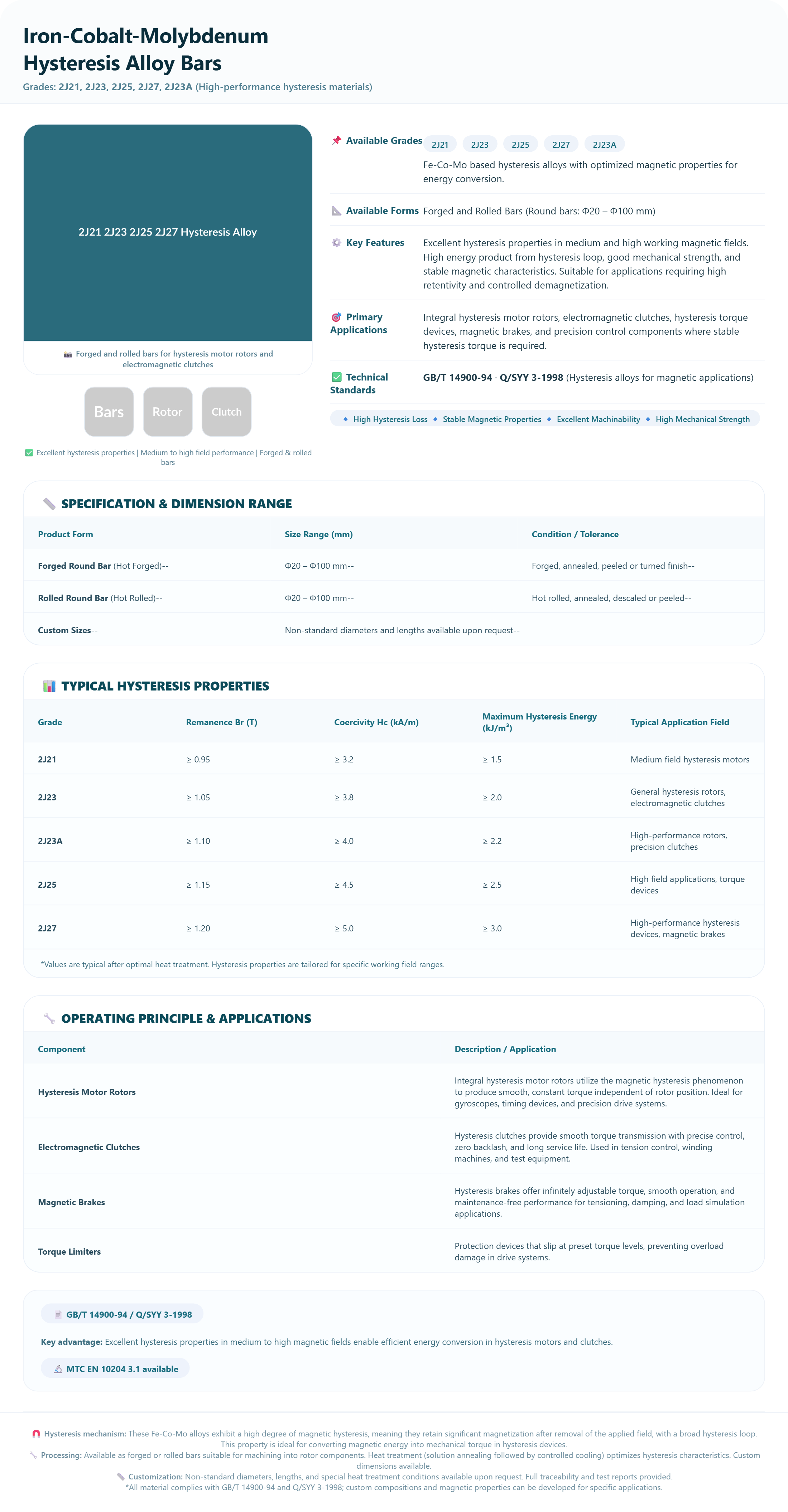
Fe-Co-Mo Hysteresis Alloy Bars | 2J21, 2J23, 2J25 & 2J27
Fe-Co-Mo Hysteresis Alloy Bars for Hysteresis Motors, Electromagnetic Clutches & Brakes
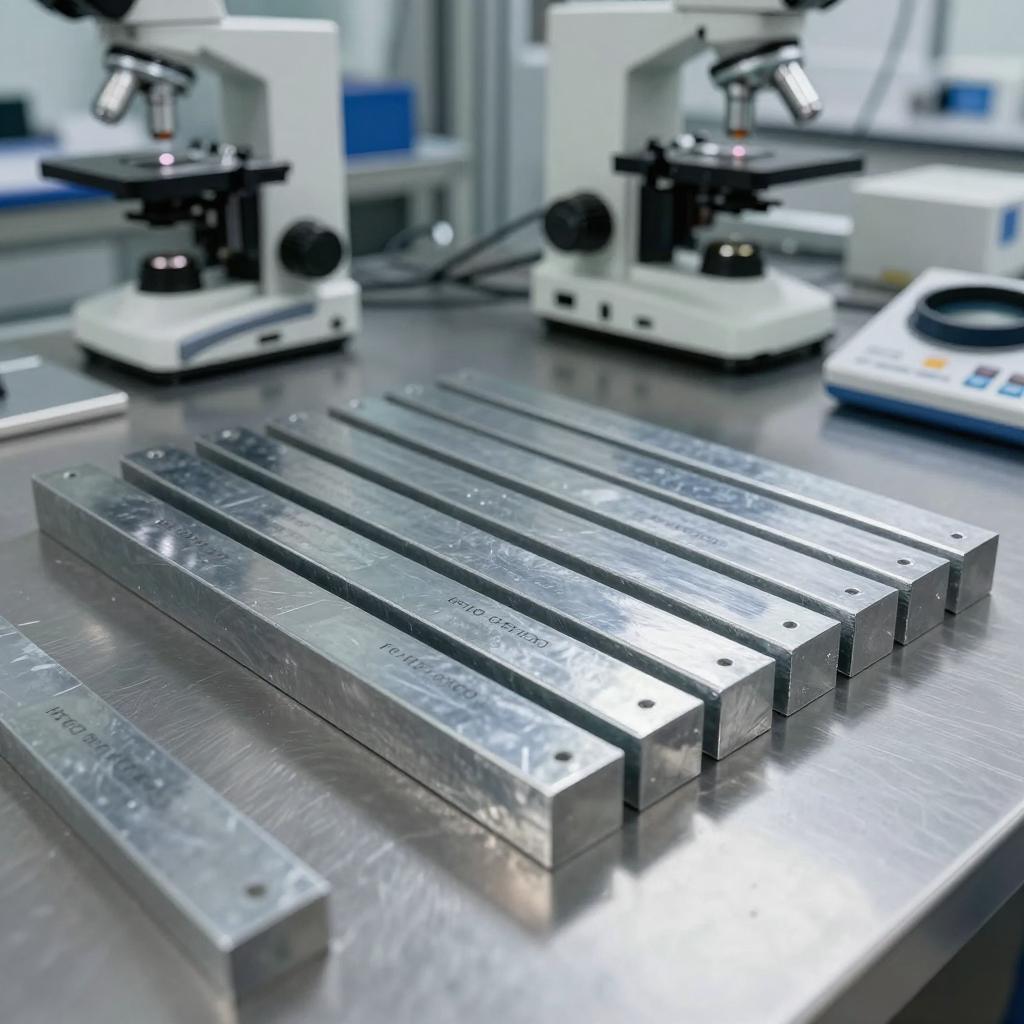
Fe-Co-Mo hysteresis alloy bars are specialized semi-hard magnetic materials designed to provide controlled hysteresis characteristics in medium-to-high working magnetic fields. The main grades include 2J21, 2J23, 2J25 and 2J27, which are specified as Fe-Co-Mo hysteresis alloys in GB/T 14988-2008.
These Fe-Co-Mo alloy bars are primarily used for hysteresis motor rotors, and can also be used in electromagnetic clutches, hysteresis brakes and other magnetic components where a controlled hysteresis response is required.
Hefei Ke Ningman New Energy Materials Technology Co., Ltd. supplies Fe-Co-Mo hysteresis alloy bars according to applicable standards or customer-specific technical requirements. Contact us for grade selection, bar dimensions, magnetic property requirements, heat-treatment requirements and material documentation.
Key Features of Fe-Co-Mo Hysteresis Alloy Bars
Fe-Co-Mo semi-hard magnetic alloy
Available in 2J21, 2J23, 2J25 and 2J27 grades
Designed for favorable hysteresis characteristics
Suitable for medium and high working magnetic fields
Controlled magnetic properties after appropriate heat treatment
Suitable for hysteresis motor rotor applications
Suitable for electromagnetic clutch and brake components
Available as hot-rolled or forged bar according to grade and specification
Custom dimensions and technical requirements can be discussed
Manufactured according to GB/T 14988-2008 or customer specifications
What Is Fe-Co-Mo Hysteresis Alloy?
Fe-Co-Mo hysteresis alloy is an iron-cobalt-molybdenum magnetic alloy developed for applications requiring a stable and controlled hysteresis response.
Unlike conventional soft magnetic alloys, Fe-Co-Mo hysteresis alloys are designed to operate with a useful hysteresis loop and are therefore classified as semi-hard magnetic materials. Their magnetic behavior makes them particularly suitable for components that convert electromagnetic input into controlled mechanical torque or magnetic holding behavior.
The current Chinese national standard GB/T 14988-2008 Hysteresis alloy covers Fe-Co-Mo hysteresis alloys including 2J21, 2J23, 2J25 and 2J27. The standard replaced the former GB/T 14990-1994 standard for iron-cobalt-molybdenum hysteresis alloy hot-rolled or forged bars.
For engineering projects, the final grade should be selected according to the required working magnetic field, hysteresis parameters, rotor design, heat-treatment condition and dimensional requirements.
Fe-Co-Mo Hysteresis Alloy Grades
| Grade | Alloy System | Typical Mo Range | Typical Co Range | Main Application |
|---|---|---|---|---|
| 2J21 | Fe-Co-Mo | 10.5–11.5% | 11.0–13.0% | Hysteresis motor rotors |
| 2J23 | Fe-Co-Mo | 12.5–13.5% | 11.0–13.0% | Hysteresis motor rotors |
| 2J25 | Fe-Co-Mo | 14.5–15.5% | 11.0–13.0% | Hysteresis motor rotors |
| 2J27 | Fe-Co-Mo | 16.5–17.5% | 11.0–13.0% | Hysteresis motor rotors |
The chemical composition ranges above are representative values associated with the Fe-Co-Mo hysteresis alloy grades covered by the relevant standard and technical references. Final chemical composition should be confirmed against the applicable purchasing specification and material test certificate.
Chemical Composition of Fe-Co-Mo Hysteresis Alloys
Representative composition requirements for the principal grades are shown below.
| Element | 2J21 / 2J23 / 2J25 / 2J27 |
|---|---|
| Carbon (C) | ≤ 0.03% |
| Silicon (Si) | ≤ 0.30% |
| Manganese (Mn) | 0.10–0.50% |
| Phosphorus (P) | ≤ 0.025% |
| Sulfur (S) | ≤ 0.025% |
| Cobalt (Co) | 11.0–13.0% |
| Molybdenum (Mo) | Grade dependent |
| Iron (Fe) | Balance |
The molybdenum content varies by grade and is one of the key differences between 2J21, 2J23, 2J25 and 2J27.
For production orders, customers should specify the required grade and applicable standard rather than selecting a composition solely from a general reference table.
Magnetic Properties of Fe-Co-Mo Hysteresis Alloy
The Fe-Co-Mo grades are designed to provide different hysteresis characteristics for different working magnetic fields.
Representative reference values are:
| Grade | Hμ Reference Range | Bμ Reference Range | Pμ, min. | Kμ, min. |
|---|---|---|---|---|
| 2J21 | 9.55–12.73 kA/m | 1.00–1.30 T | 20 kJ/m³ | 0.46 |
| 2J23 | 14.32–17.50 kA/m | 1.00–1.30 T | 30 kJ/m³ | 0.48 |
| 2J25 | 17.50–22.62 kA/m | 0.90–1.20 T | 38 kJ/m³ | 0.50 |
| 2J27 | 24.00–28.80 kA/m | 0.90–1.20 T | 47 kJ/m³ | 0.45 |
These values should be treated as technical reference data rather than a substitute for the final material certificate. Actual magnetic performance depends on grade, material condition, specimen preparation, heat treatment and testing conditions.
For production orders, the required magnetic parameters should be clearly specified in the purchase specification.
Why Choose Fe-Co-Mo Hysteresis Alloy Bars?
1. Favorable Hysteresis Characteristics
Fe-Co-Mo alloys are designed specifically for hysteresis applications rather than simply maximizing magnetic permeability.
This makes them suitable for components where the hysteresis loop and magnetic energy behavior are important design parameters.
2. Suitable for Medium and High Working Magnetic Fields
The different 2J grades provide different hysteresis characteristics, allowing engineers to select an alloy according to the required operating magnetic field.
3. Suitable for Hysteresis Motor Rotors
Fe-Co-Mo hysteresis alloys are specifically covered by GB/T 14988-2008 for applications including hysteresis motor rotors.
The material can be machined or processed into rotor components according to the required design.
4. Heat Treatment Can Influence Magnetic Performance
The hysteresis properties of Fe-Co-Mo alloy bars are evaluated after appropriate heat treatment.
Therefore, alloy grade selection and heat-treatment conditions should be considered together rather than treating chemical composition as the only selection factor.
5. Available in Bar and Forged Forms
Fe-Co-Mo hysteresis alloys are commonly supplied as hot-worked, hot-rolled or forged products depending on the grade, dimensions and purchasing requirements.
Fe-Co-Mo Alloy Bar Specifications
The standard covers hot-forged or hot-rolled Fe-Co-Mo hysteresis alloy products.
Depending on the grade and production requirements, customers can specify:
| Specification | Available by Requirement |
|---|---|
| Alloy grade | 2J21 / 2J23 / 2J25 / 2J27 |
| Product form | Bar / Rod / Forged Bar |
| Diameter | Customized according to requirement |
| Length | Customized according to requirement |
| Delivery condition | Hot rolled / Forged / Other agreed condition |
| Surface condition | According to production requirement |
| Heat treatment | According to grade and magnetic-property requirements |
| Magnetic testing | Available according to specification |
| Dimensional inspection | Available |
| Material documentation | Available according to order requirements |
For non-standard dimensions, please provide your required diameter, length, tolerance and application so that our technical team can confirm feasibility.
Fe-Co-Mo Hysteresis Alloy Bar Manufacturing Process
A controlled manufacturing process is important because hysteresis performance depends not only on chemical composition but also on processing history and heat treatment.
A typical manufacturing route may include:
1. Raw Material Preparation
Selected alloying materials are prepared according to the required Fe-Co-Mo grade.
2. Melting and Alloying
The alloy is melted and alloyed under controlled conditions to achieve the specified chemical composition.
3. Casting
The molten alloy is cast into a suitable intermediate form for subsequent hot working.
4. Hot Rolling or Forging
The material is processed into bar stock through controlled hot rolling or forging.
5. Surface Processing
Depending on the agreed delivery condition, bars may undergo surface conditioning, peeling, turning or other finishing operations.
6. Heat Treatment
Heat treatment is performed according to the applicable grade and required magnetic properties.
7. Magnetic Property Testing
Samples can be tested for the specified hysteresis parameters according to the applicable technical requirements.
8. Dimensional and Surface Inspection
Final bars are checked for diameter, length, straightness and surface condition according to the purchase specification.
9. Packing and Shipment
Finished Fe-Co-Mo alloy bars are protected against mechanical damage and environmental contamination during transportation.
Fe-Co-Mo Hysteresis Alloy for Motor Rotors
One of the most important applications of Fe-Co-Mo hysteresis alloy is the hysteresis motor rotor.
In a hysteresis motor, the rotor material needs to maintain a useful hysteresis response under the motor's working magnetic field. The Fe-Co-Mo alloy system provides different hysteresis characteristics across its 2J21, 2J23, 2J25 and 2J27 grades.
The appropriate grade should therefore be selected based on:
Required operating magnetic field
Rotor geometry
Required hysteresis torque
Magnetic energy requirements
Heat-treatment condition
Operating temperature
Manufacturing dimensions
Required magnetic test parameters
This engineering approach is more reliable than selecting a grade based only on the alloy name.
Applications of Fe-Co-Mo Hysteresis Alloy Bars
Fe-Co-Mo hysteresis alloy bars can be used for:
Hysteresis Motor Rotors
The primary application of Fe-Co-Mo hysteresis alloys is the production of hysteresis motor rotor components.
Electromagnetic Clutches
The controlled hysteresis characteristics can be useful in magnetic clutch designs requiring predictable magnetic behavior.
Hysteresis Brakes
Fe-Co-Mo hysteresis alloys can also be considered for hysteresis brake components where magnetic hysteresis is part of the operating mechanism.
Precision Magnetic Components
Depending on the grade and engineering specification, Fe-Co-Mo alloy can be used in specialized magnetic components requiring controlled hysteresis behavior.
Fe-Co-Mo Hysteresis Alloy vs Soft Magnetic Alloy
Fe-Co-Mo hysteresis alloy should not be confused with conventional soft magnetic alloys.
| Property | Fe-Co-Mo Hysteresis Alloy | Soft Magnetic Alloy |
|---|---|---|
| Magnetic classification | Semi-hard / hysteresis alloy | Soft magnetic material |
| Main design objective | Controlled hysteresis behavior | High permeability / low magnetic loss |
| Typical application | Hysteresis motors, clutches, brakes | Transformers, inductors, magnetic cores |
| Important parameter | Hysteresis characteristics | Permeability, coercivity, core loss |
| Typical grades | 2J21, 2J23, 2J25, 2J27 | Grade dependent |
This distinction is important when selecting material for electromagnetic equipment.
Fe-Co-Mo Hysteresis Alloy vs Fe-Co-V Hysteresis Alloy
Fe-Co-Mo and Fe-Co-V are both hysteresis alloy systems, but they are not interchangeable.
| Feature | Fe-Co-Mo Hysteresis Alloy | Fe-Co-V Hysteresis Alloy |
|---|---|---|
| Main alloying elements | Fe-Co-Mo | Fe-Co-V |
| Typical grades | 2J21, 2J23, 2J25, 2J27 | 2J07, 2J09, 2J10, 2J11, 2J12 |
| Typical product form | Hot-rolled / forged bar | Cold-rolled strip |
| Major application | Hysteresis motor rotors | Hysteresis motor rotors |
| Magnetic field range | Medium / high | Grade dependent |
| Standard | GB/T 14988-2008 | GB/T 14988-2008 |
The applicable product form and grade should therefore be selected according to the rotor design and required magnetic performance.
How to Select the Right Fe-Co-Mo Grade
Choose 2J21 when:
A lower hysteresis field range within the Fe-Co-Mo family is required.
Choose 2J23 when:
A higher hysteresis field range than 2J21 is required.
Choose 2J25 when:
The application requires a higher hysteresis field characteristic.
Choose 2J27 when:
The design requires the highest reference Hμ range among these four Fe-Co-Mo grades.
However, the final selection should always be based on the customer's magnetic-property requirements, motor design and applicable material specification.
Heat Treatment of Fe-Co-Mo Hysteresis Alloy
Heat treatment is a critical part of Fe-Co-Mo hysteresis alloy production because magnetic properties are evaluated after specified thermal processing.
For this reason, customers should provide the following information when requesting a quotation:
Required alloy grade
Required magnetic properties
Heat-treatment condition, if specified
Working magnetic field
Final component geometry
Bar diameter
Bar length
Required surface condition
Required testing standard
If the customer does not have a specific alloy grade, our technical team can recommend a suitable grade based on the required magnetic parameters and application.
Quality Control for Fe-Co-Mo Hysteresis Alloy Bars
For B2B alloy procurement, chemical composition alone is not sufficient.
Quality control should cover:
Chemical Composition
Verification of Fe, Co, Mo, C, Si, Mn, P and S according to the applicable grade specification.
Dimensional Inspection
Inspection of:
Diameter
Length
Straightness
Dimensional tolerance
Surface condition
Magnetic Property Testing
Testing of the required hysteresis parameters according to the applicable standard or customer specification.
Surface Inspection
Checking for cracks, folds, excessive surface defects and other conditions that could affect machining or final component performance.
Material Documentation
Material documentation can be supplied according to the order requirements.
Fe-Co-Mo Hysteresis Alloy Standard
The recommended current reference standard for this product is:
GB/T 14988-2008 — Hysteresis alloy
GB/T 14988-2008 is the current national standard and replaced both GB/T 14988-1994 and GB/T 14990-1994. Its scope includes Fe-Co-Mo hysteresis alloy grades 2J21, 2J23, 2J25 and 2J27 in hot-forged or hot-rolled forms.
When placing an order, customers should specify:
GB/T 14988-2008 + Grade + Dimensions + Delivery Condition + Magnetic Requirements
This provides a clearer purchasing specification than simply stating "Fe-Co-Mo alloy bar."
Custom Fe-Co-Mo Hysteresis Alloy Bars
Hefei Ke Ningman New Energy Materials Technology Co., Ltd. can discuss customized Fe-Co-Mo alloy requirements based on your application and technical specification.
Please provide:
Fe-Co-Mo grade
Bar diameter
Bar length
Quantity
Required delivery condition
Surface requirements
Required hysteresis parameters
Heat-treatment requirements
Applicable standard
Material certificate requirements
If you are developing a new hysteresis motor rotor or magnetic clutch component and are unsure which 2J grade to select, send us your magnetic-property requirements and component dimensions.
Why Choose Hefei Ke Ningman New Energy Materials Technology Co., Ltd.?
For precision alloy procurement, the material specification is only one part of the purchasing decision.
We focus on supplying specialized alloy materials according to defined grades, dimensions, processing requirements and application needs.
Our service can support:
Fe-Co-Mo hysteresis alloy grades
Custom bar dimensions
Technical specification review
Magnetic property requirements
Heat-treatment requirements
Material inspection
Export packaging
Sample and trial-order discussions
Technical documentation according to order requirements
Our team can work with customers to clarify the material grade and technical parameters before production.
Frequently Asked Questions
What is Fe-Co-Mo hysteresis alloy?
Fe-Co-Mo hysteresis alloy is a semi-hard magnetic alloy containing iron, cobalt and molybdenum. It is designed for controlled hysteresis behavior and is mainly used in applications such as hysteresis motor rotors.
What grades of Fe-Co-Mo hysteresis alloy are available?
The main Fe-Co-Mo hysteresis alloy grades covered by GB/T 14988-2008 are 2J21, 2J23, 2J25 and 2J27.
What is Fe-Co-Mo hysteresis alloy used for?
The principal application is hysteresis motor rotors. The material can also be used in electromagnetic clutches, hysteresis brakes and specialized magnetic components.
What is the difference between 2J21, 2J23, 2J25 and 2J27?
The main differences are their molybdenum content and resulting hysteresis characteristics. The grades provide different Hμ and other magnetic-property ranges, allowing engineers to select the material according to the working magnetic field.
Is Fe-Co-Mo hysteresis alloy a permanent magnet?
Fe-Co-Mo hysteresis alloy should be considered a hysteresis/semi-hard magnetic alloy, rather than being treated as a conventional permanent magnet such as NdFeB or SmCo.
What standard covers Fe-Co-Mo hysteresis alloy bars?
The current Chinese national standard is GB/T 14988-2008 Hysteresis alloy, which replaced GB/T 14990-1994 for Fe-Co-Mo hysteresis alloy hot-rolled or forged bars.
Can Fe-Co-Mo alloy bars be customized?
Yes. Customized dimensions and technical requirements can be discussed. Customers should provide the required grade, diameter, length, quantity, magnetic properties and delivery condition.
How do I choose the correct Fe-Co-Mo grade?
Grade selection should be based on the required hysteresis characteristics, working magnetic field, rotor design, heat treatment and applicable technical specification rather than alloy composition alone.
Request a Quote for Fe-Co-Mo Hysteresis Alloy Bars
Looking for Fe-Co-Mo hysteresis alloy bars in 2J21, 2J23, 2J25 or 2J27?
Send us your required:
Grade
Diameter
Length
Quantity
Magnetic properties
Heat-treatment requirements
Standard
Material certificate requirements
Our technical team can review your requirements and provide a suitable Fe-Co-Mo hysteresis alloy solution.
Contact Hefei Ke Ningman New Energy Materials Technology Co., Ltd. for Fe-Co-Mo hysteresis alloy bars for hysteresis motors, electromagnetic clutches and magnetic components.