



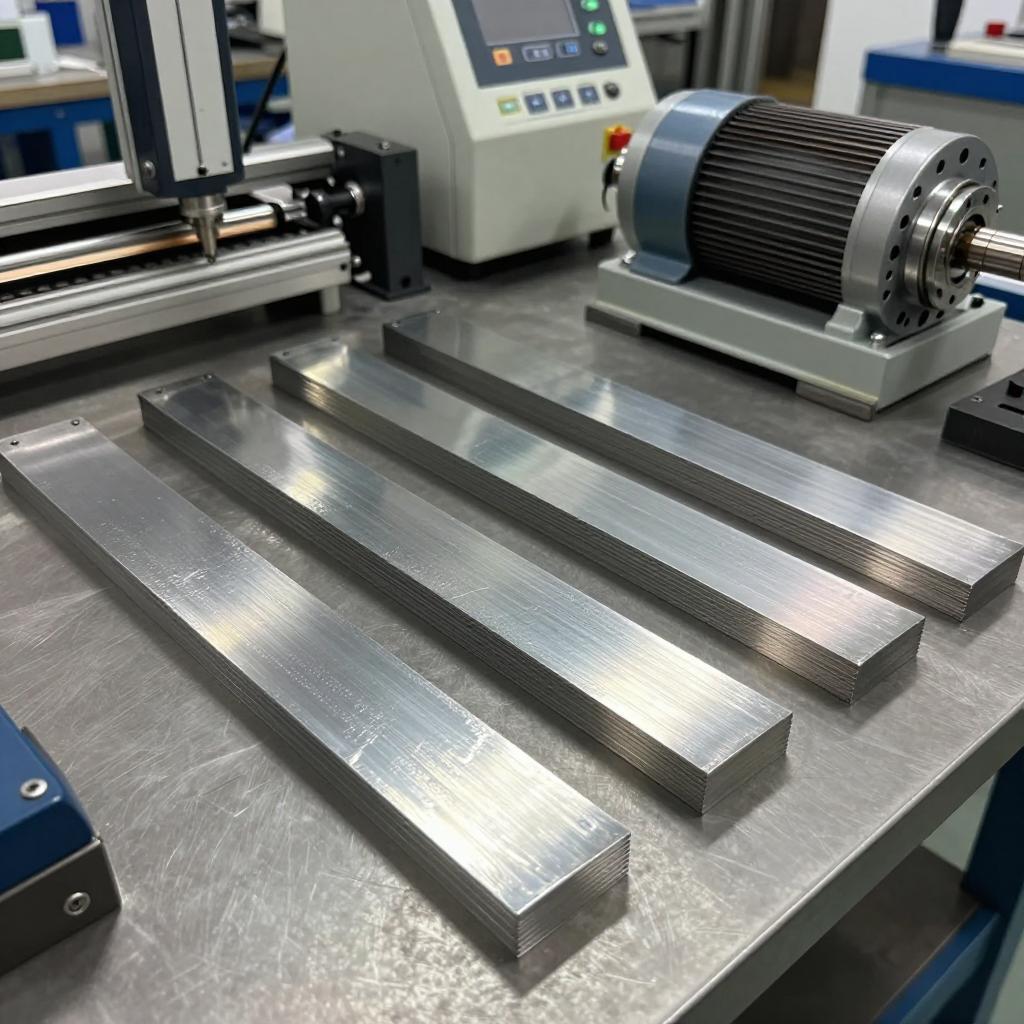
Previous
Next
Fe-Co-V Hysteresis Alloy Strip | 2J07, 2J09, 2J10, 2J11
- Fe-Co-V hysteresis alloy strip
- Fe-Co-V hysteresis alloy
- Fe-Co-V magnetic hysteresis alloy
- hysteresis alloy strip
- 2J07 hysteresis alloy
- 2J09 hysteresis alloy
- 2J10 hysteresis alloy
- hysteresis motor rotor material
Description
Iron-Cobalt-Vanadium hysteresis alloy strip (grades 2J04, 2J07, 2J09, 2J10, 2J11) offers optimized hysteresis properties for high-efficiency motor rotors. Adjustable working field, excellent formability. GB/T 14988-94 compliant.
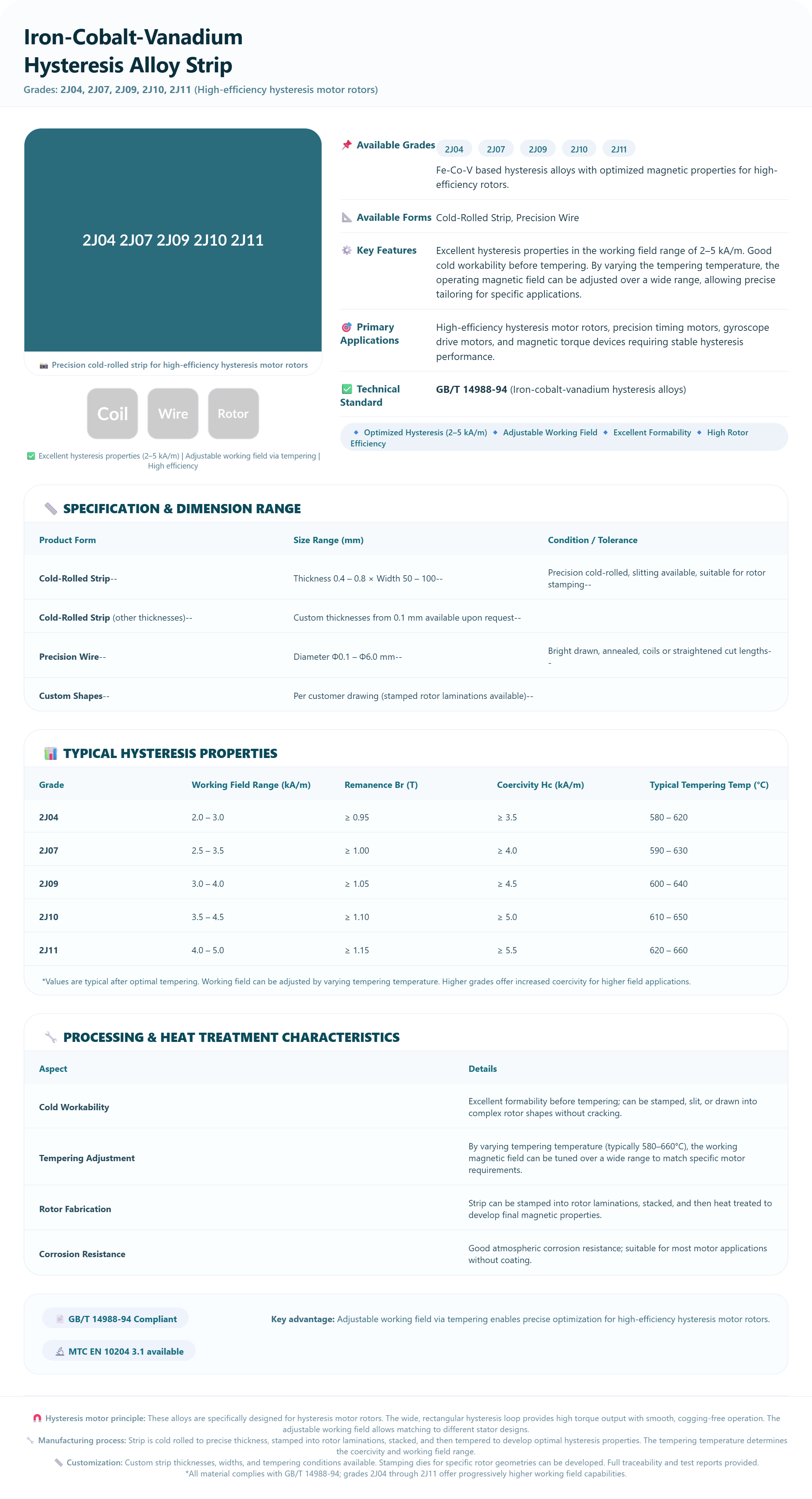
Fe-Co-V Hysteresis Alloy Strip | 2J07, 2J09, 2J10, 2J11 & 2J12
Product Overview
Fe-Co-V hysteresis alloy strip is a semi-hard magnetic alloy material designed for applications requiring stable hysteresis characteristics, controlled magnetic properties and good formability before final heat treatment.
The Fe-Co-V hysteresis alloy family includes grades such as 2J07, 2J09, 2J10, 2J11 and 2J12. These alloys are primarily used for manufacturing hysteresis motor rotors, hysteresis brakes and other precision magnetic components.
Fe-Co-V hysteresis alloy strip offers a useful combination of magnetic hysteresis performance and mechanical workability. Its magnetic working field can be adjusted through appropriate heat treatment, allowing the material to be selected for different hysteresis motor designs and magnetic operating conditions.
Hefei Ke Ningman New Energy Materials Technology Co., Ltd. supplies Fe-Co-V hysteresis alloy strip in customized dimensions and grades according to customer drawings, magnetic requirements and applicable material standards.
Key Features of Fe-Co-V Hysteresis Alloy Strip
Fe-Co-V semi-hard magnetic alloy
2J07, 2J09, 2J10, 2J11 and 2J12 grades available
Excellent hysteresis characteristics
Suitable for medium and high working magnetic fields
Good deformability before final tempering
Suitable for cold-rolled strip applications
Magnetic working field can be adjusted through heat treatment
Suitable for hysteresis motor rotors
Suitable for hysteresis brakes
Suitable for precision magnetic components
Good dimensional control in strip form
Customized thickness and width available
Manufactured according to applicable technical requirements
What Is Fe-Co-V Hysteresis Alloy?
Fe-Co-V hysteresis alloy is a semi-hard magnetic material based on iron, cobalt and vanadium.
Unlike soft magnetic alloys that are designed for very low coercivity and easy magnetization reversal, hysteresis alloys are designed to maintain a controlled magnetic hysteresis loop. This makes them useful for applications where the magnetic material itself contributes to torque production or magnetic energy conversion.
Fe-Co-V hysteresis alloys are particularly important for hysteresis motors, where the rotor material needs suitable coercivity, remanence and magnetic energy characteristics to produce stable torque.
The material can be processed into thin strip and other forms, then heat treated to obtain the required magnetic characteristics.
Fe-Co-V Hysteresis Alloy Grades
The Fe-Co-V hysteresis alloy family includes several grades with different cobalt and vanadium contents and different hysteresis characteristics.
Common grades include:
| Grade | Co Content | V Content | Typical Magnetic Characteristics |
|---|---|---|---|
| 2J07 | 51–53% | 6.5–7.5% | Lower working field range |
| 2J09 | 51–53% | 8.5–9.5% | Medium working field range |
| 2J10 | 51–53% | 9.5–10.5% | Higher working field range |
| 2J11 | 51–53% | 10.5–11.5% | Higher hysteresis field |
| 2J12 | 51–53% | 11.5–12.5% | Higher hysteresis field |
2J04 is also part of the broader hysteresis-alloy family, but it is an Fe-Co-Ni-V composition rather than a simple Fe-Co-V grade. The current GB/T 14988-2008 standard identifies 2J07, 2J09, 2J10, 2J11 and 2J12 as Fe-Co-V hysteresis alloys, while 2J04 belongs to the Fe-Co-Ni-V group.
Fe-Co-V Hysteresis Alloy Chemical Composition
Typical composition ranges for the Fe-Co-V hysteresis alloy grades are shown below.
| Element | 2J07 | 2J09 | 2J10 | 2J11 | 2J12 |
|---|---|---|---|---|---|
| C | ≤0.12% | ≤0.12% | ≤0.12% | ≤0.12% | ≤0.12% |
| Si | ≤0.70% | ≤0.70% | ≤0.70% | ≤0.70% | ≤0.70% |
| Mn | ≤0.70% | ≤0.70% | ≤0.70% | ≤0.70% | ≤0.70% |
| P | ≤0.025% | ≤0.025% | ≤0.025% | ≤0.025% | ≤0.025% |
| S | ≤0.020% | ≤0.020% | ≤0.020% | ≤0.020% | ≤0.020% |
| Ni | ≤0.70% | ≤0.70% | ≤0.70% | ≤0.70% | ≤0.70% |
| Co | 51–53% | 51–53% | 51–53% | 51–53% | 51–53% |
| V | 6.5–7.5% | 8.5–9.5% | 9.5–10.5% | 10.5–11.5% | 11.5–12.5% |
| Fe | Balance | Balance | Balance | Balance | Balance |
The final chemical composition should always be confirmed against the applicable material certificate and purchase specification.
Magnetic Properties of Fe-Co-V Hysteresis Alloy
The magnetic properties of Fe-Co-V hysteresis alloys vary according to grade and heat-treatment condition.
Typical reference characteristics for cold-rolled strip after heat treatment include:
| Grade | Hμ (kA/m) | Bμ (T) | Pμ (kJ/m³) | Kμ |
|---|---|---|---|---|
| 2J07 | 6.37–9.55 | 1.00–1.30 | ≥19 | ≥0.61 |
| 2J09 | 8.75–11.94 | 0.90–1.25 | ≥22 | ≥0.59 |
| 2J10 | 14.32–18.30 | 0.90–1.20 | ≥30 | ≥0.58 |
| 2J11 | 15.92–20.69 | 0.90–1.20 | ≥35 | ≥0.57 |
| 2J12 | 19.90–27.90 | 0.80–1.10 | ≥45 | ≥0.56 |
These values are reference data for the corresponding alloy system and should not be treated as a substitute for the actual inspection certificate of a specific production batch. Public technical references report these characteristic ranges for Fe-Co-V hysteresis alloys and identify their use in hysteresis motor rotors.
Why Choose Fe-Co-V Hysteresis Alloy Strip?
Excellent Hysteresis Characteristics
The main reason to select Fe-Co-V alloy is its controlled hysteresis behavior.
The alloy is designed to provide a suitable magnetic hysteresis loop for applications in which the material must retain magnetization and produce useful magnetic torque.
This makes it especially suitable for:
Hysteresis motor rotors
Hysteresis brakes
Magnetic torque components
Precision magnetic assemblies
Adjustable Working Magnetic Field
One of the important characteristics of Fe-Co-V hysteresis alloys is that their working magnetic field can be adjusted through controlled heat treatment.
Changing the tempering conditions can modify the final magnetic properties, allowing manufacturers to match the alloy to different motor and magnetic-system requirements.
This is particularly useful when designing hysteresis motors for different operating conditions.
Good Formability Before Tempering
Fe-Co-V hysteresis alloys have good processing characteristics before final tempering.
Depending on the product form and manufacturing route, the material can undergo:
Rolling
Cold rolling
Drawing
Forming
Cutting
Other precision processing operations
This allows thin strip and precision magnetic components to be manufactured before the final magnetic heat treatment.
Thin Strip Manufacturing
Fe-Co-V hysteresis alloy is well suited to thin strip products.
Thin strip can provide advantages for:
Rotor manufacturing
Laminated magnetic components
Precision magnetic assemblies
Narrow magnetic sections
Compact motor designs
The actual available thickness and width should be confirmed according to the production capability and customer drawing.
Fe-Co-V Hysteresis Alloy Strip Specifications
We can supply Fe-Co-V hysteresis alloy strip according to the required grade, dimensions and technical specification.
Typical specification parameters include:
| Item | Specification |
|---|---|
| Material | Fe-Co-V hysteresis alloy |
| Grades | 2J07, 2J09, 2J10, 2J11, 2J12 |
| Product Form | Cold-rolled strip |
| Thickness | Customized |
| Width | Customized |
| Length | Coil or cut length |
| Surface | According to production requirement |
| Magnetic Condition | According to specified heat treatment |
| Dimensional Tolerance | According to applicable standard/drawing |
| Chemical Composition | Grade dependent |
| Magnetic Properties | Grade and heat-treatment dependent |
| Packaging | Export or customer-specified packaging |
For precision motor components, customers should provide the required strip thickness, width, tolerance, grade and magnetic specification.
Fe-Co-V Hysteresis Alloy Strip Manufacturing Process
1. Raw Material Preparation
Iron, cobalt, vanadium and other alloying elements are prepared according to the selected Fe-Co-V grade.
Chemical composition is controlled to ensure consistency between production batches.
2. Melting
The raw materials are melted using a controlled metallurgical process.
The objective is to achieve the required alloy composition and minimize unwanted impurities.
3. Casting
The molten alloy is cast into an appropriate intermediate form for subsequent processing.
4. Hot Working
The material is hot rolled or otherwise hot worked to reduce the cross-section and prepare it for subsequent cold processing.
5. Cold Rolling
Cold rolling is used to obtain the required:
Strip thickness
Strip width
Surface quality
Dimensional accuracy
Cold working also affects the material's final magnetic behavior.
6. Intermediate Annealing
Where required, intermediate heat treatment may be used to control the material structure and support further cold working.
7. Final Heat Treatment / Tempering
Controlled heat treatment is a critical step in Fe-Co-V hysteresis alloy production.
The final hysteresis characteristics depend on the alloy composition, degree of cold working and heat-treatment conditions.
8. Slitting and Cutting
The strip can be slit or cut according to the customer's required dimensions.
9. Magnetic Testing
Final magnetic testing may include:
Hysteresis loop testing
Hμ
Bμ
Pμ
Kμ
Coercivity
Residual magnetic induction
10. Dimensional and Surface Inspection
The finished strip is inspected for:
Thickness
Width
Flatness
Surface quality
Dimensional tolerance
Fe-Co-V Hysteresis Alloy for Hysteresis Motor Rotors
The primary application of Fe-Co-V hysteresis alloy strip is the manufacture of hysteresis motor rotors.
A hysteresis motor operates using the magnetic hysteresis characteristics of the rotor material.
When the rotating magnetic field of the stator interacts with the rotor, the hysteresis characteristics of the rotor material generate torque.
For this reason, rotor material selection directly influences:
Starting behavior
Torque
Synchronization
Magnetic losses
Operating efficiency
Temperature behavior
Overall motor performance
Fe-Co-V hysteresis alloys are therefore selected when the rotor requires a controlled hysteresis loop and suitable magnetic energy characteristics.
The current GB/T 14988-2008 standard specifically covers hysteresis alloys used for hysteresis motor rotors and hysteresis brakes.
Fe-Co-V Hysteresis Alloy Applications
Hysteresis Motor Rotors
This is the primary application.
Fe-Co-V alloy strip can be used to manufacture rotor components for hysteresis motors where stable hysteresis properties are required.
Hysteresis Brakes
The material can also be used in magnetic braking systems where controlled hysteresis behavior is required.
Precision Magnetic Components
Fe-Co-V alloy can be used in selected:
Magnetic mechanisms
Precision instruments
Magnetic actuators
Specialized motor components
Magnetic Switching and Display Components
Historically, Fe-Co-V hysteresis alloys have also been used in certain magnetic switching and display mechanisms.
Aerospace and Instrumentation
Selected hysteresis alloy grades may be considered for precision magnetic components used in aerospace instrumentation and automation equipment.
Fe-Co-V Hysteresis Alloy vs Permanent Magnet Alloys
It is important to distinguish hysteresis alloys from conventional high-energy permanent magnet materials.
| Property | Fe-Co-V Hysteresis Alloy | NdFeB | SmCo |
|---|---|---|---|
| Primary Function | Controlled hysteresis behavior | High magnetic energy | High-temperature permanent magnet |
| Material Type | Semi-hard magnetic alloy | Hard permanent magnet | Hard permanent magnet |
| Typical Form | Strip, wire, etc. | Sintered/special forms | Sintered |
| Main Application | Hysteresis motors/brakes | Motors, sensors, actuators | High-temperature motors/sensors |
| Hysteresis Loop | Deliberately controlled | High coercivity | High coercivity |
| Mechanical Processing | Good before final treatment | Relatively difficult | Brittle after sintering |
| Key Advantage | Tunable hysteresis behavior | Very high energy density | High-temperature stability |
Therefore, Fe-Co-V hysteresis alloy should not be selected simply because it is a “strong magnet.” Its main advantage is the controlled hysteresis behavior required by specific magnetic devices.
How to Choose the Right Fe-Co-V Grade?
Different Fe-Co-V grades provide different hysteresis characteristics.
When selecting a grade, consider:
Required working magnetic field
Required hysteresis loop
Required Bμ
Required Hμ
Required magnetic energy parameter
Rotor design
Operating speed
Operating temperature
Strip thickness
Strip width
Heat-treatment requirements
Required dimensional tolerance
For example, a higher-grade number does not automatically mean that the material is “better.” The correct grade is the one whose magnetic characteristics match the motor's magnetic circuit and operating field.
Fe-Co-V Hysteresis Alloy Heat Treatment
Heat treatment is one of the most important factors affecting the final magnetic characteristics of Fe-Co-V hysteresis alloys.
The final properties can be influenced by:
Heating temperature
Holding time
Cooling method
Degree of cold deformation
Alloy composition
Tempering temperature
Previous processing history
Public technical data for Fe-Co-V hysteresis alloys indicates that different grades use different tempering temperature ranges, and changing the tempering temperature can alter the working magnetic field.
For production orders, the final heat-treatment condition should therefore be agreed according to the required magnetic specification rather than selected solely by alloy grade.
Quality Control for Fe-Co-V Hysteresis Alloy Strip
Quality control is important because small variations in processing can affect both dimensional accuracy and magnetic hysteresis characteristics.
Depending on the customer specification, inspection may include:
Chemical Composition Testing
Verification of:
C
Si
Mn
P
S
Ni
Co
V
Fe
Dimensional Inspection
Thickness
Width
Length
Flatness
Dimensional tolerance
Surface Inspection
Checking for:
Cracks
Scratches
Oxidation
Edge defects
Surface irregularities
Magnetic Testing
Depending on requirements:
Hμ
Bμ
Pμ
Kμ
Hysteresis loop
Coercivity
Residual magnetic induction
Heat-Treatment Records
Production records can be maintained for critical heat-treatment processes according to the agreed quality-control procedure.
Fe-Co-V Hysteresis Alloy Standards
The current Chinese national standard for hysteresis alloys is GB/T 14988-2008 Hysteresis Alloy.
The standard became effective on May 1, 2009 and replaced GB/T 14988-1994 and GB/T 14990-1994. It covers Fe-Co-V hysteresis alloy grades including 2J07, 2J09, 2J10, 2J11 and 2J12, as well as other hysteresis alloy systems.
Important SEO/technical correction
Your current product page says:
“GB/T 14988-94 compliant.”
I recommend changing this to:
Manufactured according to GB/T 14988-2008 or customer-specific technical specifications.
Only retain “GB/T 14988-1994” if a customer's drawing or historical specification specifically requires the superseded standard.
This is important because publishing an outdated standard as the current compliance standard can reduce technical credibility with professional B2B buyers.
Custom Fe-Co-V Hysteresis Alloy Strip
We support customized Fe-Co-V hysteresis alloy strip according to customer requirements.
Customization can include:
Alloy grade
Strip thickness
Strip width
Coil length
Cut length
Dimensional tolerance
Surface condition
Heat-treatment condition
Magnetic properties
Packaging requirements
Customers can provide:
Technical drawing
Existing material specification
Motor rotor design requirements
Required magnetic field
Required hysteresis characteristics
Our technical team can evaluate the material grade and manufacturing condition according to the application.
Why Choose Hefei Ke Ningman New Energy Materials Technology Co., Ltd.?
Hefei Ke Ningman New Energy Materials Technology Co., Ltd. supplies specialty magnetic alloys and functional metal materials for industrial applications.
For Fe-Co-V hysteresis alloy strip projects, we can support customers with:
Fe-Co-V material selection
2J07 / 2J09 / 2J10 / 2J11 / 2J12 grades
Customized strip dimensions
Magnetic property requirements
Heat-treatment requirements
Dimensional inspection
Magnetic testing
Technical documentation
Bulk production
Export packaging
We focus on matching the alloy grade, strip dimensions and magnetic characteristics to the customer's actual motor or magnetic-system requirements.
Frequently Asked Questions About Fe-Co-V Hysteresis Alloy Strip
What is Fe-Co-V hysteresis alloy?
Fe-Co-V hysteresis alloy is a semi-hard magnetic alloy based on iron, cobalt and vanadium. It is designed to provide controlled magnetic hysteresis characteristics for applications such as hysteresis motor rotors and hysteresis brakes.
What grades of Fe-Co-V hysteresis alloy are available?
Common Fe-Co-V grades include 2J07, 2J09, 2J10, 2J11 and 2J12.
What is Fe-Co-V hysteresis alloy used for?
Its main applications include hysteresis motor rotors and hysteresis brakes. It can also be used in selected precision magnetic components and specialized magnetic devices.
Why is Fe-Co-V used for hysteresis motors?
The alloy provides controlled hysteresis characteristics that allow the rotor to generate useful magnetic torque when interacting with the rotating magnetic field of the stator.
Can Fe-Co-V hysteresis alloy be supplied as strip?
Yes. Fe-Co-V hysteresis alloy is commonly supplied as cold-rolled strip for applications requiring thin and accurately controlled magnetic material.
Can Fe-Co-V alloy be heat treated?
Yes. Heat treatment and tempering are important for achieving the required magnetic hysteresis characteristics.
Can the working magnetic field be adjusted?
Yes. The final magnetic characteristics can be influenced by controlled heat treatment, including tempering conditions.
What is the difference between Fe-Co-V hysteresis alloy and NdFeB?
Fe-Co-V hysteresis alloy is selected primarily for controlled hysteresis behavior, while NdFeB is designed for very high coercivity and high magnetic energy density.
What is the current standard for Fe-Co-V hysteresis alloy?
The current Chinese national standard is GB/T 14988-2008 Hysteresis Alloy, which replaced GB/T 14988-1994 and GB/T 14990-1994.
Which Fe-Co-V grade should I choose?
The appropriate grade depends on the required working magnetic field, hysteresis characteristics, rotor design, operating temperature and required magnetic properties. Customers should provide the motor or magnetic-system requirements for grade selection.
Request a Fe-Co-V Hysteresis Alloy Strip Quote
Looking for a reliable Fe-Co-V hysteresis alloy strip manufacturer or supplier?
Send us your required alloy grade, strip thickness, width, magnetic properties, heat-treatment requirements and quantity.
Hefei Ke Ningman New Energy Materials Technology Co., Ltd. can evaluate your application and provide a customized Fe-Co-V hysteresis alloy strip solution for hysteresis motors, hysteresis brakes and precision magnetic components.
Contact us today for a Fe-Co-V hysteresis alloy quotation.