



Previous
Next
2J31 Fe-Co-V Permanent Magnet Alloy | High Saturation Induction
- 2J31 Fe-Co-V permanent magnet alloy
- 2J31 permanent magnet alloy
- 2J31 Fe-Co-V alloy
- Fe-Co-V permanent magnet
- 2J31 magnet alloy
- 2J31 permanent magnet wire
- 2J31 permanent magnet strip
- Fe-Co-V permanent magnet alloy
- 2J31 alloy supplier
Description
2J31 Fe-Co-V permanent magnet alloy (Remalloy type) offers high saturation induction (≥2.3T), stable magnetic properties, and excellent formability. Ideal for small-section magnets, sensors, and micro-motors. GB/T 14989-94 compliant.
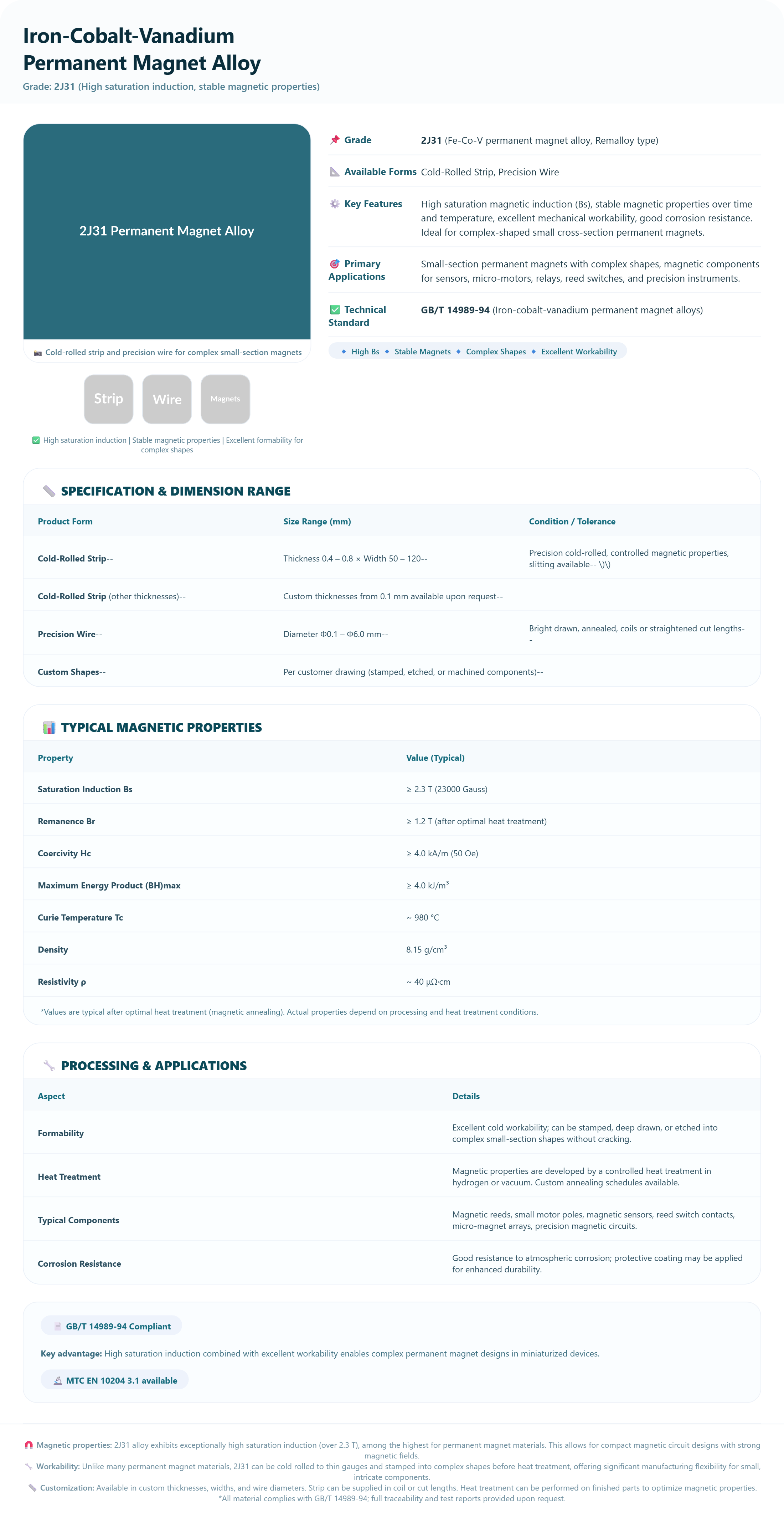
2J31 Fe-Co-V Permanent Magnet Alloy | High Saturation Induction & Stable Magnetic Properties
Product Overview
2J31 Fe-Co-V permanent magnet alloy is an iron-cobalt-vanadium permanent magnetic alloy known for its high saturation magnetic induction, stable magnetic properties and good mechanical workability. It is designed for permanent magnetic components where high magnetic induction and the ability to manufacture small or relatively complex shapes are important.
2J31 is a Fe-Co-V permanent magnet alloy covered by the GB/T 14989 standard. According to the standard material data, 2J31 contains approximately 51–53% cobalt and 10.8–11.7% vanadium, with iron as the balance and controlled amounts of other elements.
Hefei Ke Ningman New Energy Materials Technology Co., Ltd. supplies 2J31 permanent magnet alloy for precision magnetic components, small-section permanent magnets, sensors, micro-motors and other applications requiring stable magnetic performance and good processing characteristics.
Key Features of 2J31 Permanent Magnet Alloy
Fe-Co-V permanent magnet alloy
2J31 grade according to GB/T 14989
High saturation magnetic induction
Stable permanent magnetic properties
Good mechanical workability
Suitable for small-section magnetic components
Suitable for wire and strip applications
Suitable for precision magnetic components
Can be processed into thin and complex-shaped components
Suitable for sensors and small magnetic devices
Available in customized dimensions and forms
Suitable for industrial and precision magnetic applications
What Is 2J31 Fe-Co-V Permanent Magnet Alloy?
2J31 is an iron-cobalt-vanadium permanent magnet alloy belonging to the Fe-Co-V family of hard magnetic materials.
The alloy combines the high magnetic induction characteristics of Fe-Co based materials with controlled vanadium additions that contribute to its magnetic and processing characteristics.
2J31 is particularly useful where a permanent magnet needs to provide:
High magnetic induction
Stable magnetic properties
Small cross-sectional dimensions
Good mechanical processing characteristics
Controlled dimensions
Customized geometry
The alloy can be manufactured into different product forms, including wire and strip, depending on the required dimensions and applicable manufacturing standard.
2J31 Chemical Composition
The chemical composition of 2J31 is controlled according to the applicable material specification.
A typical GB/T 14989-1994 composition is shown below:
| Element | 2J31 Requirement |
|---|---|
| C | ≤0.12% |
| Mn | ≤0.70% |
| Si | ≤0.70% |
| P | ≤0.025% |
| S | ≤0.020% |
| Ni | ≤0.70% |
| Co | 51–53% |
| V | 10.8–11.7% |
| Fe | Balance |
The final chemical composition should be confirmed against the applicable material certificate and agreed customer specification. GB/T 14989-1994 provides the standardized composition requirements for 2J31, 2J32 and 2J33 Fe-Co-V permanent magnet alloys.
2J31 Magnetic Properties
The magnetic properties of 2J31 depend on product form, processing condition, heat treatment and testing method.
Important magnetic parameters include:
Saturation magnetic induction
Residual magnetic induction (Br)
Coercive force (Hc)
Magnetic energy product
Demagnetization characteristics
Magnetic stability
The published GB/T 14989-1994 data distinguishes magnetic requirements for 2J31 wire and strip. For 2J31, the standard data lists a minimum coercive force of approximately 23.88 kA/m for wire and 17.51 kA/m for strip, with residual magnetic induction of at least 1.00 T for both forms.
For production orders, the final magnetic properties should be confirmed according to the actual product form, heat-treatment condition, testing method and customer specification.
2J31 Technical Specifications
| Property | 2J31 Fe-Co-V Permanent Magnet Alloy |
|---|---|
| Material | Fe-Co-V |
| Grade | 2J31 |
| Material Type | Permanent magnet alloy |
| Standard | GB/T 14989 |
| Cobalt | 51–53% |
| Vanadium | 10.8–11.7% |
| Iron | Balance |
| Saturation Magnetic Induction | High |
| Residual Magnetic Induction (Br) | ≥1.00 T according to referenced standard data |
| Coercive Force | Product-form dependent |
| Product Forms | Wire, strip and customized forms |
| Manufacturing | Melting, hot working, cold drawing/rolling and heat treatment |
| Surface Condition | According to product specification |
| Dimensions | Customized according to requirement |
| Tolerance | According to applicable standard/customer drawing |
Why Choose 2J31 Fe-Co-V Permanent Magnet Alloy?
High Saturation Magnetic Induction
One of the key characteristics of 2J31 is its high saturation magnetic induction.
The high magnetic induction capability makes 2J31 suitable for applications where a relatively strong magnetic field is required within a compact magnetic component.
This is particularly relevant for:
Small permanent magnets
Magnetic sensors
Micro-motors
Precision instruments
Small-section magnetic components
The exact saturation value should be specified according to the applicable test method and material condition.
Stable Magnetic Properties
2J31 is designed for permanent magnetic applications requiring stable magnetic performance.
Proper control of alloy composition, deformation and heat treatment is important for achieving consistent magnetic characteristics.
For precision applications, we recommend evaluating:
Residual induction
Coercive force
Operating temperature
Magnetic aging
Dimensional stability
Demagnetization behavior
Good Mechanical Workability
Compared with many brittle permanent magnet materials, Fe-Co-V permanent magnet alloys can be processed into relatively small and complex magnetic components.
2J31 is available in forms such as:
Cold-drawn wire
Cold-rolled strip
Small-section material
Customized magnetic components
This makes the alloy suitable for precision components where dimensional control and magnetic performance must be considered together.
Suitable for Small-Section Magnetic Components
2J31 is particularly suitable for applications requiring small cross-sectional permanent magnetic components.
Typical requirements may include:
Small diameter
Thin strip
Narrow magnetic section
Precision dimensions
Complex geometry
This characteristic makes 2J31 attractive for sensors, small motors and precision magnetic mechanisms.
2J31 Permanent Magnet Alloy Manufacturing Process
The manufacturing process is controlled to achieve the required chemical composition, dimensional accuracy and magnetic properties.
1. Raw Material Preparation
Iron, cobalt, vanadium and other controlled alloying elements are prepared according to the required composition.
2. Melting
The alloy is melted under controlled conditions to obtain the required chemical composition and material uniformity.
GB/T 14989-1994 specifies that the alloy can be melted using vacuum induction melting, non-vacuum induction melting or another method capable of meeting the standard requirements.
3. Casting and Homogenization
After melting, the alloy is cast and may undergo appropriate homogenization or subsequent thermal processing before mechanical working.
4. Hot Working
The material can be hot worked into an intermediate form suitable for further processing.
5. Cold Rolling or Cold Drawing
Depending on the final product, cold rolling or drawing can be used to obtain the required dimensions and surface condition.
Typical products include:
2J31 cold-drawn wire
2J31 cold-rolled strip
Precision small-section material
GB/T 14989 specifically provides dimensional requirements for 2J31 cold-drawn wire and cold-rolled strip.
6. Heat Treatment
Controlled heat treatment is used to develop the required magnetic properties.
The final magnetic performance depends on the combination of alloy composition, deformation and thermal processing.
7. Precision Processing
Where required, the material can be processed according to the final component geometry.
8. Magnetic Testing
Final magnetic inspection can include:
Residual magnetic induction
Coercive force
Magnetic hysteresis characteristics
Other agreed magnetic parameters
9. Dimensional Inspection
Final products are inspected according to applicable dimensional tolerances and customer drawings.
2J31 Wire
2J31 permanent magnet wire is suitable for small-section magnetic components where controlled diameter, magnetic properties and mechanical processing are important.
Typical applications may include:
Small magnetic components
Precision sensors
Miniature magnetic mechanisms
Micro-motors
Electromagnetic components
Cold-drawn wire dimensions and tolerances can be specified according to GB/T 14989 and customer requirements.
For customized wire requirements, customers can provide:
Diameter
Length
Tolerance
Magnetic properties
Surface condition
Quantity
2J31 Permanent Magnet Strip
2J31 cold-rolled strip is suitable for thin and narrow magnetic components.
Applications may include:
Thin magnetic elements
Sensors
Small magnetic mechanisms
Precision instruments
Miniature motors
Strip can be specified according to:
Thickness
Width
Length
Dimensional tolerance
Magnetic performance
Surface condition
The applicable standard provides dimensional and magnetic requirements for 2J31 cold-rolled strip.
2J31 vs FeCrCo Permanent Magnet Alloy
Both 2J31 Fe-Co-V and Fe-Cr-Co are ductile or workable permanent magnet alloy systems, but their material characteristics and applications are different.
| Property | 2J31 Fe-Co-V | FeCrCo |
|---|---|---|
| Main Alloy System | Fe-Co-V | Fe-Cr-Co |
| Permanent Magnet | Yes | Yes |
| Magnetic Induction | High | Grade dependent |
| Mechanical Workability | Good | Excellent |
| Thin Strip / Wire | Suitable | Excellent |
| Complex Shapes | Suitable | Excellent |
| Rare Earth | No | No |
| Typical Advantage | High magnetic induction | Ductility + manufacturability |
| Typical Applications | Small magnetic components, sensors, micro-motors | Complex-shaped permanent magnets, sensors, instruments |
When selecting between the two materials, the final decision should be based on magnetic requirements, geometry, manufacturing process, temperature conditions and cost.
2J31 vs SmCo Permanent Magnets
2J31 and SmCo serve different application requirements.
| Property | 2J31 Fe-Co-V | SmCo |
|---|---|---|
| Material System | Fe-Co-V | Samarium-Cobalt |
| Rare Earth | No | Yes |
| Magnetic Strength | High, grade dependent | High to very high |
| High Temperature Capability | Application dependent | Excellent |
| Corrosion Resistance | Application dependent | Excellent |
| Mechanical Workability | Good | More limited after sintering |
| Small Wire / Strip | Suitable | More difficult |
| Complex Geometry | Suitable | Usually requires precision grinding |
| Typical Advantage | Workability and magnetic induction | High-temperature magnetic stability |
2J31 can be particularly attractive when the product requires a wrought Fe-Co-V material in wire or strip form, while SmCo is often selected when high-temperature stability and high coercivity are the primary requirements.
2J31 Permanent Magnet Alloy Applications
Magnetic Sensors
2J31 can be used in selected sensor applications requiring stable magnetic characteristics and small magnetic components.
Potential applications include:
Position sensing
Magnetic switching
Precision sensors
Magnetic detection systems
Micro-Motors
2J31 can be considered for selected miniature motor and actuator applications where small-section permanent magnetic components are required.
Precision Instruments
Applications may include:
Measuring instruments
Magnetic meters
Precision mechanisms
Instrument components
Small Permanent Magnetic Components
2J31 is suitable for applications requiring small or narrow magnetic sections.
Examples include:
Small magnetic elements
Precision magnetic parts
Miniature actuators
Specialized magnetic assemblies
Recording and Magnetic Components
Fe-Co-V permanent magnetic alloys have historically been used in small magnetic components and selected recording-related applications.
2J31 Quality Control
Quality control is essential for maintaining consistent magnetic and dimensional performance.
Depending on the agreed specification, inspection may include:
Chemical Composition
Verification of:
Co
V
C
Mn
Si
P
S
Ni
Fe
Dimensional Inspection
Inspection may include:
Wire diameter
Strip thickness
Strip width
Length
Straightness
Dimensional tolerance
Magnetic Inspection
Depending on the order requirements:
Residual magnetic induction
Coercive force
Saturation magnetic induction
Magnetic hysteresis characteristics
Surface Inspection
The surface is checked for defects that could affect subsequent processing or final application.
Material Documentation
Material certificates and inspection documentation can be provided according to customer requirements.
Custom 2J31 Fe-Co-V Permanent Magnet Alloy
We support customized 2J31 permanent magnet alloy according to customer drawings and technical requirements.
Customization may include:
Wire diameter
Strip thickness
Strip width
Product length
Dimensional tolerance
Magnetic properties
Surface condition
Heat treatment
Packaging
Quantity
Customers can provide a drawing, material specification or application description for technical evaluation.
How to Select 2J31 Permanent Magnet Alloy
When selecting 2J31 for a magnetic component, consider the following parameters:
Required magnetic induction
Required residual induction
Required coercive force
Product form
Wire diameter or strip thickness
Width and length
Dimensional tolerance
Operating temperature
Required magnetic stability
Mechanical processing requirements
Quantity
Applicable standard
Providing these parameters allows the material supplier to determine the appropriate product condition and manufacturing route.
2J31 Fe-Co-V Permanent Magnet Alloy Standards
2J31 is included in the GB/T 14989-1994 Iron-Cobalt-Vanadium Permanent Magnet Alloy standard.
The standard covers Fe-Co-V permanent magnet alloys including 2J31, 2J32 and 2J33 and specifies requirements relating to chemical composition, product forms, dimensions, tolerances and magnetic properties.
For export projects, the applicable technical specification should be confirmed according to the customer's required standard, drawing and inspection requirements.
Why Choose Hefei Ke Ningman New Energy Materials Technology Co., Ltd.?
Hefei Ke Ningman New Energy Materials Technology Co., Ltd. supplies specialty magnetic alloys and functional metal materials for industrial applications.
For 2J31 Fe-Co-V permanent magnet alloy projects, we can support customers with:
Material selection
2J31 grade supply
Wire and strip products
Customized dimensions
Magnetic property requirements
Dimensional tolerance control
Quality inspection
Technical documentation
Bulk production
Export packaging
Our goal is to provide a material solution matched to the customer's actual magnetic, dimensional and manufacturing requirements.
Frequently Asked Questions About 2J31 Fe-Co-V Permanent Magnet Alloy
What is 2J31 Fe-Co-V permanent magnet alloy?
2J31 is an iron-cobalt-vanadium permanent magnet alloy designed for applications requiring high magnetic induction, stable magnetic properties and good mechanical workability.
What is the chemical composition of 2J31?
According to GB/T 14989-1994, 2J31 contains approximately 51–53% cobalt and 10.8–11.7% vanadium, with iron as the balance and controlled amounts of carbon, manganese, silicon, phosphorus, sulfur and nickel.
What standard covers 2J31?
2J31 is covered by GB/T 14989-1994 Iron-Cobalt-Vanadium Permanent Magnet Alloy.
What is 2J31 used for?
2J31 can be used for small-section permanent magnetic components, sensors, micro-motors, precision instruments and other specialized magnetic applications.
Can 2J31 be supplied as wire?
Yes. 2J31 can be supplied as cold-drawn wire according to applicable dimensional and magnetic requirements.
Can 2J31 be supplied as strip?
Yes. 2J31 can be supplied as cold-rolled strip with specified thickness, width, length and dimensional tolerances.
What is the advantage of 2J31 over conventional permanent magnets?
The main advantages are its Fe-Co-V alloy system, high magnetic induction, stable magnetic properties and suitability for producing small-section and relatively complex magnetic components.
Is 2J31 a rare-earth permanent magnet?
No. 2J31 is an iron-cobalt-vanadium permanent magnet alloy and does not rely on rare-earth elements such as neodymium or samarium.
Can you provide customized 2J31 material?
Yes. Customized dimensions, product forms, tolerances, magnetic requirements and packaging can be discussed according to the customer's application and technical specification.
What information is needed for a 2J31 quotation?
Please provide the required grade, product form, dimensions, tolerances, magnetic requirements, quantity, operating conditions and technical drawings if available.
Request a 2J31 Fe-Co-V Permanent Magnet Alloy Quote
Looking for a 2J31 Fe-Co-V permanent magnet alloy manufacturer or supplier?
Send us your required dimensions, product form, magnetic specifications, technical drawing or application requirements.
Hefei Ke Ningman New Energy Materials Technology Co., Ltd. can evaluate your requirements and provide a suitable 2J31 permanent magnet alloy solution.
Contact us today for a customized 2J31 Fe-Co-V permanent magnet alloy quotation.