



Previous
Next
SmCo Permanent Magnets | Sintered Samarium Cobalt 1:5 & 2:17
- SmCo permanent magnets
- SmCo magnets
- samarium cobalt magnets
- samarium cobalt permanent magnets
- sintered SmCo magnets
- sintered samarium cobalt magnets
- SmCo 1:5 magnets
- SmCo 2:17 magnets
- high temperature SmCo magnets
Description
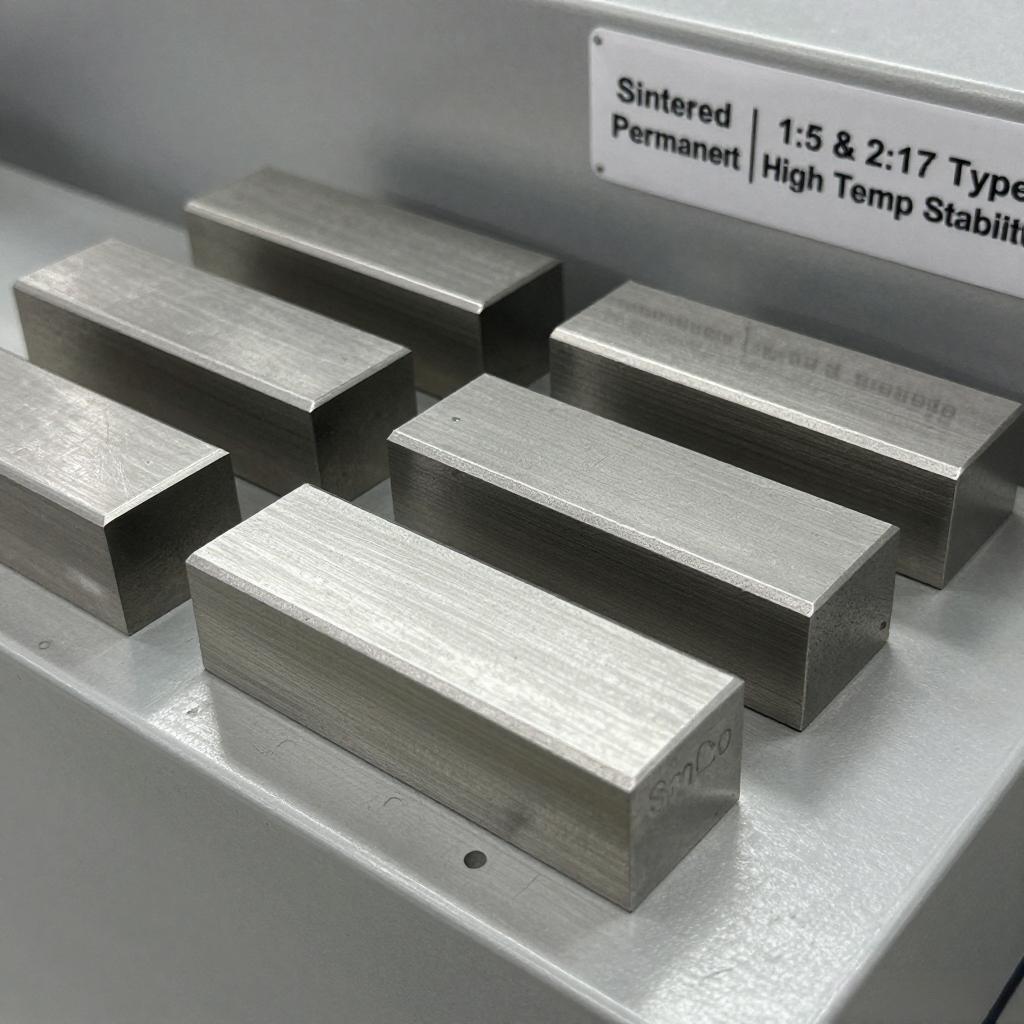
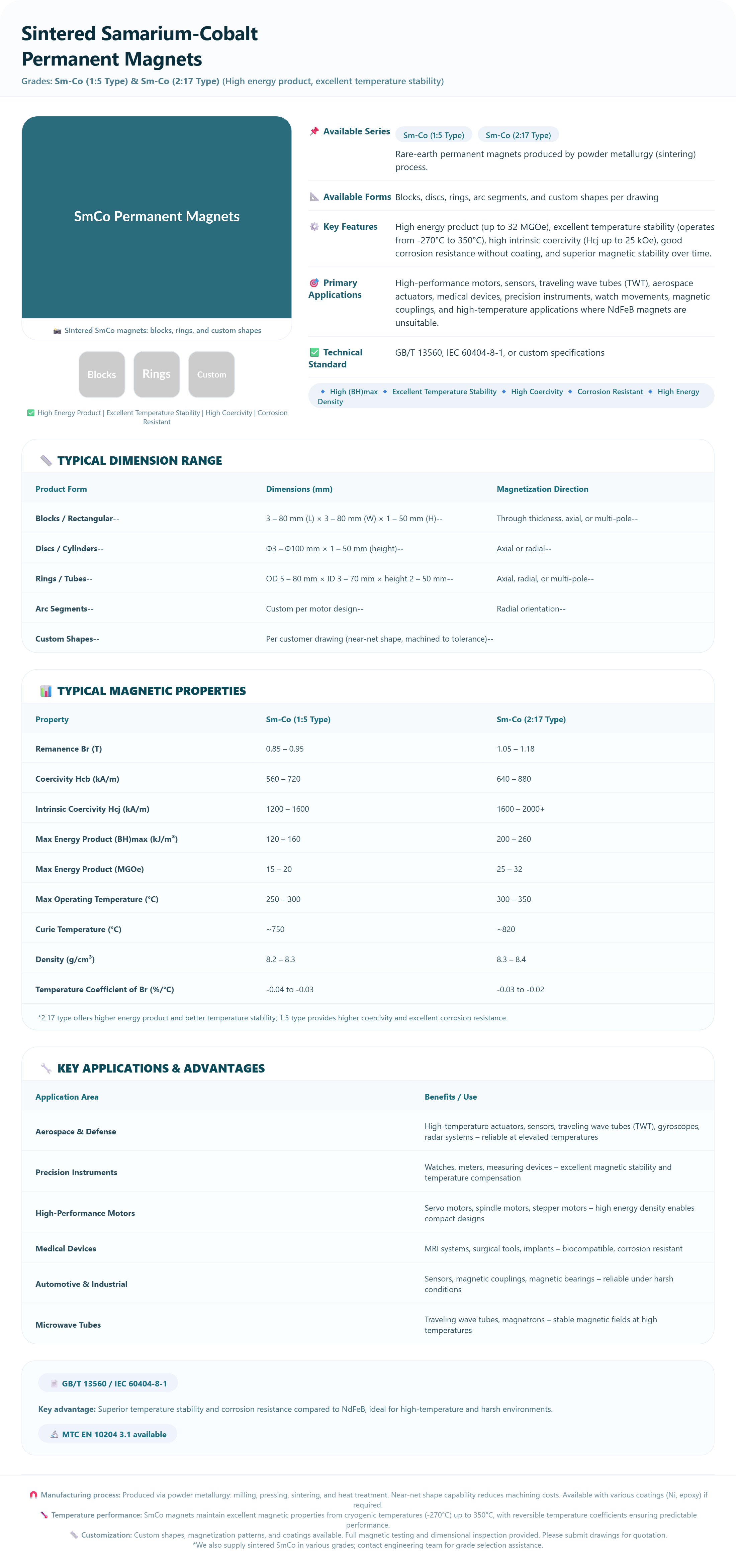
Sintered SmCo permanent magnets (1:5 & 2:17 type) offer high energy product (up to 32 MGOe), excellent temperature stability (-270°C to 350°C), and corrosion resistance. Ideal for aerospace, motors, and precision instruments. GB/T 13560 compliant.
Sintered SmCo Permanent Magnets | Samarium Cobalt 1:5 & 2:17
Product Overview
Sintered SmCo permanent magnets are high-performance rare-earth permanent magnets based primarily on samarium and cobalt. They are known for high coercivity, excellent temperature stability, strong resistance to demagnetization and good corrosion resistance.
Commercial sintered samarium cobalt magnets are generally divided into two major material families: SmCo 1:5 (SmCo₅) and SmCo 2:17 (Sm₂Co₁₇). These two material systems provide different combinations of magnetic energy product, coercivity, temperature performance and application characteristics.
Hefei Ke Ningman New Energy Materials Technology Co., Ltd. supplies custom sintered SmCo magnets in different grades, shapes, dimensions and magnetization directions for motors, sensors, aerospace equipment, automotive components, magnetic couplings, instruments and other demanding applications.
Key Features of Sintered SmCo Magnets
High-temperature magnetic stability
High intrinsic coercivity
Strong resistance to demagnetization
Excellent corrosion resistance
Stable magnetic performance
SmCo 1:5 and SmCo 2:17 material systems
Suitable for demanding industrial environments
Available in customized shapes and dimensions
Multiple magnetization directions available
Suitable for high-temperature motors, sensors and precision magnetic components
What Are SmCo Permanent Magnets?
Samarium cobalt, commonly abbreviated as SmCo, is a rare-earth permanent magnet material composed primarily of samarium and cobalt.
Sintered SmCo magnets are manufactured using powder metallurgy. The manufacturing process generally involves alloy preparation, powder processing, magnetic field orientation, pressing, sintering, heat treatment, precision machining and magnetization.
SmCo is particularly valuable when an application requires high resistance to demagnetization and stable magnetic performance at elevated temperatures.
Compared with NdFeB, SmCo generally offers better high-temperature stability and corrosion resistance, while NdFeB typically provides higher magnetic energy density at room temperature.
The appropriate magnet material should therefore be selected according to the actual operating temperature, required magnetic performance, geometry, environment and cost target.
SmCo 1:5 vs SmCo 2:17 Permanent Magnets
The two major SmCo material families are SmCo 1:5 and SmCo 2:17.
| Property | SmCo 1:5 | SmCo 2:17 |
|---|---|---|
| Chemical System | SmCo₅ | Sm₂Co₁₇ |
| Magnetic Performance | High | Very high, grade dependent |
| Maximum Energy Product | Grade dependent | Generally higher |
| Coercivity | High | High to very high |
| Temperature Stability | Excellent | Excellent |
| Demagnetization Resistance | Excellent | Excellent |
| Typical Advantage | Balanced magnetic properties | High magnetic performance |
| Typical Applications | Sensors, instruments, motors | High-performance motors and demanding industrial systems |
SmCo 1:5 and SmCo 2:17 should not simply be considered “better” or “worse.” The appropriate choice depends on the required magnetic performance, operating temperature, magnet dimensions, magnetization conditions and application environment.
SmCo Permanent Magnet Specifications
The final properties of a SmCo magnet depend on the selected grade, chemical composition, manufacturing process and heat treatment.
| Parameter | SmCo 1:5 | SmCo 2:17 |
|---|---|---|
| Material | SmCo₅ | Sm₂Co₁₇ |
| Density | Grade dependent | Grade dependent |
| Remanence (Br) | Grade dependent | Grade dependent |
| Coercive Force (Hcb) | Grade dependent | Grade dependent |
| Intrinsic Coercivity (Hcj) | Grade dependent | Grade dependent |
| Maximum Energy Product (BH)max | Grade dependent | Grade dependent |
| Curie Temperature (Tc) | Grade dependent | Grade dependent |
| Maximum Operating Temperature | Grade dependent | Grade dependent |
| Temperature Coefficient | Grade dependent | Grade dependent |
| Magnetization Direction | Axial / Radial / Custom | Axial / Radial / Custom |
| Manufacturing Method | Sintered | Sintered |
| Product Shape | Disc, block, ring, segment, cylinder and custom | Disc, block, ring, segment, cylinder and custom |
Exact magnetic properties should be confirmed according to the selected grade and customer technical requirements.
SmCo Permanent Magnet Grades
Different SmCo grades are available for different magnetic performance and operating temperature requirements.
Depending on the required specification, grades can be selected based on:
Remanence
Intrinsic coercivity
Maximum energy product
Temperature stability
Demagnetization resistance
Operating temperature
Magnetization requirements
For customized projects, customers can provide their required magnetic performance or application conditions and our technical team can evaluate a suitable SmCo grade.
Why Choose SmCo Permanent Magnets?
High Temperature Stability
One of the most important advantages of SmCo is its excellent performance at elevated temperatures.
SmCo is commonly selected for applications where the magnet may be exposed to high operating temperatures and where magnetic stability is more important than achieving the highest possible room-temperature magnetic energy density.
The maximum recommended operating temperature depends on the specific grade, magnet geometry and application conditions.
High Coercivity
SmCo magnets provide high intrinsic coercivity, which gives them strong resistance to irreversible demagnetization.
This characteristic is particularly important for applications exposed to:
High temperatures
External magnetic fields
Demagnetizing fields
Large temperature fluctuations
Demanding electromagnetic environments
Excellent Corrosion Resistance
SmCo has good inherent corrosion resistance compared with many conventional NdFeB magnet grades.
This makes SmCo attractive for applications where environmental durability is important.
However, final surface treatment requirements should always be evaluated according to humidity, chemicals, salt exposure and other environmental conditions.
Strong Resistance to Demagnetization
SmCo combines high coercivity with good temperature stability, making it suitable for applications where long-term magnetic stability is critical.
Long-Term Magnetic Stability
For industrial and precision applications, maintaining predictable magnetic performance over the service life of the component can be more important than achieving maximum initial magnetic strength.
SmCo is therefore commonly selected for applications where reliability and thermal stability are major design priorities.
Sintered SmCo Magnet Manufacturing Process
1. Raw Material Preparation
Samarium, cobalt and other alloying elements required for the selected grade are prepared according to the material specification.
2. Alloy Melting
The raw materials are melted under controlled conditions to achieve the required chemical composition and material uniformity.
3. Alloy Processing and Powder Production
The alloy is processed into a fine magnetic powder suitable for powder metallurgy.
4. Magnetic Field Orientation
The magnetic powder is pressed under a controlled magnetic field so that the magnetic particles are preferentially aligned.
This orientation process is important for achieving the desired anisotropic magnetic properties.
5. Pressing and Sintering
The oriented powder is compacted and sintered under controlled conditions to produce a dense SmCo magnetic body.
6. Heat Treatment
Controlled heat treatment and aging are used to develop the required microstructure and magnetic properties.
7. Precision Machining
Sintered SmCo is a hard and relatively brittle magnetic material. Precision grinding and other suitable machining methods may therefore be required to achieve final dimensions and tolerances.
8. Magnetization
The finished magnet is magnetized according to the required magnetization direction and magnetic performance.
9. Final Inspection
Finished SmCo magnets can be inspected for dimensional accuracy, surface condition, magnetic performance and other agreed technical requirements.
SmCo Magnetic Properties
Important magnetic parameters for SmCo magnets include:
Remanence (Br)
Coercive force (Hcb)
Intrinsic coercivity (Hcj)
Maximum energy product (BH)max
Curie temperature
Temperature coefficient
Demagnetization characteristics
The actual values depend on the SmCo grade and manufacturing condition.
For engineering applications, magnetic performance should be evaluated together with:
Magnet dimensions
Magnetic orientation
Operating temperature
External magnetic fields
Required service life
Working environment
This helps ensure that the selected SmCo grade provides sufficient performance throughout the expected operating conditions.
SmCo vs NdFeB Magnets
SmCo and NdFeB are both high-performance rare-earth permanent magnet materials, but they are suited to different applications.
| Property | SmCo | NdFeB |
|---|---|---|
| Magnetic Energy Density | High | Very high |
| High-Temperature Stability | Excellent | Grade dependent |
| High-Temperature Applications | Excellent | Grade dependent |
| Coercivity | High to very high | High to very high |
| Corrosion Resistance | Excellent | Generally lower without protection |
| Demagnetization Resistance | Excellent | Grade dependent |
| Density | Relatively high | Lower |
| Material Cost | Generally higher | Generally lower |
| Typical Advantage | Temperature stability and durability | Maximum magnetic strength |
Choose SmCo when:
High operating temperature is expected
High coercivity is required
Resistance to demagnetization is important
Corrosion resistance is important
Long-term magnetic stability is a priority
Consider NdFeB when:
Maximum magnetic energy density is the primary requirement
Operating temperature is within the selected NdFeB grade's limits
Compact magnetic design is important
Cost efficiency is a major consideration
The best choice depends on the complete application specification rather than magnetic strength alone.
SmCo 1:5 vs SmCo 2:17: Which Should You Choose?
SmCo 1:5
SmCo 1:5 magnets can be considered when the application requires:
Stable permanent magnetic performance
High coercivity
High-temperature capability
A balanced combination of magnetic properties and application requirements
SmCo 2:17
SmCo 2:17 magnets can be considered when:
Higher magnetic performance is required
Higher maximum energy product is important
High coercivity is required
Compact high-performance magnetic components are needed
High-temperature operation is expected
The final grade should be selected according to the required Br, Hcj, BHmax, operating temperature and magnet geometry.
Custom SmCo Magnet Shapes and Sizes
We supply sintered SmCo magnets in a range of standard and customized shapes.
Common shapes include:
Disc magnets
Ring magnets
Block magnets
Rectangular magnets
Cylinder magnets
Arc magnets
Segment magnets
Custom-shaped magnets
Customized dimensions can be manufactured according to customer drawings and technical specifications.
Available customization may include:
Length
Width
Thickness
Diameter
Radius
Dimensional tolerance
Magnetization direction
Magnetic grade
Magnetic performance
SmCo Magnetization Options
SmCo magnets can be supplied with different magnetization configurations according to application requirements.
Common options include:
Axial Magnetization
Magnetization is oriented along the central axis of the magnet.
Radial Magnetization
Magnetization is oriented radially and is commonly used for selected ring and cylindrical magnetic components.
Diametrical Magnetization
The magnet is magnetized across its diameter.
Custom Magnetization
Special magnetization requirements can be discussed according to the customer's magnetic circuit and application design.
Applications of Sintered SmCo Magnets
SmCo magnets are widely considered for applications where high-temperature stability and resistance to demagnetization are important.
Aerospace Applications
Aerospace actuators
Sensors
Navigation equipment
Aircraft instruments
High-temperature magnetic components
Automotive Applications
Position sensors
Temperature-resistant sensors
Motors
Actuators
Magnetic control components
High-Temperature Motors
SmCo is suitable for selected:
Permanent magnet motors
Servo motors
Brushless motors
High-temperature motors
Generators
Sensors and Instrumentation
SmCo can be used in:
Magnetic sensors
Position sensors
Encoders
Measurement equipment
Precision instruments
Magnetic Couplings
SmCo magnets can be considered for:
High-temperature magnetic couplings
Sealed pumps
Magnetic drive systems
Industrial transmission systems
Scientific and Precision Equipment
SmCo can also be used in selected:
Scientific instruments
Precision magnetic devices
Electronic equipment
Measurement systems
Custom SmCo Permanent Magnet Manufacturing
We support customized SmCo magnet manufacturing based on customer application requirements.
Customers can provide:
Magnet drawing
Material grade
Dimensions
Magnetic properties
Magnetization direction
Operating temperature
Environmental conditions
Required tolerance
Annual quantity
Our technical team can evaluate the application requirements and recommend a suitable SmCo material and manufacturing specification.
SmCo Magnet Quality Control
Quality control is essential for maintaining consistent magnetic performance and dimensional accuracy.
Depending on the agreed specification, inspection may include:
Chemical composition inspection
Dimensional inspection
Dimensional tolerance verification
Surface inspection
Density inspection
Remanence testing
Coercivity testing
Maximum energy product testing
Demagnetization curve testing
Magnetization direction inspection
Final product inspection
Material certification and inspection documentation can be discussed according to customer requirements.
How to Choose the Right SmCo Magnet Grade?
When selecting a SmCo permanent magnet, consider the following parameters:
Required magnetic energy product
Required remanence (Br)
Required coercivity (Hcb)
Required intrinsic coercivity (Hcj)
Maximum operating temperature
Magnet dimensions
Magnetization direction
Dimensional tolerance
Working environment
Corrosion requirements
External demagnetizing field
Annual quantity
Providing these parameters helps ensure that the selected SmCo magnet grade is appropriate for the application.
Why Choose Hefei Ke Ningman New Energy Materials Technology Co., Ltd.?
Hefei Ke Ningman New Energy Materials Technology Co., Ltd. supplies specialty magnetic alloys and functional metal materials for industrial applications.
For customized SmCo permanent magnet projects, we can support customers with:
Material selection
SmCo grade selection
Custom dimensions
Custom shapes
Magnetic property requirements
Magnetization requirements
Manufacturing process consultation
Quality inspection
Technical documentation
Bulk production
Export packaging
We work with customers to match magnet material, magnetic performance, dimensions and operating conditions to the actual application.
Frequently Asked Questions About SmCo Magnets
What are SmCo permanent magnets?
SmCo permanent magnets are high-performance rare-earth permanent magnets based primarily on samarium and cobalt. They are known for high coercivity, excellent temperature stability and resistance to demagnetization.
What are the two main types of SmCo magnets?
The two major SmCo material families are SmCo 1:5 (SmCo₅) and SmCo 2:17 (Sm₂Co₁₇).
What is the difference between SmCo 1:5 and SmCo 2:17?
SmCo 1:5 and SmCo 2:17 have different chemical systems and magnetic characteristics. SmCo 2:17 generally offers higher magnetic energy product, while the appropriate choice depends on the required magnetic properties, temperature and application.
Are SmCo magnets suitable for high temperatures?
Yes. SmCo is one of the preferred permanent magnet materials for high-temperature applications because of its excellent temperature stability and resistance to thermal demagnetization.
Are SmCo magnets corrosion resistant?
Yes. SmCo generally provides excellent corrosion resistance compared with many NdFeB magnet grades. However, the required surface treatment should be evaluated according to the actual environment.
Are SmCo magnets stronger than NdFeB?
Not generally. NdFeB typically provides higher magnetic energy density, while SmCo offers better high-temperature stability and corrosion resistance.
Are SmCo magnets brittle?
Yes. Sintered SmCo is a hard and relatively brittle material. Careful handling and appropriate machining methods are required to prevent chipping or cracking.
What shapes of SmCo magnets are available?
Common SmCo magnet shapes include discs, blocks, rings, cylinders, arcs, segments and customized shapes.
Can you manufacture custom SmCo magnets?
Yes. We can manufacture customized SmCo magnets according to customer drawings, dimensions, magnetic requirements, magnetization direction and application conditions.
What information is required for an SmCo magnet quotation?
The most useful information includes magnet grade, dimensions, quantity, magnetic performance requirements, magnetization direction, maximum operating temperature and technical drawings.
Request a Custom SmCo Magnet Quote
Looking for a reliable SmCo magnet manufacturer or supplier?
Send us your magnet drawing, required SmCo grade, dimensions, magnetic properties, operating temperature and quantity.
Hefei Ke Ningman New Energy Materials Technology Co., Ltd. can evaluate your requirements and provide a suitable sintered SmCo permanent magnet solution for your application.
Contact us today for a customized SmCo magnet quotation.