



Previous
Next
1J66 Constant Permeability Soft Magnetic Alloy | Stable Inductance
- 1J66 constant permeability soft magnetic alloy
- 1J66 soft magnetic alloy
- 1J66 alloy
- constant permeability alloy
- constant permeability soft magnetic alloy
- stable permeability magnetic alloy
- stable inductance magnetic material
Description
1J66 Fe-Ni based constant permeability alloy offers stable μ over wide flux, temperature, and frequency ranges. Ideal for constant inductance coils, filter chokes, and wideband transformers. GB/T 15003-94 compliant.
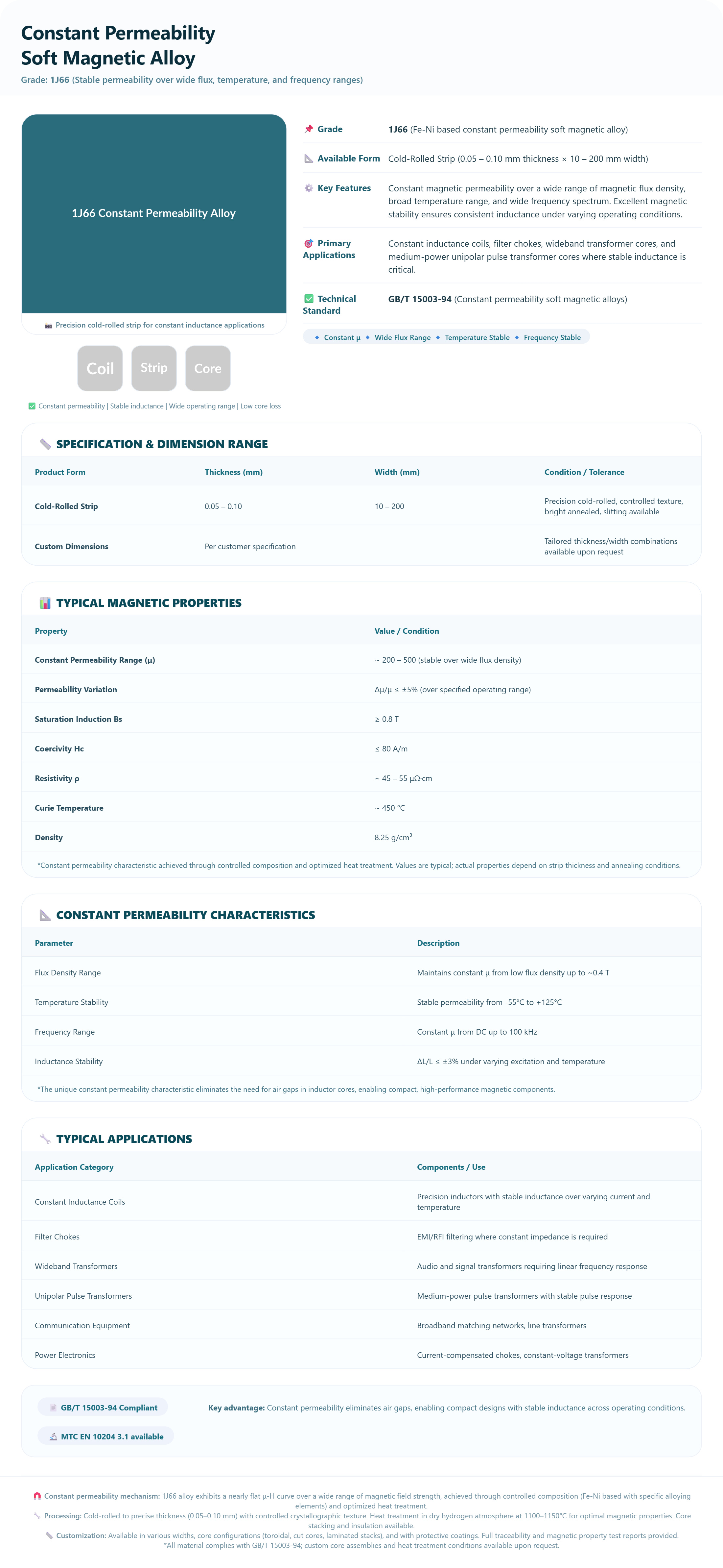
1J66 Constant Permeability Soft Magnetic Alloy
1J66 is a nickel-iron (Fe-Ni) soft magnetic alloy with relatively stable permeability over a defined range of magnetic field, temperature and frequency. Its controlled magnetic behavior makes it suitable for constant-inductance components, filter choke cores, broadband transformer cores and selected pulse transformer applications.
Greenergy Materials supplies 1J66 constant permeability soft magnetic alloy in precision strip and other available forms according to the required dimensions, magnetic properties, heat-treatment condition and application requirements.
What Is 1J66 Constant Permeability Soft Magnetic Alloy?
1J66 is a specialized Fe-Ni soft magnetic alloy designed for applications where magnetic permeability needs to remain relatively stable over a defined operating range.
Unlike soft magnetic alloys selected primarily for extremely high initial permeability or maximum saturation induction, 1J66 is mainly valued for its permeability stability.
This characteristic can help designers maintain more predictable inductance and magnetic behavior when operating conditions change.
The main application concept can be summarized as:
Constant permeability → stable magnetic response → stable inductance → predictable circuit behavior
Key Characteristics of 1J66 Alloy
Constant Permeability
The defining characteristic of 1J66 is relatively small permeability variation across a specified range of:
Magnetic field
Temperature
Frequency
This makes the alloy particularly suitable for magnetic components where inductance stability is more important than simply maximizing permeability.
Stable Inductance
The magnetic core material directly influences the inductance of an inductor or choke.
When permeability changes significantly with operating conditions, the inductance can also change.
1J66 is therefore used in applications where relatively stable magnetic characteristics are required to support stable inductance.
Fe-Ni Soft Magnetic Alloy
1J66 belongs to the nickel-iron soft magnetic alloy family.
Its nominal composition contains approximately 64.5–65.5% nickel, with iron as the balance and controlled additions of manganese and other elements.
Wide Operating Range
The alloy is designed for applications where magnetic permeability needs to remain comparatively stable over a defined range rather than under only one fixed operating condition.
The actual stable range depends on the material grade, thickness, heat treatment and test method.
1J66 Chemical Composition
A commonly published composition range for 1J66 is:
| Element | Typical Specification |
|---|---|
| C | ≤0.03% |
| Si | ≤0.10% |
| Mn | 0.70–1.10% |
| P | ≤0.02% |
| S | ≤0.02% |
| Ni | 64.5–65.5% |
| Fe | Balance |
These composition ranges are reported for 1J66 in publicly available material references associated with GB/T 32286.1-2015 and earlier precision-alloy specifications.
For production orders, the supplied chemical composition should always be controlled according to the agreed material specification and inspection requirements.
Magnetic Properties of 1J66
The magnetic performance of 1J66 depends on:
Alloy composition
Strip thickness
Cold working
Heat treatment
Magnetic field strength
Frequency
Test direction
Test method
Important parameters may include:
Induction permeability
AC permeability
DC permeability
Permeability stability
Temperature stability
Saturation magnetic induction
Coercive force
Magnetic loss
Published technical data for 1J66 report permeability-stability characteristics under specified thickness and test conditions. For example, publicly available data for 0.05–0.10 mm material describe different material classes according to induction permeability and AC/DC/temperature stability.
For this product page, Greenergy Materials should publish its own verified magnetic-property data wherever available rather than presenting third-party values as factory specifications.
What Does Constant Permeability Mean?
Magnetic permeability describes how readily a material responds to an applied magnetic field.
For many soft magnetic materials, permeability can change when:
The magnetic field changes
Temperature changes
Frequency changes
The magnetic material approaches saturation
A constant-permeability alloy is engineered so that the variation remains relatively small within a specified operating range.
This characteristic is particularly useful for magnetic components where predictable inductance is required.
Simplified relationship
For a given magnetic circuit, inductance is strongly influenced by:
Core permeability + core geometry + number of turns
Therefore, controlling permeability can help control inductance.
1J66 for Constant-Inductance Components
The primary application of 1J66 is the manufacture of constant-inductance components.
These may include:
Constant-inductance coils
Filter chokes
Choke cores
Broadband transformer cores
Pulse transformer cores
Precision magnetic circuits
Published technical references identify constant-inductance coils, filter choke cores, broadband transformer cores and medium-power unipolar pulse transformer cores among the typical applications of 1J66.
1J66 for Inductor Cores
Inductors are designed to oppose changes in electrical current by storing energy in a magnetic field.
The magnetic core has a major influence on inductance.
For applications where the inductance must remain comparatively stable as operating conditions change, a constant-permeability alloy such as 1J66 can be considered.
Potential applications include:
Precision inductors
Filter inductors
Constant-inductance coils
Signal filtering components
Magnetic chokes
The appropriate grade and material thickness should be selected according to the operating frequency, magnetic field and required inductance stability.
1J66 for Filter Choke Cores
Filter chokes are used in electrical and electronic circuits to suppress or control unwanted current components.
The core material needs to provide predictable magnetic behavior under the intended operating conditions.
1J66 can be considered when the design requires:
Stable inductance
Controlled permeability
Low variation with temperature
Controlled response over frequency
Soft magnetic behavior
The final core design should be evaluated together with the winding, operating current and frequency.
1J66 for Broadband Transformer Cores
Broadband transformers operate across a relatively wide frequency range.
A magnetic material whose permeability varies excessively with frequency can affect transformer performance.
1J66 is therefore relevant to selected broadband transformer designs where permeability stability is an important design consideration.
Potential applications include:
Broadband transformers
Signal transformers
Pulse transformers
Communication-related magnetic components
Precision transformer cores
The appropriate thickness and heat treatment should be selected according to the frequency range and magnetic flux requirements.
1J66 for Pulse Transformer Cores
Pulse transformers transfer electrical pulses between circuits while providing galvanic isolation and controlled pulse characteristics.
The magnetic core plays an important role in:
Pulse fidelity
Magnetizing inductance
Core saturation
Frequency response
Energy transfer
1J66 is associated with medium-power unipolar pulse transformer core applications.
For pulse transformer design, the alloy should be evaluated together with:
Pulse width
Repetition frequency
Voltage
Flux density
Core dimensions
Number of turns
Required inductance
1J66 vs High Initial Permeability Soft Magnetic Alloys
1J66 should not be selected simply because it is a soft magnetic alloy.
Its main advantage is permeability stability, whereas materials such as 1J79 and 1J85 are primarily selected for high initial permeability.
| Feature | 1J66 | 1J79 / 1J85 |
|---|---|---|
| Main property | Constant permeability | High initial permeability |
| Primary design objective | Stable magnetic behavior | High response under weak fields |
| Inductance stability | Major consideration | Application dependent |
| Broadband applications | Suitable for selected designs | Application dependent |
| Constant-inductance coils | Strong fit | Not primary positioning |
| Filter choke cores | Suitable | Suitable depending on design |
| Magnetic shielding | Not primary | More relevant |
| Weak-field sensitivity | Not the primary selling point | Major advantage |
For an application requiring stable inductance, 1J66 should be considered before choosing a material based only on maximum permeability.
1J66 vs 1J46, 1J50 & 1J54
1J46, 1J50 and 1J54 are positioned differently from 1J66.
| Property | 1J66 | 1J46 / 1J50 / 1J54 |
|---|---|---|
| Main characteristic | Constant permeability | High permeability + higher saturation induction |
| Primary application logic | Stable inductance | Magnetic circuits requiring permeability and higher saturation |
| Inductors | Strong fit | Application dependent |
| Filter chokes | Strong fit | Application dependent |
| Transformers | Selected applications | Strong application area |
| Saturation induction | Not primary positioning | Important |
| Permeability stability | Major advantage | Not the main positioning |
This distinction is useful when selecting material for transformer and inductor cores.
1J66 Product Forms
Depending on manufacturing capability and customer requirements, 1J66 may be supplied in forms such as:
Cold-rolled strip
Precision strip
Sheet
Coil
Wire
Bar
Other forms subject to technical confirmation
Published references identify cold-rolled strip as a standard form for constant-permeability 1J66 material.
For precision magnetic components, strip thickness and heat-treatment condition should be specified together with the magnetic requirements.
1J66 Strip Thickness and Dimensional Control
Material thickness can influence:
Magnetic permeability
AC magnetic performance
Eddy-current behavior
Heat-treatment response
Core losses
Component dimensions
For this reason, procurement specifications should define:
Nominal thickness
Thickness tolerance
Width
Width tolerance
Surface condition
Flatness
Edge condition
Delivery condition
For precision inductor and transformer cores, dimensional consistency is particularly important because it affects the repeatability of the finished magnetic component.
Heat Treatment of 1J66
Heat treatment is one of the most important factors affecting soft magnetic properties.
Cold working introduces residual stress and changes the microstructure of the alloy.
A suitable heat-treatment process can help establish the required magnetic characteristics.
For 1J66, heat treatment should be considered together with:
Alloy composition
Material thickness
Magnetic field during treatment where specified
Cooling rate
Final application
Required permeability stability
Published technical references provide specific heat-treatment procedures for 1J66 under defined standard conditions. These procedures should not be copied directly into a customer specification unless the applicable standard, product form and actual production process have been verified.
Quality Control for 1J66 Soft Magnetic Alloy
For precision magnetic alloy procurement, quality control should cover more than chemical composition.
Chemical Composition
Verify:
Nickel
Manganese
Silicon
Carbon
Phosphorus
Sulfur
Iron balance
Dimensional Inspection
Check:
Thickness
Width
Thickness tolerance
Width tolerance
Flatness
Surface quality
Magnetic Testing
Depending on the agreed specification:
Induction permeability
AC permeability
DC permeability
Permeability stability
Temperature stability
Frequency stability
Saturation induction
Coercive force
Heat-Treatment Verification
Production should control:
Heating temperature
Holding time
Atmosphere
Cooling rate
Magnetic-field treatment where applicable
Surface Inspection
Precision strip should be inspected for:
Scratches
Oxidation
Surface defects
Edge damage
Contamination
How to Choose 1J66 for Your Magnetic Component
Step 1: Define the Circuit
Determine whether the material is required for:
Inductor
Filter choke
Transformer
Broadband transformer
Pulse transformer
Constant-inductance coil
Step 2: Define the Frequency Range
Frequency has a direct influence on magnetic performance.
Specify:
Minimum frequency
Maximum frequency
AC waveform
Operating cycle
Step 3: Define the Magnetic Field
Specify the expected:
DC bias
AC magnetic field
Peak magnetic field
Flux density
Step 4: Define the Stability Requirement
Determine whether the critical parameter is:
AC stability
DC/AC stability
Temperature stability
Frequency stability
Overall inductance stability
Step 5: Define Material Dimensions
Specify:
Thickness
Width
Coil size
Core geometry
Tolerance
Step 6: Confirm the Applicable Standard
1J66 appears in historical precision-alloy specifications and in later Fe-Ni soft-magnetic alloy standards. Buyers should confirm the exact current standard and grade designation required for the purchase. Public references associate 1J66 with GB/T 32286.1-2015, while newer database records map the old 1J66 designation to 1J466/J14660 under GB/T 14986.2-2025.
Technical Specification of 1J66
| Item | 1J66 |
|---|---|
| Alloy family | Nickel-Iron soft magnetic alloy |
| Main characteristic | Constant permeability |
| Ni content | 64.5–65.5% |
| Mn | 0.70–1.10% |
| Si | ≤0.10% |
| C | ≤0.03% |
| P | ≤0.02% |
| S | ≤0.02% |
| Fe | Balance |
| Density | Approx. 8.25 g/cm³ |
| Product focus | Precision magnetic strip and other forms subject to specification |
| Typical applications | Constant-inductance coils, filter chokes, broadband transformers, pulse transformers |
The composition and physical-property values above are reference values from publicly available technical material data; actual Greenergy product specifications should be based on your verified factory data and the applicable purchase standard.
Custom 1J66 Soft Magnetic Alloy Supply
Greenergy Materials can evaluate customized 1J66 requirements according to:
Alloy grade
Thickness
Width
Coil dimensions
Magnetic properties
Permeability stability
Heat-treatment condition
Surface condition
Quantity
Packaging requirements
For technical evaluation, please provide:
1J66 Grade + Thickness + Width + Quantity + Frequency Range + Magnetic Requirements + Application
This information allows the appropriate material specification and delivery condition to be evaluated before production.
Technical Documentation
For qualified projects, technical documentation may include:
Chemical composition
Material specification
Magnetic-property data
Dimensional inspection
Heat-treatment condition
Material test report
Packaging information
Shipping documentation
Additional inspection requirements can be discussed before production.
Frequently Asked Questions
What is 1J66 soft magnetic alloy?
1J66 is a nickel-iron soft magnetic alloy characterized by relatively stable magnetic permeability over a defined range of magnetic field, temperature and frequency. It is primarily used for constant-inductance magnetic components.
What is 1J66 used for?
Typical applications include constant-inductance coils, filter choke cores, broadband transformer cores and selected pulse transformer cores.
What makes 1J66 different from 1J79?
1J66 is primarily selected for constant permeability and stable inductance, while 1J79 is primarily positioned as a high initial permeability soft magnetic alloy.
Is 1J66 a nickel-iron alloy?
Yes. 1J66 is an Fe-Ni soft magnetic alloy containing approximately 64.5–65.5% nickel according to published material specifications.
Is 1J66 suitable for inductors?
Yes. Constant-inductance coils and filter choke cores are among the typical applications reported for 1J66.
Is 1J66 suitable for transformers?
Yes. 1J66 can be used for selected broadband and pulse transformer core applications where permeability stability is important.
Does 1J66 have constant permeability under all conditions?
No. "Constant permeability" does not mean that permeability is mathematically constant under every field, temperature and frequency. The material is designed for relatively small permeability variation within a defined operating range and test condition.
What product forms are available?
Depending on manufacturing capability and customer requirements, 1J66 may be supplied as precision strip, sheet, coil, wire, bar or other forms subject to technical confirmation.
Can Greenergy provide customized 1J66 material?
Yes. Customized dimensions, material conditions and magnetic requirements can be evaluated according to the application.
Can you provide magnetic test data?
Technical and inspection data can be supplied according to the agreed product specification and order requirements.
Request a Quote for 1J66 Soft Magnetic Alloy
Looking for 1J66 constant permeability soft magnetic alloy for an inductor, filter choke, broadband transformer or pulse transformer?
Send us your:
Grade + Thickness + Width + Quantity + Frequency Range + Magnetic Requirements + Application
Greenergy Materials can help evaluate the appropriate 1J66 material specification, dimensions and delivery condition for your magnetic component.
Contact us for technical support, material selection and quotation.