



Previous
Next
Corrosion-Resistant Soft Magnetic Alloys | 1J17, 1J18 & 1J36
- corrosion-resistant soft magnetic alloy
- 1J17 soft magnetic alloy
- 1J18 soft magnetic alloy
- 1J36 soft magnetic alloy
- corrosion resistant magnetic alloy
- corrosion resistant soft magnetic material
- high saturation soft magnetic alloy
- low remanence soft magnetic alloy
- Fe-Ni soft magnetic alloy
Description
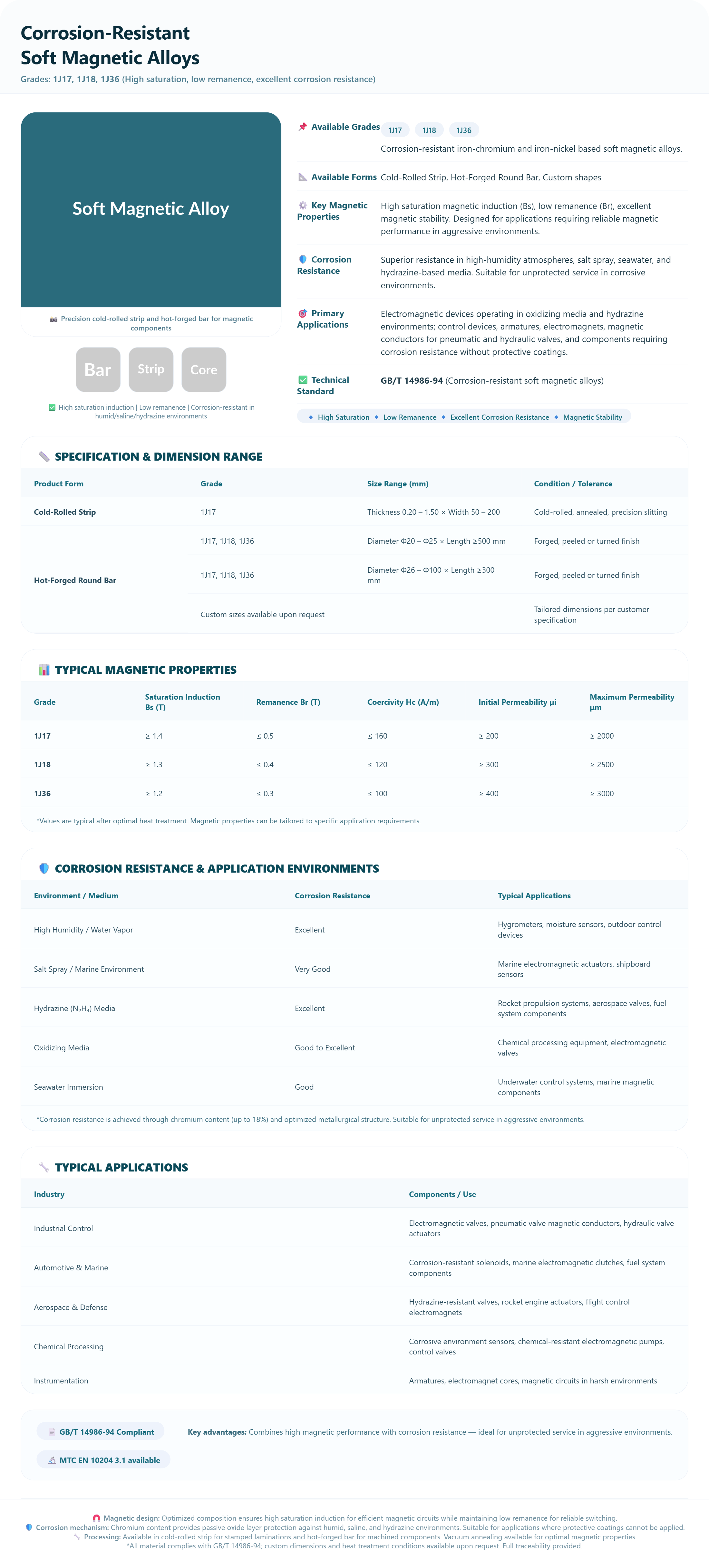
Corrosion-resistant soft magnetic alloys (1J17, 1J18, 1J36) offer high saturation induction, low remanence, and excellent corrosion resistance. Ideal for marine, aerospace, and chemical processing applications. GB/T 14986-94 compliant.
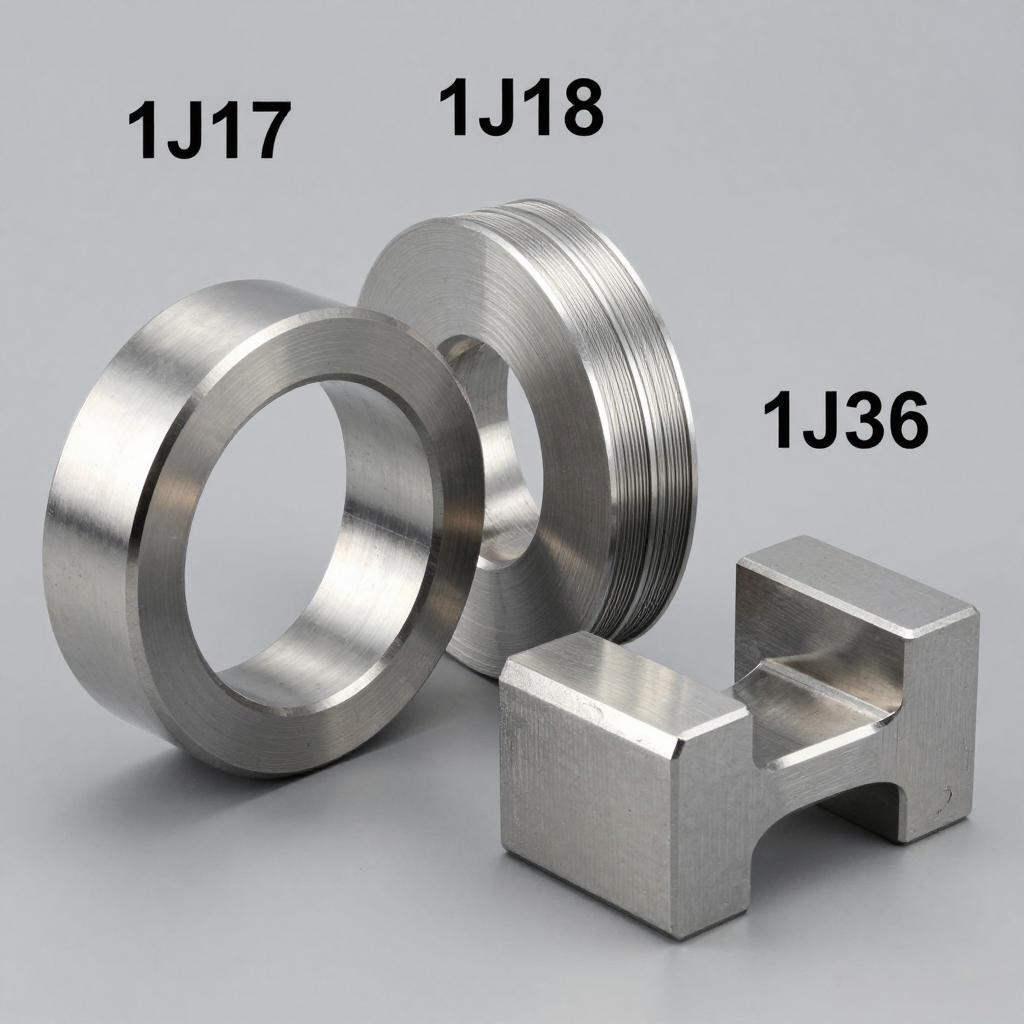
Corrosion-Resistant Soft Magnetic Alloys | 1J17, 1J18 & 1J36
1J17, 1J18 and 1J36 are corrosion-resistant soft magnetic alloys designed for magnetic components operating in demanding environments where magnetic performance, corrosion resistance, high saturation induction and low remanence are important.
These specialized magnetic materials are used in selected solenoid valves, electromagnetic control systems, precision magnetic circuits, sensors and other components exposed to moisture, corrosive media or demanding operating conditions.
Greenergy Materials supplies soft magnetic alloy materials in customized grades, dimensions, product forms and delivery conditions according to customer specifications.
What Are Corrosion-Resistant Soft Magnetic Alloys?
Corrosion-resistant soft magnetic alloys combine the magnetic characteristics required for easy magnetization and demagnetization with improved resistance to environmental attack.
Compared with conventional soft magnetic materials, corrosion-resistant grades can be considered when the magnetic component is exposed to:
Water vapor
Humid environments
Salt spray
Corrosive media
Chemical processing environments
Temperature and pressure variations
The 1J17, 1J18 and 1J36 grades belong to specialized soft magnetic alloy families with different alloy compositions and magnetic characteristics.
The appropriate grade should therefore be selected according to the actual operating environment, magnetic requirements, mechanical requirements and applicable material specification.
1J17, 1J18 & 1J36 Alloy Overview
| Grade | Alloy System | Main Characteristics | Typical Application Focus |
|---|---|---|---|
| 1J17 | Fe-Cr based | Corrosion-resistant soft magnetic alloy | Magnetic components and control devices |
| 1J18 | Fe-Cr-Ti based | Corrosion resistance with controlled magnetic characteristics | Magnetic control components and precision devices |
| 1J36 | Fe-Ni based | High saturation induction, low remanence and corrosion resistance | Solenoid valves and magnetic control systems |
The exact application should be confirmed according to the required magnetic properties, environmental conditions and material standard.
1J17 Soft Magnetic Alloy
1J17 is a chromium-containing iron-based soft magnetic alloy developed for applications where corrosion resistance and magnetic performance are both important.
The alloy contains approximately 15.5–16.5% chromium, with iron as the balance. Publicly available technical tables also specify controlled levels of carbon, manganese, silicon, phosphorus and sulfur.
Key Characteristics
Chromium-containing Fe-based alloy
Corrosion-resistant material system
Soft magnetic behavior
Suitable for selected magnetic control components
Suitable for applications requiring improved environmental resistance
When selecting 1J17, magnetic performance should be evaluated together with the required corrosion environment and component geometry.
1J18 Soft Magnetic Alloy
1J18 is a chromium-containing soft magnetic alloy with titanium addition.
Public technical composition data identify approximately 17–18.5% chromium, 0.5–0.7% nickel and 0.3–0.7% titanium, with iron as the balance.
The controlled alloy composition provides a combination of corrosion resistance and soft magnetic behavior for specialized magnetic components.
Potential Selection Advantages
Corrosion-resistant alloy system
Fe-Cr based soft magnetic material
Titanium-containing composition
Suitable for selected precision magnetic components
Designed for applications where environmental resistance matters
The actual magnetic properties depend on alloy condition, processing history, heat treatment and test method.
1J36 Soft Magnetic Alloy
1J36 is an iron-nickel soft magnetic alloy containing approximately 35–37% nickel.
It is commonly associated with applications requiring a combination of corrosion resistance, high saturation magnetic induction and low residual magnetic induction.
This makes 1J36 particularly relevant to magnetic components operating in demanding environments.
Key Characteristics
Fe-Ni soft magnetic alloy
Approximately 35–37% nickel
High saturation magnetic induction
Low remanence
Corrosion resistance
Suitable for selected electromagnetic control applications
High Saturation Magnetic Induction
High saturation magnetic induction is important when a magnetic component needs to operate effectively under relatively strong magnetic excitation without reaching magnetic saturation too early.
For applications such as electromagnetic actuators and solenoid valves, saturation behavior can directly affect:
Magnetic force
Actuation performance
Core size
Electromagnetic efficiency
Control response
1J36 is particularly relevant when high saturation magnetic induction is required together with corrosion resistance and low remanence.
Low Remanence and Low Residual Magnetism
Remanence, also called residual magnetic induction, describes the magnetic induction remaining in a material after the external magnetizing field is removed.
Low remanence can be beneficial in electromagnetic devices that need:
Reliable release
Fast magnetic response
Reduced residual magnetic force
Stable repeated switching
Consistent electromagnetic control
For this reason, low-remanence soft magnetic alloys can be advantageous in solenoid and electromagnetic control applications.
Corrosion Resistance in Soft Magnetic Components
Corrosion can be particularly problematic in magnetic components because surface degradation may affect both mechanical dimensions and magnetic performance.
Depending on the application, corrosion resistance can help improve material suitability in environments involving:
Water Vapor
Moisture can cause oxidation and surface degradation in conventional magnetic materials.
Salt Spray
Salt-containing environments can accelerate corrosion and may require specialized material selection.
Chemical Media
Certain control systems expose magnetic components to chemical or process media.
Temperature and Pressure
Solenoid valves and electromagnetic control systems may operate under combined temperature, pressure and environmental stresses.
Material selection should therefore consider both the magnetic circuit and the surrounding environment.
1J17 vs 1J18 vs 1J36
| Property | 1J17 | 1J18 | 1J36 |
|---|---|---|---|
| Main alloy system | Fe-Cr | Fe-Cr-Ti | Fe-Ni |
| Corrosion resistance | Important | Important | Important |
| Magnetic properties | Soft magnetic | Soft magnetic | Soft magnetic |
| High saturation induction | Application dependent | Application dependent | Key characteristic |
| Low remanence | Application dependent | Application dependent | Key characteristic |
| Ni addition | No major Ni range listed | Small Ni addition | Approx. 35–37% |
| Cr addition | Approx. 15.5–16.5% | Approx. 17–18.5% | — |
| Ti addition | — | Approx. 0.3–0.7% | — |
| Typical focus | Corrosion-resistant magnetic components | Corrosion-resistant precision components | Solenoid valves and magnetic control systems |
The final grade should be selected according to the required magnetic performance and operating environment rather than corrosion resistance alone.
Chemical Composition
Representative composition ranges from publicly available technical tables are shown below.
| Element | 1J17 | 1J18 | 1J36 |
|---|---|---|---|
| C | ≤0.03% | ≤0.03% | ≤0.03% |
| Si | ≤0.20% | ≤0.15% | ≤0.20% |
| Mn | ≤0.60% | 0.30–0.70% | ≤0.60% |
| P | ≤0.02% | ≤0.02% | ≤0.02% |
| S | ≤0.02% | ≤0.02% | ≤0.02% |
| Ni | — | 0.5–0.7% | 35.0–37.0% |
| Cr | 15.5–16.5% | 17.0–18.5% | — |
| Ti | — | 0.3–0.7% | — |
| Fe | Balance | Balance | Balance |
These values should be treated as reference composition ranges. The material supplied by Greenergy Materials should be controlled according to the agreed specification, applicable standard and inspection requirements. Public technical tables report these ranges for the respective grades.
Magnetic Properties
Magnetic performance depends on:
Alloy grade
Chemical composition
Strip or sheet thickness
Heat treatment
Cold working
Grain structure
Test field
Measurement method
Relevant parameters may include:
Saturation magnetic induction
Remanent magnetic induction
Coercive force
Initial permeability
Maximum permeability
Magnetic loss
Magnetic stability
For procurement projects, the required magnetic test conditions should be specified together with the material grade.
Greenergy Materials recommends using actual batch test data or agreed specification values rather than generic magnetic-property numbers when evaluating production material.
Applications of Corrosion-Resistant Soft Magnetic Alloys
Solenoid Valves
One of the most important application areas for corrosion-resistant soft magnetic alloys is electromagnetic solenoid valves.
The magnetic core of a solenoid valve must generate sufficient magnetic force while operating reliably in its surrounding environment.
1J36 has been associated with solenoid valve production for control systems operating under conditions involving media, temperature and pressure.
Potential applications include:
Industrial solenoid valves
Fluid control systems
Gas control systems
Hydraulic control systems
Pneumatic control systems
Electromagnetic actuators
Electromagnetic Control Systems
Corrosion-resistant soft magnetic alloys can be used in selected:
Magnetic actuators
Electromagnetic switches
Control valves
Magnetic relays
Electromagnetic mechanisms
Low remanence can be particularly valuable when the device must repeatedly magnetize and release.
Sensors and Precision Magnetic Components
Selected grades can also be considered for:
Magnetic sensors
Precision magnetic circuits
Electromagnetic control components
Instrument components
Magnetic shielding components
The appropriate material should be selected based on magnetic sensitivity, corrosion environment and mechanical requirements.
Material Forms
Depending on the alloy grade and production requirements, materials may be supplied in forms such as:
Cold-rolled strip
Precision strip
Sheet
Coil
Custom-cut material
Other forms subject to technical confirmation
For electromagnetic components, thickness and dimensional tolerance should be specified together with magnetic requirements.
Thickness and Dimensional Control
For precision magnetic components, material thickness can influence:
Magnetic response
Eddy-current behavior
Heat-treatment response
Component dimensions
Stamping performance
Assembly accuracy
Procurement specifications should therefore define:
Thickness
Width
Thickness tolerance
Width tolerance
Flatness
Surface condition
Edge condition
Delivery state
Heat Treatment and Magnetic Performance
Heat treatment can significantly affect the magnetic performance of soft magnetic alloys.
Cold working and residual stress can alter:
Magnetic permeability
Coercive force
Remanence
Magnetic loss
Magnetic stability
For this reason, the required heat-treatment condition should be specified according to the final application.
Greenergy Materials can evaluate the appropriate material condition according to the customer's magnetic and mechanical requirements.
Quality Control
A reliable corrosion-resistant soft magnetic alloy supply program should evaluate more than chemical composition.
Chemical Composition
Verify the required alloying elements and impurity limits.
Magnetic Properties
Depending on the specification:
Saturation induction
Remanence
Coercive force
Initial permeability
Maximum permeability
Dimensional Inspection
Check:
Thickness
Width
Tolerance
Flatness
Surface condition
Mechanical Testing
Depending on application:
Hardness
Tensile strength
Elongation
Corrosion / Surface Evaluation
Where corrosion resistance is a critical requirement, the appropriate corrosion or environmental test method should be agreed before production.
This is particularly important because "corrosion resistant" is application-dependent and should not be interpreted as universal resistance to every chemical environment.
How to Choose Between 1J17, 1J18 and 1J36
Use the following selection process.
Step 1: Define the Environment
Determine whether the component will encounter:
Moisture
Water vapor
Salt spray
Chemical media
High temperature
Pressure
Step 2: Define Magnetic Requirements
Identify the required:
Saturation induction
Remanence
Coercive force
Permeability
Magnetic loss
Step 3: Define the Component
Determine whether the alloy will be used for:
Solenoid valve core
Magnetic actuator
Sensor
Relay
Magnetic circuit
Precision instrument
Step 4: Define Dimensions
Specify:
Strip thickness
Strip width
Sheet dimensions
Tolerances
Step 5: Define Delivery Condition
Specify:
Cold rolled
Annealed
Heat treated
Surface condition
Step 6: Confirm the Applicable Standard
Do not select a grade based solely on an old supplier catalog.
Confirm:
Current applicable standard
Grade designation
Product form
Magnetic test method
Mechanical requirements
Environmental requirements
1J36 vs Conventional Soft Magnetic Alloys
When choosing a magnetic material for a corrosive environment, conventional high-permeability alloys may not always be the best solution.
A material such as 1J36 may be preferable when the application requires a combination of:
corrosion resistance + high saturation induction + low remanence + soft magnetic behavior.
By contrast, if the primary objective is extremely high initial permeability, other Fe-Ni alloys such as 1J79 and 1J85 may be more appropriate.
Corrosion-Resistant vs High-Permeability Soft Magnetic Alloys
| Requirement | Corrosion-Resistant Alloys | High Initial Permeability Alloys |
|---|---|---|
| Corrosive environment | Strong priority | Application dependent |
| High initial permeability | Important but application dependent | Primary priority |
| Low remanence | Important in control systems | Application dependent |
| High saturation induction | Important for selected applications | Not always primary |
| Magnetic head applications | Selected applications | Stronger fit |
| Solenoid valves | Strong fit | Application dependent |
| Precision sensors | Possible | Strong fit |
| Material selection priority | Environment + magnetic behavior | Magnetic sensitivity |
Custom Corrosion-Resistant Soft Magnetic Alloy Supply
Greenergy Materials can evaluate customized requirements for:
1J17
1J18
1J36
Strip
Sheet
Coil
Custom dimensions
Specific magnetic properties
Specific heat-treatment conditions
Customized inspection requirements
For a technical quotation, provide:
Alloy Grade + Product Form + Thickness + Width + Quantity + Application + Magnetic Requirements + Operating Environment
Our team can help determine the appropriate soft magnetic alloy according to the application.
Technical Documentation
For qualified projects, technical documentation may include:
Chemical composition
Material specification
Magnetic-property data
Mechanical-property data
Dimensional inspection
Surface inspection
Material test report
Packaging information
Shipping documentation
The exact documents supplied depend on the agreed product specification.
Frequently Asked Questions
What is a corrosion-resistant soft magnetic alloy?
It is a soft magnetic material designed to maintain useful magnetic performance while providing improved resistance to environmental corrosion compared with conventional magnetic materials.
What is 1J36 used for?
1J36 is associated with corrosion-resistant soft magnetic applications requiring high saturation magnetic induction and low residual magnetic induction. Solenoid valves are an important application area reported for this grade.
What is the difference between 1J17 and 1J18?
Both are chromium-containing Fe-based soft magnetic alloys, but 1J18 contains nickel and titanium in addition to chromium. Their exact magnetic and environmental performance should be evaluated according to the applicable material specification.
Is 1J36 a nickel-iron soft magnetic alloy?
Yes. 1J36 is an Fe-Ni soft magnetic alloy with approximately 35–37% nickel according to commonly published composition data.
Why is low remanence important?
Low remanence reduces residual magnetism after the external magnetic field is removed. This can be beneficial in electromagnetic actuators, valves and switching components that require reliable release.
Are these alloys suitable for solenoid valves?
Yes. Corrosion-resistant soft magnetic alloys, particularly 1J36, are associated with solenoid valve applications in control systems exposed to demanding environmental conditions.
Can Greenergy supply customized dimensions?
Yes. Customized strip, sheet and other material dimensions can be evaluated according to grade, application and production requirements.
Can Greenergy provide magnetic test data?
Technical and inspection data can be provided according to the agreed material specification and order requirements.
Request a Quote
Looking for 1J17, 1J18 or 1J36 corrosion-resistant soft magnetic alloy?
Send us your:
Grade + Dimensions + Quantity + Application + Magnetic Requirements + Operating Environment
Greenergy Materials can help evaluate the appropriate material grade and supply specification for your magnetic component.
Contact us for technical support, material selection and quotation.