



Previous
Next
High Hardness High Resistivity Soft Magnetic Alloy | 1J87 & 1J88
- high hardness high resistivity soft magnetic alloy
- 1J87 soft magnetic alloy
- 1J88 soft magnetic alloy
- high hardness soft magnetic alloy
- high resistivity soft magnetic alloy
- high permeability soft magnetic alloy
- iron nickel soft magnetic alloy
- Fe-Ni soft magnetic alloy
Description
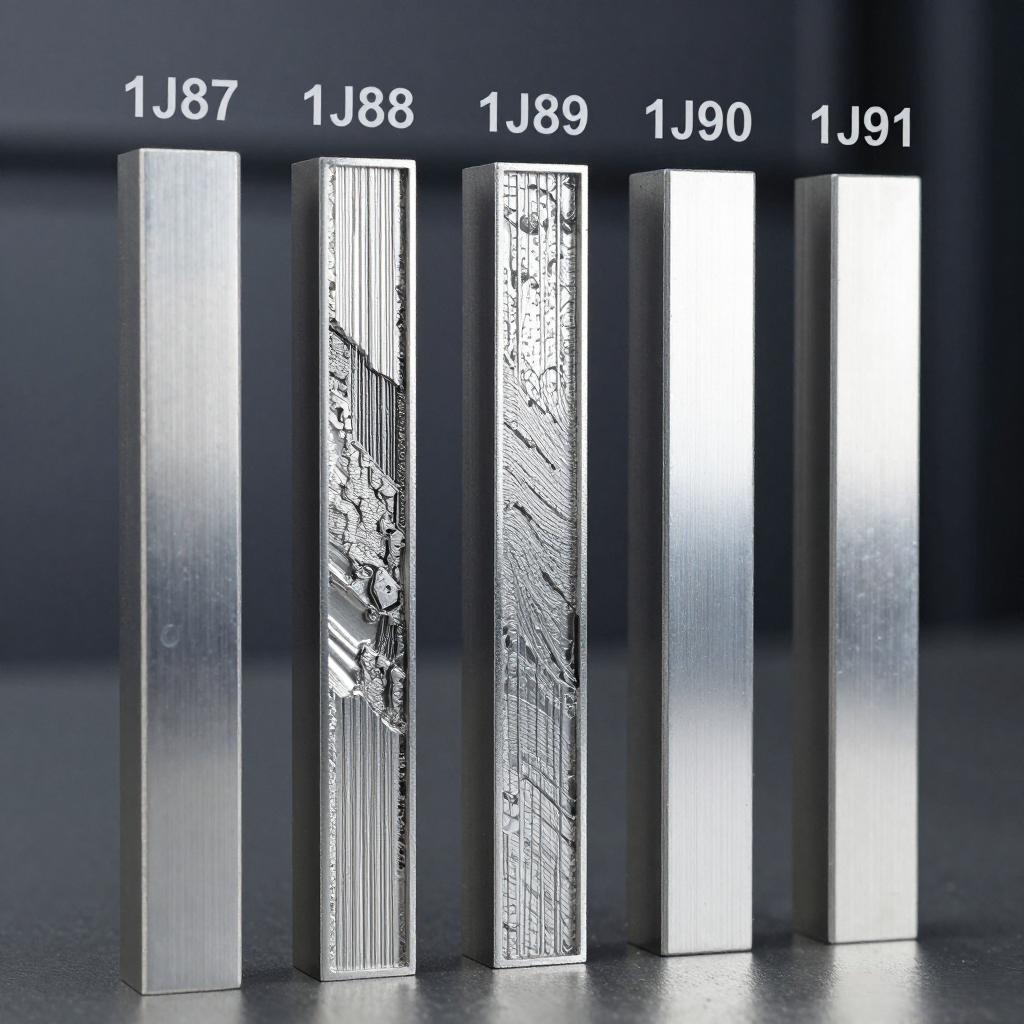
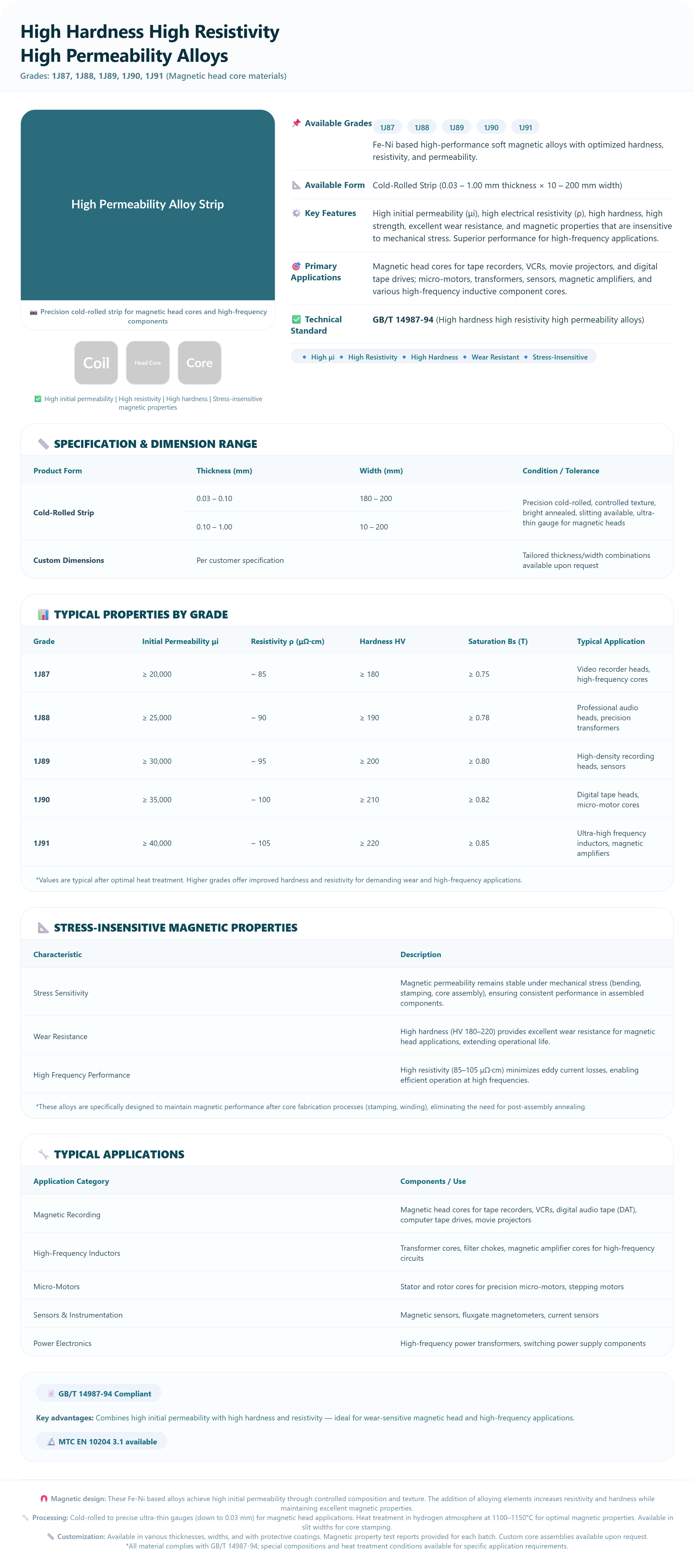
Fe-Ni based high permeability alloys (1J87-1J91) offer high initial permeability, high resistivity, and hardness. Ideal for magnetic head cores and high-frequency inductors. GB/T 14987-94 compliant.
High Hardness High Resistivity Soft Magnetic Alloys | 1J87 & 1J88
1J87, 1J88 and related high-hardness Fe-Ni soft magnetic alloys are designed for magnetic components that require high initial permeability, high electrical resistivity, good wear resistance and reduced sensitivity to mechanical stress. These precision soft magnetic alloys are particularly suitable for magnetic heads, sensor components, high-frequency magnetic cores, miniature motors, transformers and other precision magnetic devices.
Greenergy Materials supplies high-hardness, high-resistivity soft magnetic alloy materials in customized dimensions and delivery conditions according to application, magnetic performance and processing requirements.
What Are High Hardness High Resistivity Soft Magnetic Alloys?
High hardness high resistivity soft magnetic alloys are specialized iron-nickel (Fe-Ni) soft magnetic materials developed for applications where conventional high-permeability alloys may not provide sufficient mechanical durability or electrical resistance.
The 1J87, 1J88, 1J89, 1J90 and 1J91 grades are historically associated with this alloy family. Their characteristic combination of:
High initial magnetic permeability
High electrical resistivity
High hardness and strength
Good wear resistance
Relatively low sensitivity of magnetic properties to mechanical stress
makes this alloy family suitable for precision magnetic components exposed to mechanical wear, high-frequency operation or dimensional constraints.
For current material specifications, grade availability, applicable standards and delivery conditions, customers should confirm the required grade and product form with Greenergy Materials before ordering.
1J87 & 1J88 High Hardness Soft Magnetic Alloys
Among this alloy family, 1J87 and 1J88 are particularly important for high-hardness, high-resistivity Fe-Ni soft magnetic strip applications.
The current GB/T 14987-2016 standard is titled Iron-Nickel Soft Magnetic Alloy Cold-Rolled Strips with High Hardness and High Electrical Resistance and specifies 1J87 and 1J88 cold-rolled strip products.
The standard identifies applications including magnetic head components, sensor chips and special transformer components.
For buyers sourcing according to a current Chinese national standard, it is therefore important to distinguish the current 1J87/1J88 strip specification from historical references to 1J89, 1J90 and 1J91.
1J87, 1J88, 1J89, 1J90 & 1J91 Grade Overview
| Grade | Main Characteristics | Typical Application Focus |
|---|---|---|
| 1J87 | High initial permeability, high hardness, high resistivity and good wear resistance | Magnetic heads, sensor components, miniature motors, transformers |
| 1J88 | High initial permeability, high hardness and high electrical resistivity | Magnetic head components and precision magnetic cores |
| 1J89 | High-permeability Fe-Ni alloy with high hardness and electrical resistivity | Precision magnetic components and high-frequency applications |
| 1J90 | High-permeability alloy with high hardness and resistivity | Magnetic cores and precision electronic components |
| 1J91 | High-permeability alloy with high hardness and resistivity | Magnetic heads and high-frequency magnetic components |
Important: 1J89, 1J90 and 1J91 may appear in historical specifications and supplier catalogs for this alloy family. Their applicability should be confirmed against the customer's required product standard, material condition and delivery form.
Key Properties of 1J87 & 1J88
High Initial Magnetic Permeability
High initial permeability allows the material to respond effectively to relatively weak magnetic fields.
This characteristic is important in magnetic head components, sensors and precision magnetic circuits where the magnetic response at low field strength is critical.
High Electrical Resistivity
Compared with conventional low-resistivity magnetic materials, high electrical resistivity helps reduce eddy-current-related losses in applications involving changing magnetic fields.
This is particularly relevant to high-frequency magnetic components and thin magnetic strips.
High Hardness
Mechanical hardness is one of the defining characteristics of this alloy family.
High hardness can improve resistance to:
Surface wear
Mechanical abrasion
Contact-related damage
Dimensional changes during handling and processing
This makes the material particularly useful where the magnetic component also experiences mechanical contact or wear.
Good Wear Resistance
Magnetic head components and other precision magnetic parts can experience repeated mechanical interaction.
The combination of hardness, strength and magnetic performance makes these alloys suitable for applications where wear resistance is important.
Reduced Sensitivity to Mechanical Stress
Mechanical stress can influence the magnetic behavior of soft magnetic materials.
The high-hardness high-resistivity Fe-Ni alloy family is valued for relatively low magnetic sensitivity to mechanical stress, making it useful for precision components where dimensional stability and magnetic consistency are important.
Chemical Composition of 1J87 & 1J88
Typical composition ranges referenced in GB/T 14987-2016 include:
| Element | 1J87 | 1J88 |
|---|---|---|
| C | ≤0.03% | ≤0.03% |
| Si | ≤0.30% | ≤0.30% |
| P | ≤0.020% | ≤0.020% |
| S | ≤0.020% | ≤0.020% |
| Mn | 0.30–0.60% | 0.30–0.60% |
| Ni | 78.5–80.5% | 79.5–80.5% |
| Nb | 6.50–7.50% | 7.50–9.00% |
| Mo | 1.60–2.20% | — |
| Fe | Balance | Balance |
The exact chemical composition supplied with an order should be confirmed against the applicable material specification and the customer's purchase requirements.
Magnetic Properties of 1J87 & 1J88
Magnetic performance depends strongly on alloy grade, strip thickness, heat treatment, magnetic test method and delivery condition.
For this reason, Greenergy Materials recommends specifying the required magnetic parameters together with the material grade and dimensions.
Typical parameters that may be specified include:
Initial magnetic permeability
Maximum magnetic permeability
Saturation magnetic flux density
Coercive force
AC magnetic permeability
Frequency-dependent magnetic performance
Electrical resistivity
Hardness
For qualified production lots, technical data can be provided according to the agreed inspection and test requirements.
Do not publish generic magnetic-property values on the product page unless they are supported by your actual material certificate, test report or applicable standard.
Why High Resistivity Matters in High-Frequency Magnetic Components
When a magnetic material operates under an alternating magnetic field, electrical currents can be induced inside the material.
These eddy currents can contribute to energy loss and reduce magnetic efficiency.
Increasing electrical resistivity is therefore an important material-design strategy for certain high-frequency magnetic applications.
For this reason, high-resistivity Fe-Ni soft magnetic alloys can be considered when the application requires a combination of:
high permeability + electrical resistivity + mechanical hardness + wear resistance.
The appropriate grade should be selected based on operating frequency, magnetic field strength, component geometry, thickness, heat treatment and mechanical requirements.
Applications of 1J87 & 1J88 Soft Magnetic Alloys
Magnetic Heads
One of the most important application areas is the manufacture of precision magnetic head components.
The combination of magnetic permeability, hardness, wear resistance and electrical resistivity makes this alloy family suitable for magnetic head-related applications.
Potential applications include:
Magnetic tape heads
Recording head components
Magnetic head chips
Sensor chips
Precision magnetic elements
High-Frequency Magnetic Cores
These alloys can also be used in selected high-frequency magnetic components where electrical resistivity and magnetic response are important.
Applications may include:
High-frequency inductive components
Transformer cores
Sensor cores
Magnetic amplifier components
Precision magnetic circuits
Miniature Motors
Thin magnetic alloy components can be used in selected miniature motor and precision electromagnetic applications where both mechanical durability and magnetic properties are required.
Sensors
The combination of high permeability and relatively low stress sensitivity can be useful in selected magnetic sensing and detection components.
1J87 vs 1J88: Which Grade Should You Choose?
| Selection Factor | 1J87 | 1J88 |
|---|---|---|
| Initial permeability | High | High |
| Electrical resistivity | High | High |
| Hardness | High | High |
| Mechanical wear resistance | Excellent potential | Excellent potential |
| Magnetic head applications | Yes | Yes |
| High-frequency components | Yes | Yes |
| Alloy chemistry | Ni-Fe-Nb-Mo system | Ni-Fe-Nb system |
| Selection priority | Magnetic + mechanical balance | Magnetic + electrical resistance requirements |
The final grade should not be selected by grade number alone.
For procurement, provide:
Required alloy grade
Strip thickness
Strip width
Magnetic performance
Electrical resistivity requirement
Hardness requirement
Heat-treatment condition
Surface condition
Quantity
Applicable standard
Greenergy Materials can then evaluate the most appropriate material specification.
Available Product Forms
Depending on production capability and customer requirements, high-hardness soft magnetic alloys may be supplied in forms such as:
Cold-rolled strip
Precision strip
Coil
Sheet
Custom-cut magnetic components
Other forms subject to technical confirmation
For precision magnetic head applications, thin cold-rolled strip is particularly important because thickness, flatness, surface condition and heat treatment can directly influence downstream processing and magnetic performance.
Thickness and Dimensional Requirements
For high-performance magnetic materials, dimensional accuracy is not simply a purchasing specification.
Strip thickness can influence:
Magnetic permeability
AC magnetic behavior
Eddy-current losses
Heat-treatment response
Component dimensions
Stamping and forming performance
Therefore, buyers should specify the required thickness and width tolerance together with the magnetic requirements.
Greenergy Materials can evaluate customized dimensions according to the customer's application and manufacturing requirements.
Heat Treatment and Magnetic Performance
Heat treatment is a critical step in soft magnetic alloy production.
Cold working, residual stress, grain structure and annealing conditions can significantly influence magnetic properties.
For high-hardness high-resistivity Fe-Ni alloys, the required heat-treatment condition should therefore be considered together with:
Alloy grade
Strip thickness
Magnetic target
Hardness
Delivery condition
Final component manufacturing process
When ordering, customers should clarify whether the material is required in a hard cold-rolled condition, annealed condition or another agreed delivery state.
Quality Control for High-Hardness Soft Magnetic Alloys
For precision magnetic alloy procurement, chemical composition alone is not enough.
A reliable quality-control program should evaluate multiple parameters.
1. Chemical Composition
Verify the concentration of major alloying elements such as:
Ni
Nb
Mo
Mn
Si
C
P
S
2. Dimensional Inspection
Check:
Thickness
Width
Thickness tolerance
Width tolerance
Flatness
Edge condition
3. Magnetic Testing
Depending on the agreed specification:
Initial permeability
Maximum permeability
Saturation flux density
Coercive force
AC permeability
Frequency-dependent magnetic properties
4. Electrical Testing
Electrical resistivity can be evaluated where required by the purchase specification.
5. Hardness Testing
Hardness is especially important for this alloy family because mechanical durability is one of its defining advantages.
6. Surface Inspection
Precision strip should be checked for:
Scratches
Oxidation
Peeling
Delamination
Oil contamination
Surface defects
How to Choose a High Hardness Soft Magnetic Alloy
When selecting 1J87, 1J88 or related grades, use the following decision process.
Step 1: Define the Application
Is the material intended for:
Magnetic heads?
Sensors?
High-frequency cores?
Transformers?
Miniature motors?
Magnetic amplifiers?
Step 2: Define the Magnetic Requirement
Determine whether the priority is:
High initial permeability
High maximum permeability
Low coercivity
Low magnetic loss
Stable magnetic response
Step 3: Define the Mechanical Requirement
If the component experiences mechanical contact or wear, hardness and wear resistance become critical selection criteria.
Step 4: Define the Electrical Requirement
For high-frequency applications, evaluate electrical resistivity and frequency-dependent magnetic behavior.
Step 5: Define the Material Form
Specify:
Strip or sheet
Thickness
Width
Coil dimensions
Surface condition
Delivery state
Step 6: Match the Applicable Standard
For current 1J87/1J88 cold-rolled strip procurement, confirm the applicable version of the relevant standard rather than relying on older 1994-era supplier descriptions.
1J87/1J88 vs 1J79/1J85 High Initial Permeability Alloys
These two alloy families should not be treated as interchangeable.
| Feature | 1J87 / 1J88 | 1J79 / 1J85 |
|---|---|---|
| Main positioning | High hardness + high resistivity | High initial permeability |
| Mechanical hardness | Important | Application dependent |
| Wear resistance | Major advantage | Not the primary positioning |
| Electrical resistivity | High | High |
| Magnetic permeability | High | Very high initial permeability focus |
| Magnetic head applications | Strong fit | Also used in magnetic applications |
| High-frequency components | Suitable | Suitable |
| Selection priority | Magnetic + mechanical durability | Magnetic sensitivity/permeability |
If your application is primarily focused on maximum magnetic sensitivity and initial permeability, consider the 1J79/1J85 family.
If the application requires magnetic performance combined with high hardness, wear resistance and high electrical resistivity, 1J87/1J88 should be evaluated.
1J87/1J88 vs 1J22 High Saturation Induction Alloy
These materials solve different engineering problems.
| Property | 1J87 / 1J88 | 1J22 |
|---|---|---|
| Primary advantage | High hardness + high resistivity + high permeability | High saturation magnetic induction |
| Material family | Fe-Ni | Fe-Co based |
| Magnetic head applications | Suitable | Generally not the primary target |
| High-frequency components | Suitable | Application dependent |
| Mechanical wear resistance | Important advantage | Not the primary positioning |
| High saturation induction | Not the main selling point | Major advantage |
Therefore, do not optimize this page around the keyword high saturation induction alloy. That intent belongs to the 1J22 product page.
Technical Documentation Available on Request
For qualified inquiries, technical documentation may include:
Material specification
Chemical composition
Magnetic-property data
Electrical resistivity data
Hardness data
Dimensional tolerances
Inspection requirements
Material test reports
Packaging and shipping information
The exact documentation depends on the product grade, product form and customer specification.
Custom 1J87 & 1J88 Soft Magnetic Alloy Supply
Greenergy Materials supports custom sourcing for customers requiring specific combinations of:
Alloy grade
Strip thickness
Strip width
Magnetic performance
Electrical resistivity
Hardness
Heat treatment
Surface condition
Packaging
Quantity
For a quotation, send your required grade, dimensions, quantity, application and technical specification.
Our engineering team can help determine whether 1J87, 1J88 or another soft magnetic alloy is better suited to your application.
Frequently Asked Questions
What is 1J87 soft magnetic alloy?
1J87 is a high-hardness, high-electrical-resistivity Fe-Ni soft magnetic alloy designed for applications requiring magnetic performance together with mechanical durability and wear resistance.
What is 1J88 alloy used for?
1J88 is used for precision soft magnetic components, particularly applications involving magnetic heads and other magnetic components where high permeability, electrical resistivity and hardness are required.
Are 1J87 and 1J88 high permeability alloys?
Yes. Their product positioning combines high initial permeability with high hardness and high electrical resistivity rather than focusing only on permeability.
What is the difference between 1J87 and 1J88?
The main difference is their alloy chemistry and corresponding magnetic, electrical and mechanical characteristics. The correct grade should be selected according to the required magnetic properties, dimensions, hardness and applicable standard.
Are 1J87 and 1J88 suitable for magnetic heads?
Yes. Magnetic head components are an important application area for this high-hardness, high-resistivity Fe-Ni soft magnetic alloy family.
Are 1J87 and 1J88 suitable for high-frequency applications?
They can be used in selected high-frequency magnetic components. However, frequency, thickness, magnetic flux density and electrical resistivity should all be considered when selecting the material.
What is the difference between 1J87 and 1J79?
1J87 is positioned around the combination of high initial permeability, high hardness, high electrical resistivity and wear resistance. 1J79 is primarily positioned as a high-initial-permeability Fe-Ni soft magnetic alloy.
Can Greenergy supply customized dimensions?
Yes. Customized dimensions and technical requirements can be evaluated according to the required alloy grade, product form, quantity and application.
Can you provide material test reports?
Technical documentation and inspection reports can be provided according to the agreed product specification and order requirements.
Request a Quote for 1J87 / 1J88 Soft Magnetic Alloy
Looking for 1J87, 1J88 or other high-hardness high-resistivity soft magnetic alloys?
Send us your required:
Grade + Thickness + Width + Quantity + Application + Magnetic Requirements
Greenergy Materials can help you evaluate the appropriate Fe-Ni soft magnetic alloy and supply specification for your project.
Contact Greenergy Materials for a technical quotation and material recommendation.