



Previous
Next
High Initial Permeability Soft Magnetic Alloys | 1J79, 1J85 ,1J86,1J89| Permalloy & Supermalloy
- high initial permeability soft magnetic alloy
- 1J79 soft magnetic alloy
- 1J85 soft magnetic alloy
- 1J86 soft magnetic alloy
- 1J89 soft magnetic alloy
- high initial permeability alloy
- Fe-Ni soft magnetic alloy
- nickel iron soft magnetic alloy
Description
High initial permeability Fe-Ni alloys (1J79 Permalloy, 1J85 Supermalloy, 1J86, 1J89) offer ultra-high μi, low Hc, and low core loss. Ideal for sensors, transformers, and magnetic shielding. GBn 198-88 compliant.
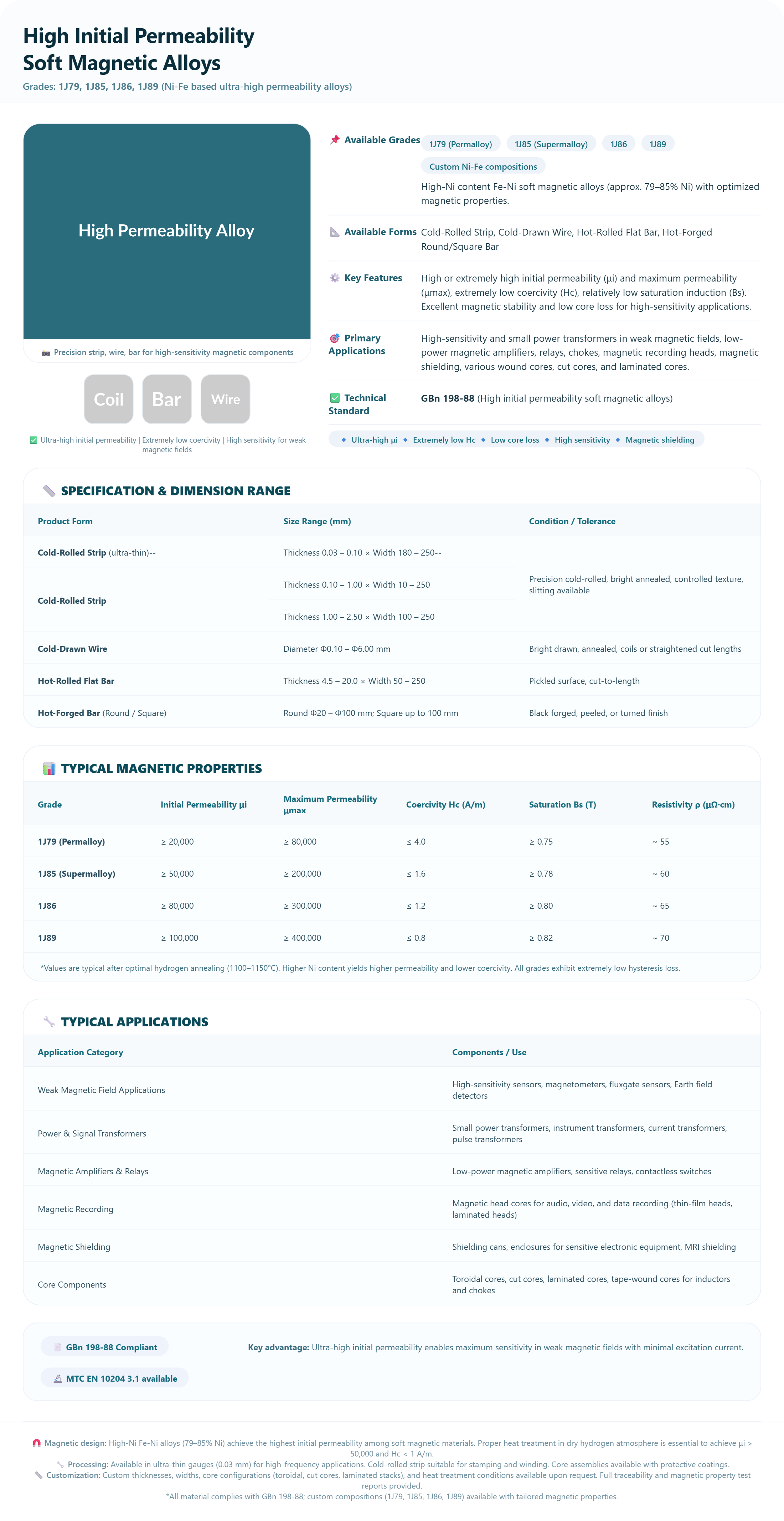
High Initial Permeability Soft Magnetic Alloys (1J79, 1J85, 1J86, 1J89)
1J79, 1J85, 1J86 and 1J89 are high initial permeability Fe-Ni soft magnetic alloys designed for magnetic circuits that require strong magnetic response under relatively weak magnetic fields.
These nickel-iron magnetic alloys are used in precision magnetic components including transformer cores, current transformers, magnetic amplifiers, chokes, magnetic shielding components, sensors, relays and other low-field electromagnetic applications.
Among these grades, 1J79 is commonly associated with Permalloy 80, while 1J85 is commonly associated with Supermalloy-type high-permeability materials. The appropriate grade should be selected according to the required permeability, coercive force, saturation induction, frequency, thickness and heat-treatment condition.
Greenergy Materials supplies high initial permeability soft magnetic alloys in customized forms and dimensions for industrial and precision magnetic applications.
What Is a High Initial Permeability Soft Magnetic Alloy?
A high initial permeability soft magnetic alloy is a material that can achieve a strong increase in magnetic induction under a relatively weak applied magnetic field.
The term initial permeability describes the magnetic response of a material at low magnetic field strength.
This property is particularly important when a magnetic component operates in a weak-field region and needs to produce a significant magnetic response without requiring a strong magnetizing field.
High initial permeability Fe-Ni alloys are therefore widely used in:
Low-field magnetic cores
Signal transformers
Current transformers
Chokes
Magnetic amplifiers
Magnetic shielding
Sensors
Relays
Precision electromagnetic components
Why Is Initial Permeability Important?
Magnetic permeability describes how easily a material supports magnetic flux when exposed to an external magnetic field.
For a low-field magnetic circuit, high initial permeability can provide several advantages:
Strong magnetic response at low field strength
Efficient magnetic flux conduction
High sensitivity to small magnetic fields
Improved magnetic coupling
Reduced magnetizing requirements
Suitable performance for weak-signal magnetic circuits
For this reason, high initial permeability is often more important than maximum saturation induction in low-field applications.
1J79, 1J85, 1J86 and 1J89 Soft Magnetic Alloys
| Alloy Grade | Material Family | Main Magnetic Characteristic | Typical Selection |
|---|---|---|---|
| 1J79 | Fe-Ni-Mo | High initial permeability | Transformers, current transformers, chokes, shielding |
| 1J85 | Fe-Ni-Mo | Very high permeability / high initial permeability | Precision magnetic cores, transformers, weak-signal applications |
| 1J86 | Fe-Ni | High initial permeability | Low-field magnetic circuits and precision magnetic components |
| 1J89 | Fe-Ni soft magnetic alloy | High-permeability material for specialized magnetic applications | Application-dependent |
Actual magnetic properties depend on material composition, thickness, processing condition, annealing and test conditions. The final alloy grade should therefore be selected using the applicable technical specification rather than the grade name alone.
1J79 Permalloy
1J79 is a nickel-iron soft magnetic alloy commonly associated with Permalloy 80-type materials.
Permalloy is a family of Fe-Ni magnetic alloys known for high permeability, particularly in weak magnetic fields.
1J79 is suitable for applications requiring a combination of:
High initial permeability
Low coercive force
Good magnetic response at low field strength
Suitable electrical resistivity
Precision processing capability
Typical applications include:
Transformer cores
Current transformer cores
Common-mode chokes
Magnetic shielding
Relays
Magnetic amplifiers
Low-field magnetic circuits
Public technical references commonly associate 1J79 with Permalloy 80 and list it among high-initial-permeability soft magnetic alloys.
1J85 Supermalloy-Type Soft Magnetic Alloy
1J85 is a high-permeability Fe-Ni-Mo soft magnetic alloy commonly associated with Supermalloy.
Supermalloy-type materials are designed for extremely high permeability and low-field magnetic applications.
1J85 can be considered when an application requires:
Very high magnetic permeability
Low coercive force
Strong response under weak magnetic fields
High magnetic sensitivity
Precision magnetic-core performance
Typical applications include:
Precision transformer cores
Input and output transformers
Current transformers
Common-mode inductors
Magnetic shielding
Weak-signal magnetic circuits
Precision sensors
Public technical references identify 1J85 as a high-initial-permeability soft magnetic alloy and associate it with Supermalloy-type materials.
1J86 High Initial Permeability Alloy
1J86 is another Fe-Ni soft magnetic alloy in the high initial permeability category.
Its selection should be based on the required:
Initial permeability
Maximum permeability
Coercive force
Saturation induction
Frequency
Thickness
Heat-treatment condition
For precision applications, customers should request the applicable magnetic-property data for the actual material condition being supplied.
1J89 Soft Magnetic Alloy
1J89 can be supplied as a high-permeability Fe-Ni soft magnetic alloy for specialized magnetic applications.
Because magnetic performance can vary with processing and heat treatment, 1J89 should be selected according to the actual application requirements and applicable material specification.
For quotation, customers are encouraged to provide the target magnetic properties, operating frequency, field strength, dimensions and required material form.
Chemical Composition
The 1J79 and 1J85 grades belong to the high-initial-permeability Fe-Ni alloy family.
Typical standard-based composition ranges include:
| Element | 1J79 | 1J85 |
|---|---|---|
| C | ≤0.03% | ≤0.03% |
| P | ≤0.02% | ≤0.02% |
| S | ≤0.02% | ≤0.02% |
| Mn | 0.60–1.10% | 0.30–0.60% |
| Si | 0.30–0.50% | 0.15–0.30% |
| Ni | 78.5–80.0% | 79.0–81.0% |
| Mo | — | 4.80–5.20% |
| Cu | ≤0.20% | ≤0.20% |
| Fe | Balance | Balance |
Published standard-related data also places 1J86 in the high-initial-permeability category, with an Ni range of approximately 80.5–81.5% and Mo of approximately 5.8–6.2%.
Note: Chemical composition should be confirmed against the applicable current material standard and the actual production specification before publication or procurement.
Magnetic Properties of High Initial Permeability Alloys
The most important magnetic parameters for this material family include:
Initial permeability
Maximum permeability
Coercive force
Saturation magnetic induction
Remanent induction
Magnetic loss
AC permeability
Electrical resistivity
Curie temperature
A suitable technical data sheet should evaluate these properties under defined test conditions.
For example, published technical data for 1J79 and 1J85 shows that permeability varies with strip thickness and test frequency, demonstrating why the material grade alone is not sufficient to predict final AC magnetic performance.
Initial Permeability vs Maximum Permeability
These two terms should not be treated as interchangeable.
Initial Permeability
Initial permeability describes the magnetic response of the material at very low magnetic field strength.
It is particularly important for:
Weak magnetic fields
Signal transformers
Sensors
Magnetic shielding
Precision magnetic circuits
Maximum Permeability
Maximum permeability represents the highest permeability reached within a specified magnetization range.
It can be important for magnetic cores and applications requiring efficient magnetic flux conduction over a wider magnetic field range.
Therefore, when purchasing a high-permeability alloy, buyers should specify which permeability parameter is required.
Applications of High Initial Permeability Soft Magnetic Alloys
Transformer Cores
1J79 and 1J85 can be considered for transformer cores where high permeability and low-field magnetic response are important.
Applications include:
Signal transformers
Input transformers
Output transformers
Pulse transformers
Small-signal transformers
Frequency and core geometry should be considered when selecting material thickness.
Current Transformers
High initial permeability alloys can be used for current transformer cores where a strong magnetic response is required under relatively low magnetic excitation.
Material selection should consider:
Frequency
Excitation level
Core dimensions
Saturation margin
Required accuracy
Magnetic loss
Magnetic Shielding
Permalloy-type Fe-Ni alloys are widely used for magnetic shielding applications because their high permeability can provide a low-reluctance path for magnetic flux.
Possible applications include:
Electronic instruments
Sensors
Precision measurement equipment
Communication equipment
Magnetic detectors
Sensitive electronic components
Shielding performance depends on material thickness, magnetic field strength, frequency, geometry and annealing condition.
Chokes and Common-Mode Inductors
1J79 and related high-permeability alloys can be considered for choke and common-mode magnetic components where high permeability is required.
Magnetic Amplifiers
High initial permeability materials can be used in magnetic amplifier cores and low-field control circuits.
Magnetic Sensors
High-permeability Fe-Ni alloys can be used in magnetic sensor components where sensitivity to small magnetic fields is important.
Relays and Electromagnetic Components
These alloys can also be considered for relay cores, pole pieces and other electromagnetic components that operate within the appropriate magnetic field range.
1J79 vs 1J85 vs 1J86 vs 1J89
The four grades should not be selected only according to their nominal nickel content.
The correct grade depends on the target application.
| Requirement | Recommended Evaluation |
|---|---|
| Very high initial permeability | 1J85 / applicable high-permeability grade |
| Permalloy-type application | 1J79 |
| Weak magnetic field | Compare initial permeability |
| Transformer core | Compare permeability, frequency and losses |
| Magnetic shielding | Compare permeability and shielding geometry |
| Current transformer | Compare permeability, saturation and accuracy requirements |
| High-frequency application | Evaluate AC permeability and material thickness |
| Precision magnetic component | Evaluate heat treatment and dimensional tolerance |
Final grade selection should be based on the customer's magnetic circuit and required test conditions.
1J79 vs 1J85: What Is the Difference?
1J79 and 1J85 are both high initial permeability Fe-Ni soft magnetic alloys, but their alloy compositions are different.
1J79 contains approximately 78.5–80.0% Ni and is commonly associated with Permalloy 80-type materials.
1J85 contains approximately 79.0–81.0% Ni and approximately 4.8–5.2% Mo and is commonly associated with Supermalloy-type materials.
The Mo-containing composition of 1J85 is associated with its high-permeability material design.
For a precision application, compare the actual initial permeability, maximum permeability, coercive force and saturation characteristics rather than selecting solely by the commercial material name.
High Initial Permeability vs High Saturation Induction
These are different material-selection priorities.
| Requirement | High Initial Permeability Alloy | High Saturation Induction Alloy |
|---|---|---|
| Weak-field sensitivity | Excellent | Application dependent |
| Initial permeability | Primary property | Not always primary |
| Saturation induction | Secondary consideration | Primary property |
| Typical material | 1J79 / 1J85 / 1J86 / 1J89 | 1J22 |
| Typical application | Sensors, shielding, signal transformers | High-flux magnetic circuits |
| Main design priority | Magnetic response at low field | Maximum usable magnetic flux |
For very high flux density applications, see our 1J22 high saturation induction soft magnetic alloy.
High Initial Permeability Alloy vs 1J46 / 1J50 / 1J54
1J46, 1J50 and 1J54 belong to a different soft magnetic alloy group emphasizing a balance between high permeability and higher saturation magnetic induction.
By comparison, 1J79, 1J85, 1J86 and 1J89 are positioned primarily around high initial permeability and weak-field magnetic performance.
Choose according to the actual design requirement:
Weak magnetic field → High initial permeability alloy
High flux density → High saturation induction alloy
Balanced permeability and saturation → 1J46 / 1J50 / 1J54
Very high saturation induction → 1J22
Available Material Forms
Depending on the alloy grade and production requirements, high initial permeability soft magnetic alloys can be supplied as:
Cold-rolled strip
Precision strip
Thin strip
Sheet
Foil
Wire
Rod
Customized magnetic components
For precision magnetic applications, customers can specify:
Thickness
Width
Length
Diameter
Dimensional tolerance
Surface condition
Edge condition
Hardness
Heat treatment
Packaging
Thin-strip applications are particularly important for high-frequency magnetic components because material thickness can influence eddy-current losses and AC magnetic performance.
Heat Treatment and Magnetic Performance
Heat treatment is one of the most important factors affecting the final magnetic performance of high-permeability Fe-Ni alloys.
The same nominal alloy grade can exhibit different magnetic characteristics depending on:
Cold-working condition
Annealing temperature
Annealing atmosphere
Holding time
Cooling rate
Final stress condition
Product thickness
For high-performance applications, material selection and heat treatment should therefore be considered together.
Manufacturing and Quality Control
For high initial permeability soft magnetic alloys, chemical composition alone does not guarantee the required magnetic performance.
Our quality-control process can include:
Chemical Composition Testing
Verify the alloy composition against the required grade and applicable material specification.
Dimensional Inspection
Check:
Thickness
Width
Length
Diameter
Flatness
Dimensional tolerance
Surface Inspection
Inspect the surface for scratches, oxidation, cracks, inclusions and other defects that may affect processing or component performance.
Magnetic Property Testing
Depending on the specification, magnetic testing can include:
Initial permeability
Maximum permeability
Coercive force
Saturation magnetic induction
Remanence
AC permeability
Hysteresis characteristics
Heat Treatment Control
Heat treatment is controlled according to the required magnetic performance and material specification.
Custom High Initial Permeability Alloy Supply
Greenergy Materials supplies high initial permeability Fe-Ni soft magnetic alloys for industrial and precision applications.
Customers can request customized:
Alloy grade
Thickness
Width
Length
Diameter
Tolerance
Surface condition
Heat treatment
Magnetic performance
Packaging
Quantity
For a new application, please provide:
Operating frequency
Magnetic field strength
Required initial permeability
Required maximum permeability
Saturation induction requirement
Component dimensions
Operating temperature
Material form
Required quantity
This information allows the material specification to be evaluated more accurately.
Technical Documentation
For industrial procurement, technical documentation can be supplied according to the agreed specification.
Potential documentation includes:
Chemical composition report
Magnetic property report
Dimensional inspection report
Material Test Certificate
Heat-treatment information
Product specification
Packing documentation
For critical magnetic applications, customers should specify the required test method and acceptance criteria before production.
Why Choose Greenergy Materials?
Greenergy Materials specializes in special alloys, soft magnetic materials and electromagnetic components.
Our soft magnetic alloy portfolio includes:
High initial permeability soft magnetic alloys
1J79 Permalloy-type alloys
1J85 Supermalloy-type alloys
1J86 and 1J89 high-permeability alloys
1J22 high saturation induction Fe-Co-V alloy
1J46 / 1J50 / 1J54 high permeability and higher saturation alloys
Rectangular hysteresis loop soft magnetic alloys
Magnetic temperature compensation alloys
Corrosion-resistant soft magnetic alloys
Constant permeability soft magnetic alloys
This allows customers to compare different soft magnetic alloy families according to magnetic performance rather than selecting a material solely by nominal grade.
Frequently Asked Questions
What is a high initial permeability soft magnetic alloy?
A high initial permeability soft magnetic alloy is a material that provides a strong magnetic response under relatively weak magnetic fields. It is commonly used in low-field magnetic circuits, transformers, sensors, shielding and precision magnetic components.
What is 1J79 alloy?
1J79 is a high initial permeability Fe-Ni soft magnetic alloy commonly associated with Permalloy 80-type materials.
What is 1J85 alloy?
1J85 is a high initial permeability Fe-Ni-Mo soft magnetic alloy commonly associated with Supermalloy-type materials.
Is 1J79 the same as Permalloy 80?
1J79 is commonly associated with Permalloy 80-type material, but exact equivalence should be verified against chemical composition, magnetic properties, product form and applicable specifications.
Is 1J85 the same as Supermalloy?
1J85 is commonly associated with Supermalloy-type high-permeability materials. However, exact equivalence should be confirmed using the applicable material specification and magnetic-property requirements.
What is 1J86?
1J86 is an Fe-Ni soft magnetic alloy in the high initial permeability category. It should be selected according to its actual magnetic-property requirements and applicable specification.
What is 1J89?
1J89 is a high-permeability soft magnetic alloy grade used for specialized magnetic applications. The appropriate specification should be confirmed according to the required magnetic properties and product form.
What is initial permeability?
Initial permeability describes the magnetic response of a material at low magnetic field strength. It is especially important for weak-field magnetic circuits.
What is the difference between initial permeability and maximum permeability?
Initial permeability describes the low-field magnetic response, while maximum permeability represents the highest permeability reached over a specified magnetization range.
Are high initial permeability alloys suitable for magnetic shielding?
Yes. High-permeability Fe-Ni alloys such as Permalloy-type materials can be used for magnetic shielding when the material thickness, field strength, frequency, geometry and heat treatment are properly selected.
Can 1J79 and 1J85 be used for transformer cores?
Yes. They can be considered for transformer and signal-transformer cores where high permeability and low-field magnetic performance are required. Frequency and core-loss requirements should be considered during material selection.
Can these alloys be used for current transformers?
Yes. High-permeability Fe-Ni alloys can be used in current transformer cores, particularly where magnetic sensitivity and low excitation requirements are important.
Can you provide customized dimensions?
Yes. Thickness, width, length, diameter, tolerance, surface condition and other requirements can be discussed according to production capability.
Can you provide samples?
Sample or trial orders can be discussed before mass production.
Request a Quote for High Initial Permeability Soft Magnetic Alloy
Looking for 1J79, 1J85, 1J86 or 1J89 high initial permeability soft magnetic alloy?
Send us your:
Required alloy grade
Thickness / width / length
Operating frequency
Magnetic field strength
Required initial permeability
Required maximum permeability
Operating temperature
Application
Quantity
Required technical documents
Our technical team can help evaluate the appropriate Fe-Ni high-permeability magnetic material for your application.
Request a Quote | Ask for Technical Data | Discuss Custom Alloy Requirements
Greenergy Materials supplies high initial permeability soft magnetic alloys for transformers, current transformers, magnetic shielding, sensors, chokes, relays and precision electromagnetic components.