



Previous
Next
1J46 1J50 1J54 Soft Magnetic Alloys | High Permeability & Saturation
- 1J50 soft magnetic alloy
- 1J46 soft magnetic alloy
- 1J54 soft magnetic alloy
- high permeability soft magnetic alloy
- high saturation induction soft magnetic alloy
- Fe-Ni soft magnetic alloy
- 1J46 1J50 1J54 alloy
Description
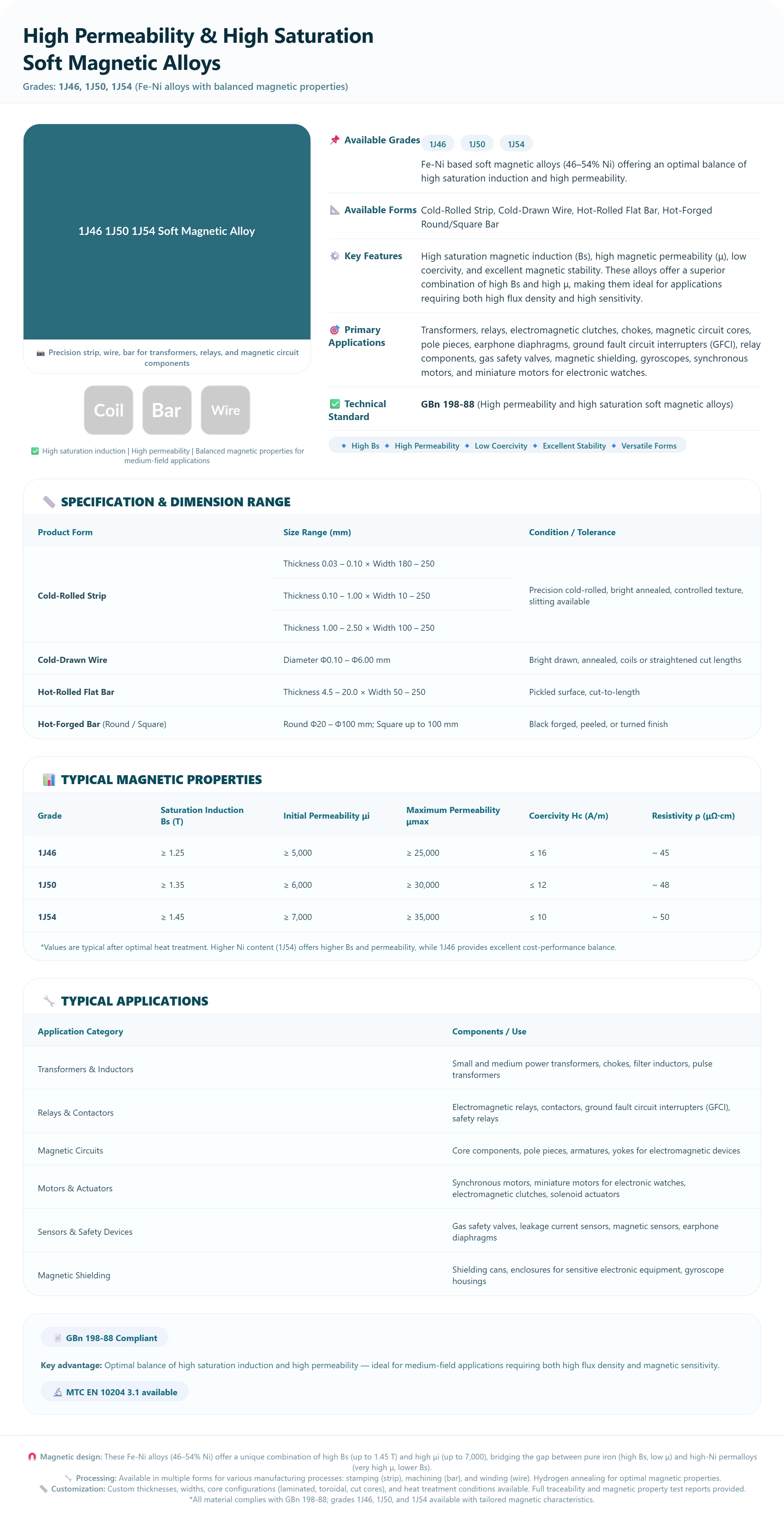
Fe-Ni based soft magnetic alloys (1J46, 1J50, 1J54) offer balanced high saturation induction and high permeability. Ideal for transformers, relays, motors, and magnetic circuits. GBn 198-88 compliant.
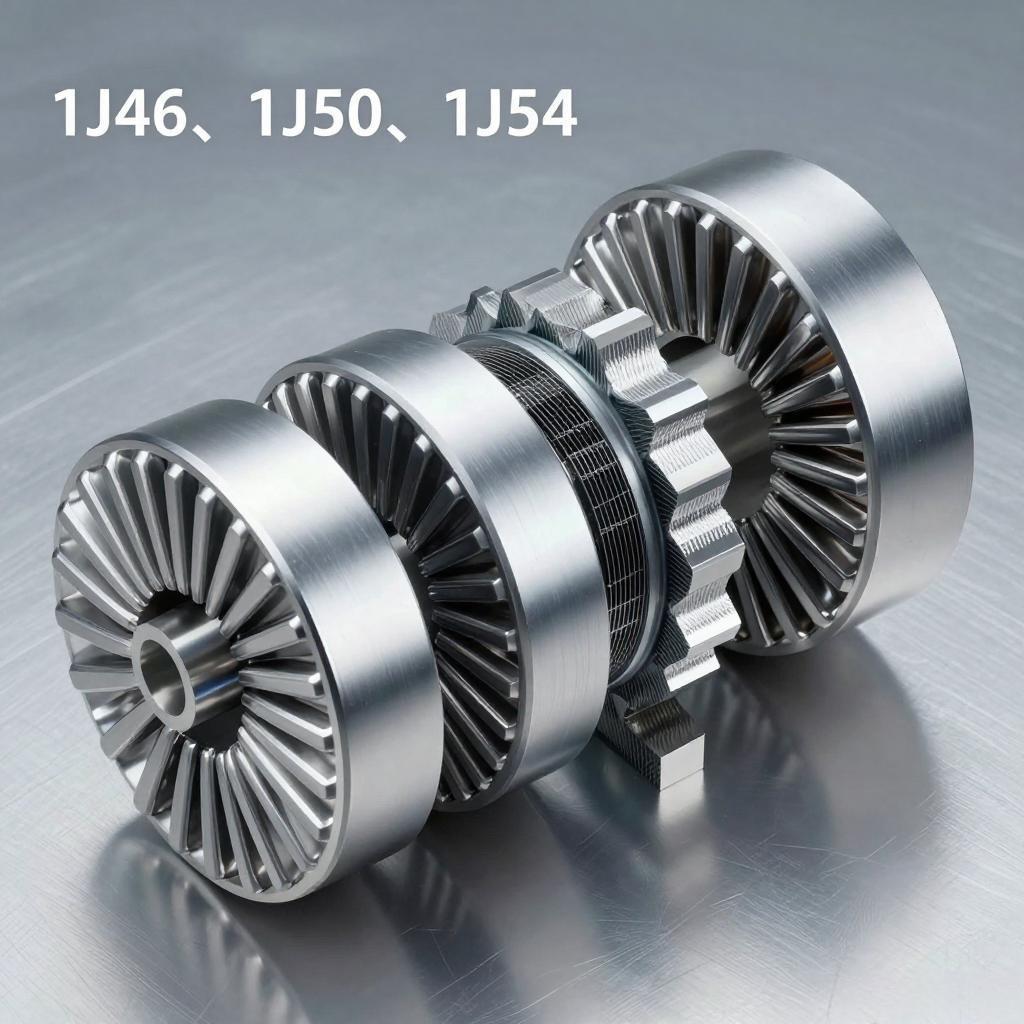
1J46, 1J50 and 1J54 High Permeability Soft Magnetic Alloys
1J46, 1J50 and 1J54 are Fe-Ni soft magnetic alloys developed for applications requiring a combination of high magnetic permeability and relatively high saturation magnetic induction.
These alloys are used in magnetic circuits operating at moderate magnetic fields, including transformer cores, relay components, electromagnetic clutches, chokes, magnetic cores and other precision electromagnetic components.
Greenergy Materials supplies 1J46, 1J50 and 1J54 soft magnetic alloys in customized material forms and dimensions according to application requirements, material specifications and production needs.
What Are 1J46, 1J50 and 1J54 Soft Magnetic Alloys?
1J46, 1J50 and 1J54 belong to the Fe-Ni family of soft magnetic alloys with high permeability and higher saturation magnetic induction.
Compared with conventional soft magnetic materials designed primarily for general electromagnetic applications, these alloys provide a useful balance between:
Magnetic permeability
Saturation magnetic induction
Coercive force
Magnetic response
Electrical resistivity
Processability
They are particularly useful when a magnetic component needs both good permeability and sufficient magnetic flux capacity.
Key Properties of 1J46, 1J50 and 1J54
High Magnetic Permeability
High permeability allows a magnetic material to respond effectively to a relatively small magnetizing field.
This makes 1J46, 1J50 and 1J54 suitable for magnetic circuits where efficient flux conduction is required.
Typical applications include:
Transformer cores
Relay cores
Electromagnetic components
Magnetic shielding components
Chokes
Magnetic circuit parts
Higher Saturation Magnetic Induction
One of the defining characteristics of this alloy family is its relatively high saturation magnetic induction compared with many high-permeability Fe-Ni alloys.
This provides a useful balance between permeability and magnetic flux capacity.
The published material classification identifies 1J46, 1J50 and 1J54 as soft magnetic alloys with high permeability and higher saturation magnetic induction.
Low Coercive Force
Low coercive force is important for soft magnetic applications because it allows the material to magnetize and demagnetize more easily.
Actual coercive force depends on alloy grade, product form, thickness, heat treatment and test conditions.
Stable Magnetic Performance
For industrial magnetic components, consistent material properties are important for maintaining repeatable component performance.
Material processing and final heat treatment should therefore be controlled according to the applicable material specification.
1J46 vs 1J50 vs 1J54
Although all three grades belong to the same high-permeability and higher-saturation-induction family, their compositions and magnetic characteristics are not identical.
| Alloy Grade | Main Alloy System | Main Characteristics | Typical Selection |
|---|---|---|---|
| 1J46 | Fe-Ni | High permeability and relatively high saturation induction | Magnetic cores, transformers, relays and magnetic circuit components |
| 1J50 | Fe-Ni | High permeability with higher saturation magnetic induction | Transformer cores, relays, electromagnetic components and motors |
| 1J54 | Fe-Ni-Cr | High permeability and higher saturation induction with Cr addition | Magnetic components requiring the characteristics of this modified Fe-Ni grade |
The appropriate grade should be selected according to the required magnetic properties, operating field, product form, heat treatment and application.
Chemical Composition of 1J46, 1J50 and 1J54
Typical standard-based composition ranges are summarized below.
| Grade | Ni (%) | Mn (%) | Si (%) | Cr (%) | Cu (%) | Fe |
|---|---|---|---|---|---|---|
| 1J46 | 45.0–46.5 | 0.60–1.10 | 0.15–0.30 | — | ≤0.20 | Balance |
| 1J50 | 49.0–50.5 | 0.30–0.60 | 0.15–0.30 | — | ≤0.20 | Balance |
| 1J54 | 49.5–51.0 | 0.60–1.10 | 0.60–1.40* | 3.80–4.20 | ≤0.20 | Balance |
*The exact Si range should be confirmed against the applicable current material standard and the production specification used for your order.
The published standard-related data confirms the distinct Ni and Cr composition ranges of these three grades.
Magnetic Properties of 1J46 and 1J50
Magnetic properties should always be evaluated according to the product form, thickness, test method and heat-treatment condition.
For example, published technical data for 1J46 shows different permeability and coercive-force requirements at different strip thicknesses, while 1J50 data likewise varies with thickness and frequency.
A typical technical data table for production should therefore include:
| Property | 1J46 | 1J50 | 1J54 |
|---|---|---|---|
| Initial / low-field permeability | According to specification | According to specification | According to specification |
| Maximum permeability | According to specification | According to specification | According to specification |
| Coercive force | According to specification | According to specification | According to specification |
| Saturation magnetic induction | According to specification | According to specification | According to specification |
| Electrical resistivity | According to specification | According to specification | According to specification |
| Product form | Strip / wire / bar / customized | Strip / wire / bar / customized | Strip / wire / bar / customized |
For quotation and production, Greenergy Materials can provide the applicable technical data according to the selected grade and product specification.
Why Choose a High Permeability and Higher Saturation Alloy?
Magnetic material selection is usually a trade-off between different properties.
A material with extremely high permeability may not always provide the required saturation magnetic induction.
Conversely, a material with extremely high saturation induction may not provide the permeability required by a low-field magnetic circuit.
1J46, 1J50 and 1J54 are designed for applications where engineers need a practical balance between these properties.
They can therefore be considered when the magnetic circuit requires:
Good magnetic permeability
Relatively high saturation induction
Low coercive force
Stable magnetic response
Suitable mechanical processing characteristics
Applications of 1J46, 1J50 and 1J54
Transformer Cores
1J46, 1J50 and 1J54 can be used in selected transformer core applications where high permeability and adequate saturation magnetic induction are required.
Material thickness and magnetic loss requirements should be considered according to operating frequency.
Relay Cores
These Fe-Ni soft magnetic alloys can be used for relay magnetic circuits and electromagnetic switching components.
Their magnetic characteristics allow efficient flux conduction within the magnetic circuit.
Electromagnetic Clutches
The combination of permeability and saturation capability makes these alloys suitable for selected electromagnetic clutch components.
Chokes and Magnetic Components
1J46, 1J50 and 1J54 can be considered for magnetic circuit components such as chokes and magnetic cores operating within their specified field conditions.
Magnetic Circuit Components
Applications may include:
Magnetic cores
Pole pieces
Magnetic shields
Electromagnetic actuators
Relay components
Magnetic circuit parts
Precision electromagnetic components
Motors and Electromagnetic Devices
Certain 1J-series Fe-Ni alloys are used in magnetic components of motors and other electromagnetic devices where the balance between permeability and saturation induction is important.
1J46 vs 1J50 vs 1J54: How to Choose?
The correct grade should not be selected only by the alloy number.
Choose 1J46 When
Consider 1J46 when your application requires the magnetic characteristics associated with its approximately 45–46.5% nickel composition and high-permeability / higher-saturation material class.
Choose 1J50 When
1J50 is a common choice when the application requires approximately 49–50.5% nickel Fe-Ni soft magnetic material with a combination of permeability and higher saturation induction.
Choose 1J54 When
1J54 should be considered when the application requires the specific magnetic and compositional characteristics of its Ni-Cr-containing Fe-Ni alloy system.
For final selection, compare the required magnetic properties with the actual material datasheet.
1J50 Soft Magnetic Alloy for Medium Magnetic Fields
1J46, 1J50 and 1J54 are commonly considered for magnetic circuits operating in moderate magnetic fields.
This differentiates them from several other soft magnetic alloy families on the market.
For example:
1J22 is selected primarily for very high saturation induction.
1J76 / 1J79 / 1J85 are selected for high initial or maximum permeability.
1J34 / 1J51 are selected for rectangular hysteresis characteristics.
1J30 / 1J31 / 1J32 / 1J33 / 1J38 are used for magnetic temperature compensation.
1J46 / 1J50 / 1J54 provide a balance between permeability and higher saturation magnetic induction.
This distinction is important when selecting a material for a specific magnetic circuit.
Comparison with 1J22 High Saturation Induction Alloy
| Feature | 1J46 / 1J50 / 1J54 | 1J22 |
|---|---|---|
| Main alloy family | Fe-Ni | Fe-Co-V |
| Primary advantage | Permeability + higher saturation induction | Very high saturation induction |
| Magnetic field application | Moderate magnetic fields | High-flux magnetic circuits |
| Typical applications | Transformers, relays, magnetic cores | Electromagnets, high-flux magnetic systems |
| Material selection priority | Balanced magnetic properties | Maximum saturation capability |
If your main requirement is maximum saturation induction, 1J22 may be more appropriate.
If the application requires a balance between permeability and saturation induction, 1J46, 1J50 or 1J54 may be more suitable.
Comparison with High Initial Permeability Alloys
High initial permeability alloys such as other Fe-Ni grades are designed primarily for strong magnetic response under weak magnetic fields.
1J46, 1J50 and 1J54 are instead positioned in the material family combining high permeability with higher saturation magnetic induction.
Therefore, the best material depends on whether the application prioritizes:
Initial permeability
Maximum permeability
Saturation induction
Coercive force
Frequency
Magnetic loss
Operating field
Available Forms
Depending on alloy grade and production requirements, 1J46, 1J50 and 1J54 can be supplied in forms such as:
Cold-rolled strip
Precision strip
Thin strip
Sheet
Wire
Rod
Hot-rolled flat material
Forged bar
Customized magnetic components
Published technical references show these alloy grades in cold-rolled strip and other industrial forms, with available dimensions depending on product type and specification.
Custom 1J46, 1J50 and 1J54 Alloy Supply
Greenergy Materials supports customized material supply for industrial magnetic applications.
Customers can specify:
Alloy grade
Thickness
Width
Length
Diameter
Dimensional tolerance
Surface condition
Edge condition
Heat treatment
Magnetic performance requirements
Packaging requirements
Quantity
For a new application, providing the magnetic field, operating frequency, temperature range and component geometry will help determine the appropriate material specification.
Manufacturing and Quality Control
For high-permeability soft magnetic alloys, final magnetic properties depend not only on chemical composition but also on processing and heat treatment.
Our quality-control process can include:
Chemical Composition Inspection
The chemical composition is checked against the required alloy grade and applicable specification.
Dimensional Inspection
Thickness, width, diameter, length and dimensional tolerances can be inspected according to the purchase specification.
Surface Inspection
The material surface is checked for defects that could affect further processing or component performance.
Magnetic Property Testing
Depending on the order specification, magnetic testing can include:
Magnetic permeability
Maximum permeability
Coercive force
Saturation magnetic induction
AC magnetic properties
Hysteresis characteristics
Heat Treatment Control
Appropriate heat treatment is important for achieving the required soft magnetic characteristics.
The final heat-treatment condition should be specified according to the application and applicable material standard.
Technical Data and Material Documentation
For industrial procurement, we recommend requesting technical documentation before placing a production order.
Depending on the order, documentation may include:
Material specification
Chemical composition report
Magnetic property data
Dimensional inspection report
Surface inspection record
Material Test Certificate
Heat-treatment information
Packing and shipping documentation
Technical values should always be confirmed for the exact grade, product form, dimensions and heat-treatment condition supplied.
Why Choose Greenergy Materials?
Greenergy Materials supplies special alloys and magnetic materials for industrial applications.
Our soft magnetic alloy range includes:
1J46, 1J50 and 1J54 high permeability alloys
1J22 high saturation induction alloy
Rectangular hysteresis loop soft magnetic alloys
Magnetic temperature compensation alloys
High initial permeability soft magnetic alloys
Corrosion-resistant soft magnetic alloys
Constant permeability soft magnetic alloys
High-hardness and high-resistivity magnetic alloys
This broader product range allows customers to compare different magnetic alloy families according to actual application requirements.
Frequently Asked Questions
What are 1J46, 1J50 and 1J54?
1J46, 1J50 and 1J54 are Fe-Ni soft magnetic alloys classified for high permeability and relatively high saturation magnetic induction.
What is 1J50 soft magnetic alloy used for?
1J50 can be used in transformer cores, relay components, electromagnetic devices, magnetic circuit parts and other applications requiring a combination of permeability and saturation magnetic induction.
What is the difference between 1J46 and 1J50?
The main difference is their alloy composition and resulting magnetic characteristics. 1J46 contains approximately 45.0–46.5% Ni, while 1J50 contains approximately 49.0–50.5% Ni under the referenced standard composition ranges.
What is 1J54?
1J54 is an Fe-Ni-Cr soft magnetic alloy containing approximately 49.5–51.0% Ni and 3.8–4.2% Cr under the referenced composition range.
Are 1J46, 1J50 and 1J54 high permeability alloys?
Yes. They belong to the material category of soft magnetic alloys with high permeability and higher saturation magnetic induction.
What is the saturation magnetic induction of 1J50?
Published technical data gives a saturation magnetic induction requirement of approximately 1.5 T for specified 1J50 product forms. However, the exact value should be confirmed against the applicable standard, product thickness and test condition for your order.
Can 1J50 replace 1J79?
Not automatically. 1J50 and 1J79 belong to different soft magnetic alloy categories and should be selected according to permeability, saturation induction, field strength, frequency and other application requirements.
What is the difference between 1J50 and 1J22?
1J50 is an Fe-Ni alloy emphasizing a combination of high permeability and higher saturation magnetic induction. 1J22 is an Fe-Co-V alloy designed for substantially higher saturation induction. The two materials therefore serve different magnetic design priorities.
Can 1J46, 1J50 and 1J54 be customized?
Yes. Customized thickness, width, length, diameter, tolerances, surface condition and heat-treatment requirements can be discussed according to production capability and order requirements.
Can you supply samples?
Sample or trial orders can be discussed before larger production quantities.
Can you provide a material test certificate?
Material documentation can be provided according to the agreed product grade and purchase specification. Please specify required documents when requesting a quotation.
Request a Quote for 1J46, 1J50 or 1J54 Soft Magnetic Alloy
Looking for 1J46, 1J50 or 1J54 high permeability soft magnetic alloy?
Send us your:
Required alloy grade
Thickness or diameter
Width and length
Quantity
Operating frequency
Magnetic field
Operating temperature
Application
Required magnetic properties
Required technical documents
Our technical team can help you evaluate the appropriate Fe-Ni soft magnetic alloy for your magnetic circuit.
Request a Quote | Ask for Technical Data | Discuss Custom Alloy Requirements
Greenergy Materials supplies 1J46, 1J50 and 1J54 soft magnetic alloys for transformers, relays, magnetic cores, electromagnetic components and other industrial applications.