



Previous
Next
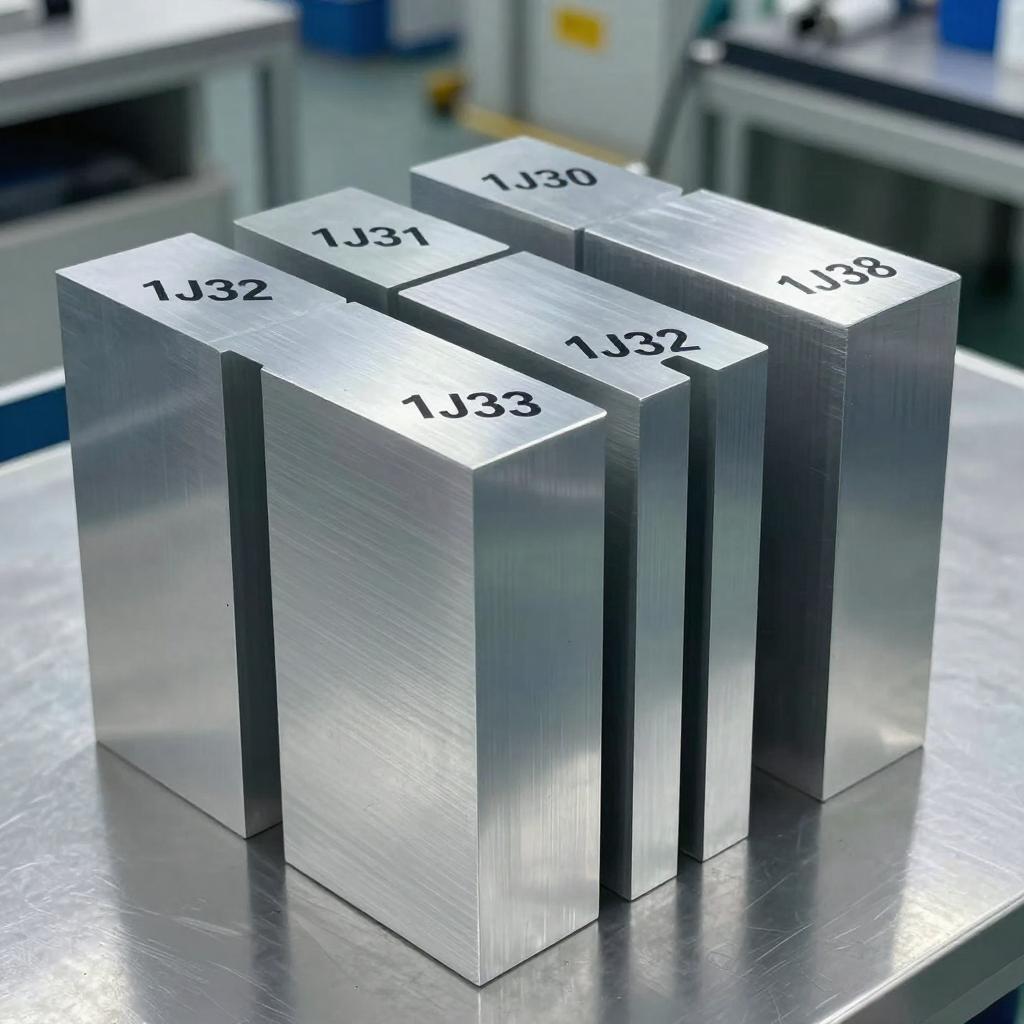
Magnetic Temperature Compensation Alloys (1J30, 1J31, 1J32, 1J33, 1J38) | Low Curie Temp Alloys
- magnetic temperature compensation alloy
- temperature compensation alloy
- magnetic temperature compensation material
- low Curie temperature alloy
- low Curie temperature magnetic alloy
- Fe-Ni temperature compensation alloy
- 1J30 magnetic alloy
Description
Fe-Ni based magnetic temperature compensation alloys (1J30-1J38) offer low Curie temperature (15-200°C) and linear B-T characteristics. Ideal for instrument temperature compensation and magnetic shunt applications. GB/T 15005-94 compliant.
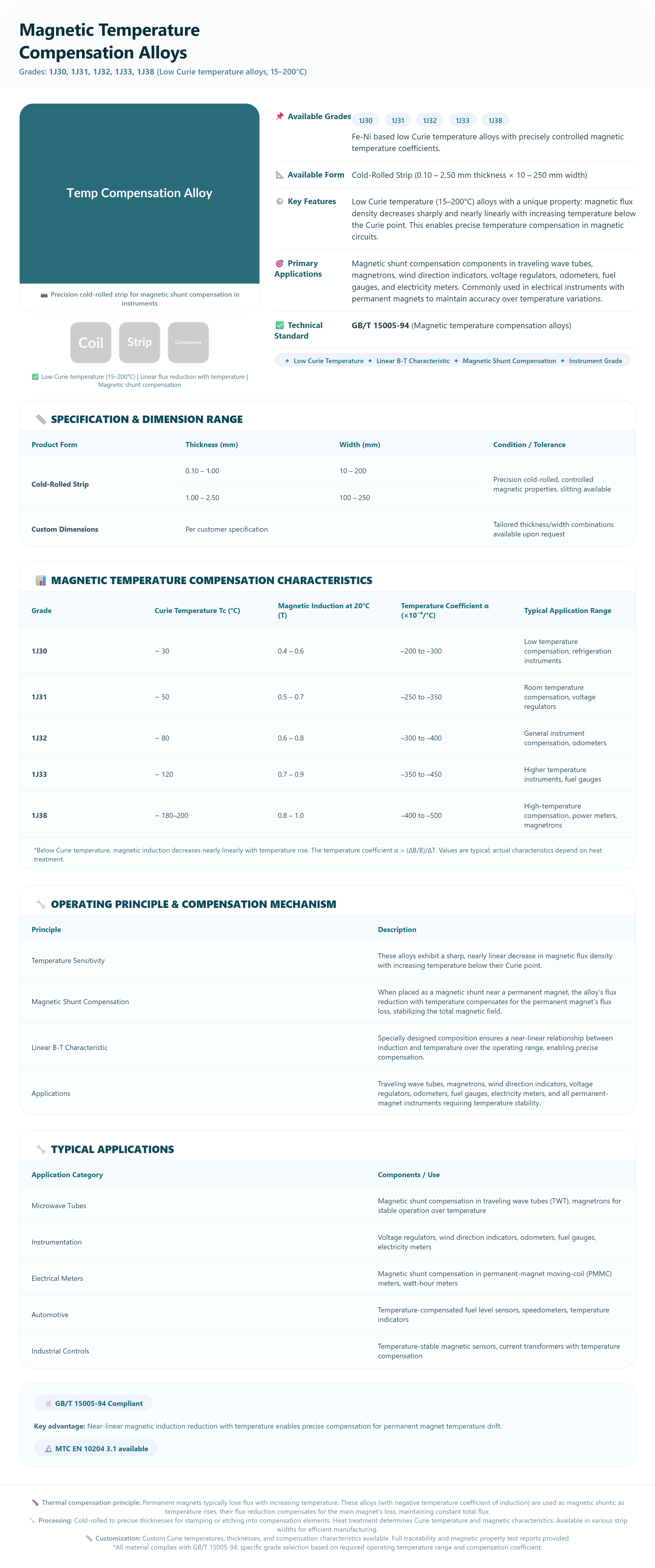
Magnetic Temperature Compensation Alloys (1J30, 1J31, 1J32, 1J33, 1J38)
Magnetic temperature compensation alloys are specialized soft magnetic materials designed to provide a predictable change in magnetic induction as temperature changes. Greenergy Materials supplies 1J30, 1J31, 1J32, 1J33 and 1J38 magnetic temperature compensation alloys for applications that require temperature-dependent magnetic characteristics, magnetic shunt compensation and thermal stabilization.
These low Curie temperature alloys are typically selected when the magnetic circuit must compensate for temperature-related changes in a permanent magnet or other magnetic component. We support customized alloy grades, dimensions, thicknesses and material forms according to application and technical requirements.
What Is a Magnetic Temperature Compensation Alloy?
A magnetic temperature compensation alloy is a soft magnetic material whose magnetic properties change significantly with temperature around its designed Curie temperature.
Unlike conventional soft magnetic alloys that are primarily selected for high permeability, low coercivity or high saturation induction, magnetic temperature compensation alloys are selected specifically for their controlled temperature-dependent magnetic behavior.
When temperature increases within the applicable operating range, the magnetic induction of the compensation alloy can decrease in a controlled manner. This behavior can be used to compensate for temperature-dependent changes in other magnetic components.
The result is improved magnetic circuit stability over a defined temperature range.
Key Characteristics of Magnetic Temperature Compensation Alloys
1. Low Curie Temperature
1J30, 1J31, 1J32, 1J33 and 1J38 are low Curie temperature magnetic alloys. Their Curie temperatures are intentionally positioned much lower than those of many conventional high-temperature soft magnetic materials.
This makes them suitable for applications where magnetic properties need to change within a relatively low operating temperature range.
2. Temperature-Dependent Magnetic Induction
The key feature of magnetic temperature compensation alloys is the strong relationship between magnetic induction and temperature.
Below the Curie temperature, magnetic induction can decrease significantly as temperature increases. This temperature-dependent response makes the material useful as a magnetic compensation element.
3. Controlled Magnetic Compensation
By selecting the appropriate alloy grade and controlling the geometry of the magnetic shunt or compensation element, engineers can tune the magnetic response of a magnetic circuit to reduce temperature-related performance variation.
4. Different Alloy Grades for Different Temperature Requirements
The 1J30, 1J31, 1J32, 1J33 and 1J38 grades do not have identical magnetic-temperature characteristics.
The appropriate grade should therefore be selected according to:
Operating temperature range
Required magnetic induction
Compensation temperature
Magnetic circuit design
Required temperature coefficient
Component dimensions
Heat treatment condition
Required dimensional tolerance
1J30, 1J31, 1J32, 1J33 and 1J38 Magnetic Temperature Compensation Alloys
We supply the following commonly used magnetic temperature compensation alloy grades:
| Alloy Grade | Alloy Family | Main Characteristic | Typical Selection Consideration |
|---|---|---|---|
| 1J30 | Fe-Ni | Low Curie temperature magnetic compensation | Strong temperature-dependent magnetic response |
| 1J31 | Fe-Ni | Temperature-sensitive magnetic properties | Magnetic compensation applications |
| 1J32 | Fe-Ni | Low Curie temperature behavior | Applications requiring a different magnetic induction level |
| 1J33 | Fe-Ni-Al | Modified magnetic and electrical characteristics | Temperature compensation and voltage regulation applications |
| 1J38 | Fe-Ni-Cr | Temperature compensation with modified electrical and magnetic properties | Metering and automotive instrument applications |
Note: Actual magnetic properties depend on alloy composition, product form, heat treatment and test conditions. Detailed magnetic-property data should be confirmed against the applicable material specification and your application requirements.
Typical Chemical Composition
The major alloying elements vary according to grade.
| Grade | Main Alloying Elements | Material Type |
|---|---|---|
| 1J30 | Fe-Ni | Fe-Ni magnetic temperature compensation alloy |
| 1J31 | Fe-Ni | Fe-Ni magnetic temperature compensation alloy |
| 1J32 | Fe-Ni | Fe-Ni magnetic temperature compensation alloy |
| 1J33 | Fe-Ni-Al | Fe-Ni-Al magnetic temperature compensation alloy |
| 1J38 | Fe-Ni-Cr | Fe-Ni-Cr magnetic temperature compensation alloy |
For production orders, we can provide the applicable chemical composition and material test documentation according to the required grade and specification.
Magnetic Temperature Compensation Performance
The most important performance parameter for this type of alloy is not simply permeability.
For engineering selection, buyers should evaluate the relationship between:
Magnetic induction and temperature
Curie temperature
Temperature coefficient of magnetic induction
Magnetic field strength
Remanence
Coercive force
Saturation induction
Electrical resistivity
Heat-treatment condition
For example, public technical references describe the 1J30–1J38 family as low-Curie-temperature alloys whose magnetic induction decreases substantially with increasing temperature below the Curie point. Different grades are designed for different magnetic-temperature characteristics.
For a production application, we recommend selecting the grade from the required B-T curve and operating temperature range, rather than selecting solely by alloy number.
Applications of Magnetic Temperature Compensation Alloys
Magnetic temperature compensation alloys are used where temperature changes would otherwise cause unacceptable variation in magnetic circuit performance.
Permanent Magnet Magnetic Circuits
A magnetic compensation alloy can be used as a magnetic shunt or compensation element around a permanent magnet.
As temperature changes, the magnetic properties of the compensation element change, helping stabilize the magnetic flux delivered to the working circuit.
Traveling Wave Tubes
1J-series magnetic temperature compensation alloys can be used in temperature-compensation components associated with permanent-magnet magnetic circuits in traveling wave tube systems.
Magnetrons
The temperature-dependent magnetic response of these alloys makes them suitable for magnetic compensation components used in magnetron-related applications.
Voltage Regulators
Certain grades, particularly Fe-Ni-Al temperature compensation alloys such as 1J33, can be considered for magnetic temperature compensation in voltage-regulating systems.
Meters and Instrumentation
Magnetic temperature compensation materials can be used in:
Electricity meters
Automotive instruments
Speedometers
Fuel gauges
Temperature-sensitive magnetic mechanisms
Precision measuring instruments
Magnetic Shunt Compensation
One of the most important applications is the design of magnetic shunts used to compensate for temperature-induced changes in permanent magnet flux.
How Does Magnetic Temperature Compensation Work?
A simplified magnetic compensation system typically includes:
Permanent Magnet → Magnetic Circuit → Compensation Alloy → Air Gap / Working Component
When temperature increases, the permanent magnet may experience a change in magnetic properties.
A properly selected magnetic temperature compensation alloy responds to the same temperature change by altering its magnetic permeability or magnetic induction.
This changes the amount of magnetic flux passing through the compensation path.
By correctly selecting:
Alloy grade
Compensation element thickness
Width and length
Magnetic circuit geometry
Air gap
Operating temperature range
Heat treatment condition
engineers can optimize the overall temperature stability of the magnetic circuit.
How to Choose the Right Magnetic Temperature Compensation Alloy
Choosing between 1J30, 1J31, 1J32, 1J33 and 1J38 should be based on the actual magnetic circuit rather than the alloy name alone.
Step 1: Define the Operating Temperature Range
Identify the minimum, normal and maximum operating temperatures.
For example:
Minimum operating temperature
Ambient temperature
Maximum operating temperature
Compensation target temperature
Step 2: Define the Required Magnetic Response
Determine how much the magnetic induction needs to change as temperature changes.
This is particularly important when the alloy is used as a magnetic shunt.
Step 3: Compare B-T Characteristics
The B-T relationship should be evaluated under the actual magnetic field conditions of the application.
Step 4: Select the Alloy Grade
Different grades provide different magnetic-temperature characteristics.
A material supplier should recommend the grade based on the required magnetic performance rather than simply supplying the nearest nominal composition.
Step 5: Confirm Dimensions and Heat Treatment
Thickness, width, geometry and final heat treatment can influence the final magnetic properties.
For precision applications, dimensional tolerance and heat-treatment condition should therefore be specified together with the alloy grade.
Magnetic Temperature Compensation Alloy vs Conventional Soft Magnetic Alloy
| Feature | Magnetic Temperature Compensation Alloy | Conventional Soft Magnetic Alloy |
|---|---|---|
| Main Design Objective | Temperature compensation | Efficient magnetic response |
| Curie Temperature | Intentionally selected for compensation | Usually not the primary selection criterion |
| Magnetic Response to Temperature | Important design parameter | Often minimized or controlled differently |
| B-T Characteristics | Critical | Application dependent |
| Typical Use | Magnetic compensation, thermal stabilization | Transformers, inductors, magnetic cores |
| Material Selection | Based on magnetic-temperature behavior | Based on permeability, coercivity, saturation, losses, etc. |
Therefore, a high-permeability alloy is not automatically a suitable replacement for a magnetic temperature compensation alloy.
Magnetic Temperature Compensation Alloy vs Permanent Magnet Alloy
| Feature | Temperature Compensation Alloy | Permanent Magnet Alloy |
|---|---|---|
| Magnetic Function | Controlled magnetic response to temperature | Generate and retain magnetic flux |
| Main Property | Temperature-dependent magnetic behavior | High coercivity and remanence |
| Typical Role | Compensation element / magnetic shunt | Magnetic source |
| Curie Temperature | Selected for compensation behavior | Usually selected for magnetic stability |
| Typical Application | Temperature compensation systems | Permanent magnets, motors, actuators |
In many magnetic circuits, the two materials can work together rather than being direct substitutes.
Available Material Forms
Depending on the alloy grade and production requirements, magnetic temperature compensation alloys can be supplied in forms such as:
Cold-rolled strip
Precision strip
Sheet
Thin strip
Wire
Rod
Customized material forms
Available dimensions should be confirmed according to the selected grade, manufacturing process and order requirements.
For precision applications, customers can provide:
Required thickness
Width
Length
Dimensional tolerance
Surface condition
Edge condition
Material hardness
Heat treatment condition
Packaging requirements
Custom Magnetic Temperature Compensation Alloy Supply
Greenergy Materials supports customized supply for engineering and industrial applications.
We can discuss material selection according to:
Target operating temperature
Required Curie temperature
B-T curve
Magnetic induction
Magnetic field strength
Component geometry
Thickness and width
Heat-treatment requirements
Quantity
Application environment
For a new application, sending the required temperature range, magnetic field condition, component dimensions and target magnetic response will allow our technical team to recommend a more appropriate alloy grade.
Quality Control for Magnetic Temperature Compensation Alloys
For magnetic temperature compensation materials, chemical composition alone is not enough to determine application performance.
Our quality-control process can include:
Chemical Composition Inspection
Verify the alloy composition against the specified grade.
Dimensional Inspection
Check thickness, width, length and dimensional tolerances according to the purchase specification.
Surface Inspection
Inspect surface condition for defects that could affect processing or final component performance.
Magnetic Property Testing
Where specified, magnetic properties can be evaluated under defined test conditions.
Heat Treatment Control
Heat treatment is an important part of soft magnetic alloy production because it can affect the final magnetic characteristics.
For production orders, inspection and documentation requirements can be agreed before manufacturing.
Why Choose Greenergy Materials?
Greenergy Materials specializes in high-performance special alloys and magnetic materials for industrial applications.
Our product portfolio includes:
Soft magnetic alloys
Permanent magnet alloys
Magnetic temperature compensation alloys
High-permeability alloys
High-saturation magnetic alloys
Magnetic cores
Precision alloy materials
Electronic magnetic components
We support both standard alloy grades and customized material requirements.
Our technical team can help customers evaluate the relationship between alloy grade, magnetic properties, temperature range, geometry and heat treatment before mass production.
Frequently Asked Questions
What is a magnetic temperature compensation alloy?
A magnetic temperature compensation alloy is a specialized soft magnetic material whose magnetic properties change predictably with temperature. It is used to compensate for temperature-dependent changes in magnetic circuits.
What are 1J30, 1J31, 1J32, 1J33 and 1J38?
They are commonly used low-Curie-temperature magnetic temperature compensation alloy grades. Their compositions and magnetic-temperature characteristics differ, so the correct grade should be selected according to the application.
What is the difference between a low Curie temperature alloy and a conventional soft magnetic alloy?
A low-Curie-temperature alloy is specifically designed so that its magnetic properties change significantly within a selected temperature range. Conventional soft magnetic alloys are generally selected for properties such as permeability, coercivity, saturation induction or magnetic loss.
What is the main application of 1J30?
1J30 can be used for magnetic temperature compensation applications where a strong temperature-dependent magnetic response is required. Typical applications include magnetic shunts and temperature-compensation elements.
What is 1J33 used for?
1J33 is an Fe-Ni-Al magnetic temperature compensation alloy that can be considered for applications such as voltage regulation and temperature compensation where its specific magnetic-temperature characteristics are suitable.
What is 1J38?
1J38 is an Fe-Ni-Cr magnetic temperature compensation alloy. The addition of chromium modifies its magnetic and electrical characteristics and makes it suitable for certain metering and instrument applications.
Can magnetic temperature compensation alloys be customized?
Yes. Customization can include alloy grade selection, thickness, width, length, dimensional tolerance, surface condition and other production requirements.
Can you provide material test reports?
Material documentation can be provided according to the product grade and purchase specification. Customers should specify required documentation before ordering.
How do I choose between 1J30, 1J31, 1J32, 1J33 and 1J38?
The best grade depends on the required operating temperature, magnetic field, B-T characteristics, magnetic induction and component design. Send us your application parameters and we can help identify a suitable grade.
Can I order samples before mass production?
Sample and trial orders can be discussed for material evaluation before larger production quantities.
Request a Magnetic Temperature Compensation Alloy Quote
Looking for 1J30, 1J31, 1J32, 1J33 or 1J38 magnetic temperature compensation alloy?
Send us your required alloy grade, dimensions, operating temperature range, quantity and application requirements.
Our technical team can help you select a suitable magnetic temperature compensation material and provide a quotation for your project.
Request a Quote | Ask for Material Data | Discuss Custom Alloy Requirements
Contact Greenergy Materials for magnetic temperature compensation alloy supply and customized soft magnetic material solutions.