



Previous
Next
Rectangular Hysteresis Loop Soft Magnetic Alloy | High Squareness Ratio
- rectangular hysteresis loop soft magnetic alloy
- rectangular hysteresis loop alloy
- high squareness ratio soft magnetic alloy
- rectangular magnetic alloy
- Fe-Ni soft magnetic alloy
- high squareness magnetic alloy
- soft magnetic alloy for magnetic amplifiers
Description
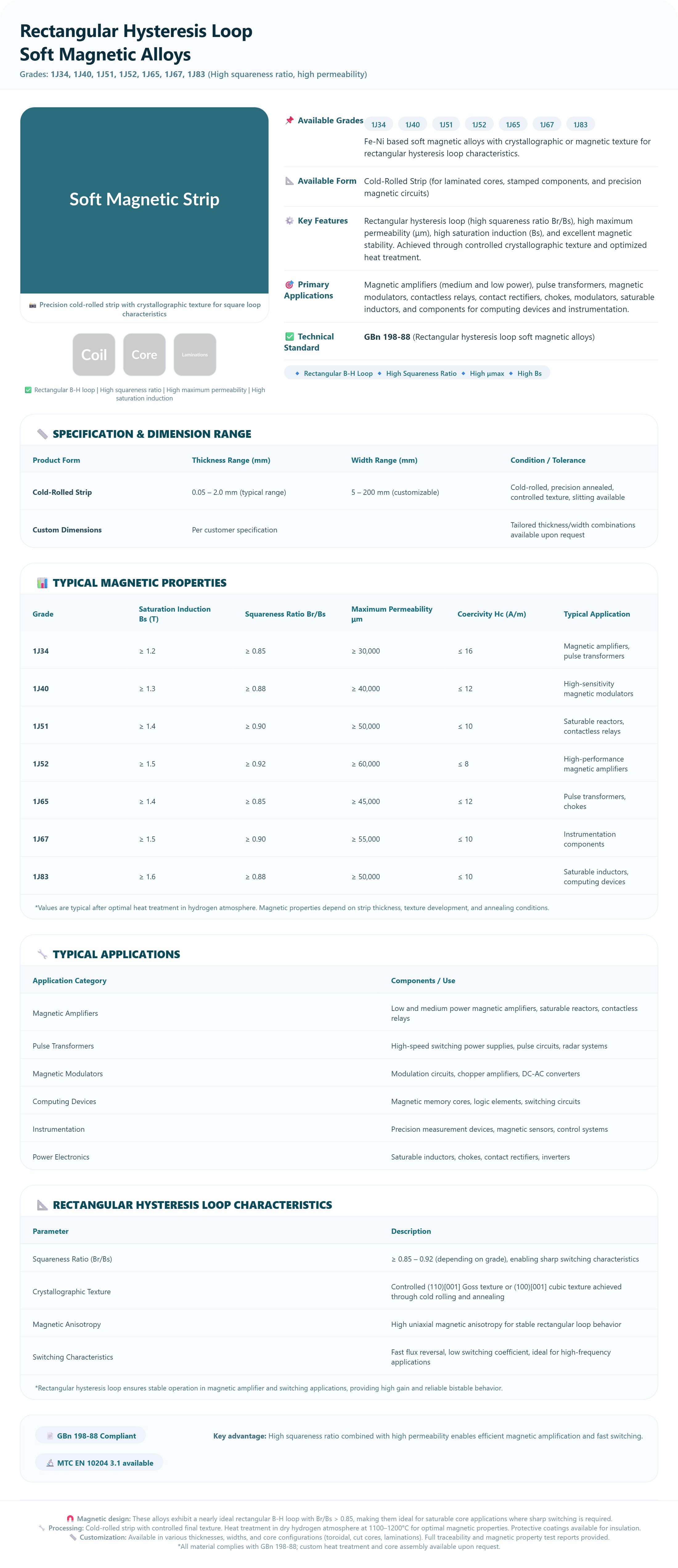
Fe-Ni based rectangular hysteresis loop soft magnetic alloys (1J34-1J83) offer high squareness ratio (Br/Bs≥0.85), high permeability, and high saturation. Ideal for magnetic amplifiers, pulse transformers, and saturable inductors. GBn 198-88 compliant.
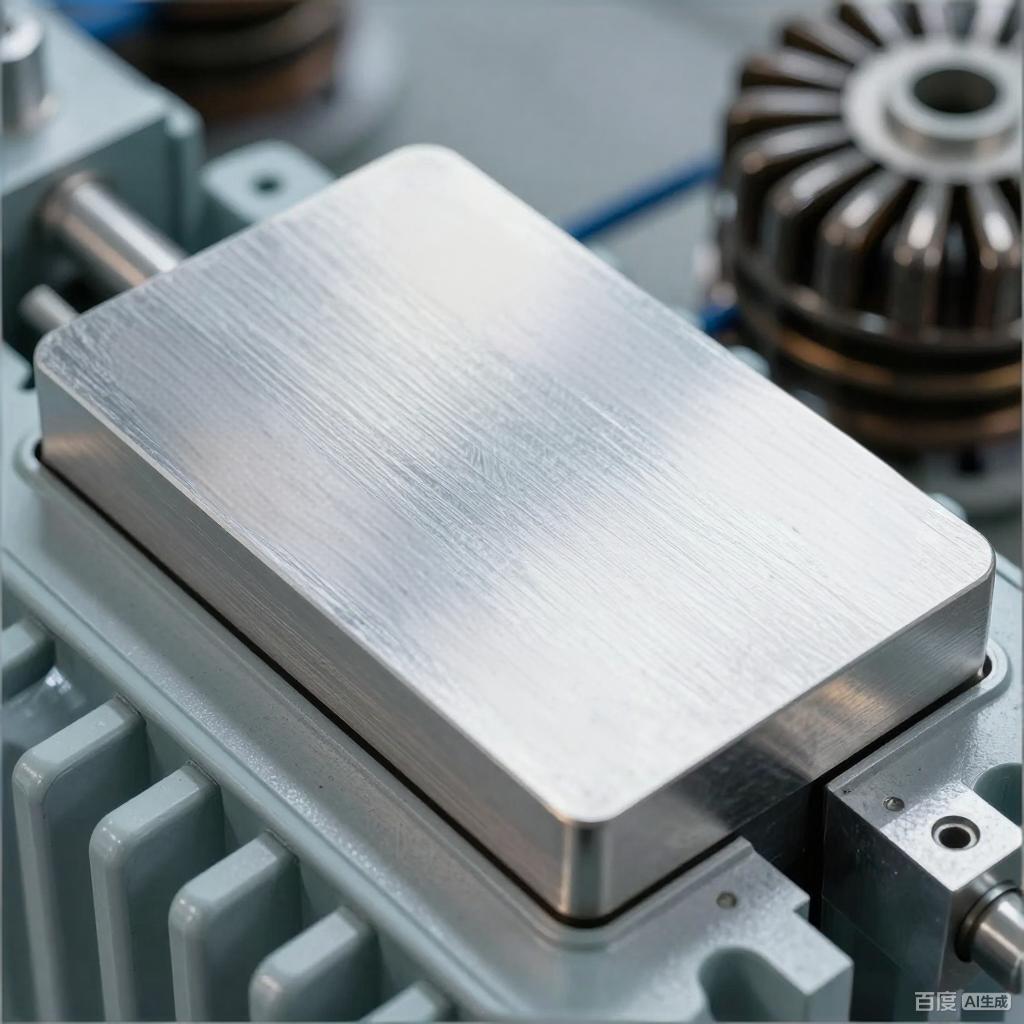
Rectangular Hysteresis Loop Soft Magnetic Alloy
Rectangular hysteresis loop soft magnetic alloys are precision magnetic materials engineered to provide a pronounced rectangular B-H hysteresis loop together with suitable soft magnetic characteristics such as high permeability, controlled coercivity and appropriate saturation properties.
These materials are particularly relevant to magnetic applications where the shape of the hysteresis loop, remanent induction and saturation behavior are important to component performance.
Fe-Ni-based rectangular hysteresis loop soft magnetic alloys can be considered for magnetic amplifiers, pulse transformers, saturable inductors, magnetic modulators, relays, chokes and other specialized electromagnetic and electronic components.
The appropriate alloy grade should be selected according to the required squareness ratio, permeability, coercive force, saturation induction, operating frequency, material dimensions, heat treatment and application conditions.
What Is a Rectangular Hysteresis Loop Soft Magnetic Alloy?
A rectangular hysteresis loop soft magnetic alloy is a magnetic material designed to exhibit a relatively pronounced rectangular B-H curve.
The magnetic hysteresis loop describes the relationship between magnetic field strength and magnetic induction as a material is magnetized and demagnetized.
For rectangular hysteresis loop materials, the degree of rectangularity is commonly evaluated using a squareness ratio such as:
Br/Bs
where:
Br = remanent magnetic induction
Bs = saturation magnetic induction
A relatively high Br/Bs ratio indicates that the material retains a relatively high proportion of its magnetic induction after the external magnetic field is removed.
This characteristic can be useful in magnetic switching, pulse, memory and saturation-related applications.
High Squareness Ratio
The squareness ratio is one of the key characteristics used to evaluate rectangular hysteresis loop magnetic materials.
A high squareness ratio can provide a more pronounced transition between magnetized and demagnetized states and may be desirable in applications that rely on controlled magnetic switching or saturation behavior.
The required squareness ratio depends on the specific component design and operating conditions. It should therefore be evaluated together with coercivity, permeability and saturation induction.
Key Properties of Rectangular Hysteresis Loop Soft Magnetic Alloys
High Squareness Ratio
A high Br/Bs ratio indicates a relatively high remanent induction compared with saturation induction and contributes to a more rectangular hysteresis loop.
High Magnetic Permeability
High permeability can allow efficient response to an applied magnetic field and support magnetic flux guidance within an appropriately designed magnetic circuit.
Controlled Coercivity
Coercive force affects the magnetic field required to reverse the magnetization state. The appropriate coercivity depends on the intended magnetic switching and operating conditions.
Suitable Saturation Induction
Saturation induction determines the approximate upper magnetic induction range of the material before magnetic saturation becomes dominant.
Controlled Hysteresis Characteristics
The shape and stability of the B-H loop are important in applications where magnetic switching, pulse response or controlled saturation is required.
Stable Magnetic Properties
Consistent material composition, processing and heat treatment are important for maintaining repeatable magnetic performance between production batches.
Fe-Ni Rectangular Hysteresis Loop Soft Magnetic Alloys
Fe-Ni-based soft magnetic alloys are an important group of precision magnetic materials.
Depending on the alloy grade and application, Fe-Ni materials can be engineered or processed to provide specific combinations of:
Magnetic permeability
Coercive force
Remanent induction
Saturation induction
Squareness ratio
Hysteresis characteristics
Mechanical properties
Dimensional accuracy
Potential alloy grades within relevant material series may include 1J34, 1J40, 1J51, 1J52, 1J65, 1J67, 1J83 and other application-specific grades.
The exact chemical composition and magnetic properties should always be confirmed against the applicable material standard and the technical specification of the supplied alloy grade.
Rectangular Hysteresis Loop Alloy Grades
Different alloy grades can provide different combinations of permeability, coercivity, saturation characteristics and hysteresis-loop shape.
| Material Item | Description |
|---|---|
| Alloy System | Fe-Ni-based soft magnetic alloys |
| Typical Grades | 1J34, 1J40, 1J51, 1J52, 1J65, 1J67, 1J83 and application-specific grades |
| Main Magnetic Characteristic | Rectangular hysteresis behavior |
| Key Parameter | Squareness Ratio Br/Bs |
| Other Parameters | Permeability, Coercivity, Remanent Induction, Saturation Induction |
| Material Form | Strip / Sheet / Customized Form |
| Thickness | According to Alloy Grade and Requirements |
| Width | According to Customer Requirements |
| Surface Condition | According to Specification |
| Heat Treatment | Alloy and Application Dependent |
| Inspection | According to Material Specification |
Exact grade availability and technical values should be confirmed according to the current product specification.
Magnetic Properties
The following magnetic parameters are commonly considered when selecting rectangular hysteresis loop soft magnetic alloys.
| Magnetic Parameter | Engineering Significance |
|---|---|
| Squareness Ratio Br/Bs | Indicates the rectangularity of the hysteresis loop |
| Remanent Induction Br | Indicates the magnetic induction remaining after removal of the external field |
| Saturation Induction Bs | Indicates the saturation magnetic induction |
| Coercive Force Hc | Indicates resistance to magnetization reversal |
| Initial Permeability | Indicates magnetic response under relatively low magnetic fields |
| Maximum Permeability | Important for magnetic flux efficiency |
| Hysteresis Characteristics | Important for magnetic switching and cyclic operation |
| Electrical Resistivity | Relevant to eddy-current behavior in suitable applications |
Actual magnetic-property values depend on alloy grade, material thickness, processing condition, heat treatment and test method.
Applications of Rectangular Hysteresis Loop Soft Magnetic Alloys
Magnetic Amplifiers
Rectangular hysteresis loop materials can be used in magnetic amplifier cores where controlled magnetic saturation and predictable hysteresis behavior are required.
Pulse Transformers
Selected alloy grades can be considered for pulse transformer cores and related magnetic components where controlled magnetic response is important.
Saturable Inductors
Soft magnetic alloys with suitable saturation and hysteresis characteristics can be used in saturable inductors designed around controlled changes in inductance.
Magnetic Modulators
Certain rectangular-loop magnetic materials can be considered for magnetic modulation and switching applications.
Relays
Selected soft magnetic alloy grades can be used in magnetic circuits for relays and specialized electromagnetic switching components.
Chokes
Depending on the alloy grade and operating conditions, rectangular hysteresis loop materials may be considered for specialized choke applications.
Electronic Components
Precision magnetic alloys can also be used in specialized electronic and electromagnetic components requiring controlled magnetic behavior.
Rectangular Hysteresis Loop vs Conventional Soft Magnetic Material
Not all soft magnetic alloys are designed to provide the same B-H loop shape.
| Feature | Rectangular Hysteresis Loop Alloy | Conventional Soft Magnetic Material |
|---|---|---|
| Main Characteristic | Pronounced rectangular B-H loop | Depends on material grade |
| Key Parameter | Squareness Ratio Br/Bs | Permeability, coercivity, loss and saturation |
| Remanence | Relatively high for selected grades | Depends on material |
| Typical Applications | Switching, pulse and saturation-related applications | Magnetic cores, sensors and electromagnetic components |
| Selection Priority | Hysteresis loop characteristics | Overall magnetic performance |
The appropriate material depends on the required magnetic behavior and operating conditions.
Rectangular Hysteresis Loop Alloy vs Permanent Magnet Alloy
Although both materials exhibit magnetic hysteresis, their intended functions are different.
| Feature | Rectangular Hysteresis Loop Soft Magnetic Alloy | Permanent Magnet Alloy |
|---|---|---|
| Main Purpose | Controlled magnetic response | Permanent magnetic field |
| Hysteresis Characteristics | Designed for specific loop behavior | Designed for high coercivity and magnetic retention |
| Coercivity | Generally lower than hard magnetic materials | Generally high |
| Typical Applications | Magnetic amplifiers, pulse components and switching-related magnetic circuits | Motors, actuators and permanent magnets |
Material selection should be based on the actual function of the magnetic component.
How to Select a Rectangular Hysteresis Loop Soft Magnetic Alloy
1. Define the Required Squareness Ratio
Determine the required Br/Bs ratio according to the intended magnetic circuit and switching characteristics.
2. Determine the Required Coercivity
The appropriate coercive force depends on how the magnetic component is magnetized and demagnetized during operation.
3. Check Saturation Induction
Make sure the selected alloy can operate within the required magnetic flux range.
4. Consider Permeability
Permeability should be evaluated according to the required magnetic response and magnetic circuit design.
5. Consider Operating Frequency
Operating frequency can influence magnetic loss and material selection. Material thickness should therefore be evaluated together with frequency.
6. Consider Material Thickness
Thickness can affect magnetic behavior, manufacturing processes and eddy-current characteristics.
7. Consider Heat Treatment
Heat treatment can have a significant influence on magnetic characteristics. The required processing condition should be defined together with the alloy grade.
8. Consider Dimensional Tolerance
Precision magnetic components may require controlled thickness and width tolerances for consistent manufacturing.
Custom Rectangular Hysteresis Loop Soft Magnetic Alloy
Different applications can require different combinations of squareness ratio, permeability, coercivity and saturation characteristics.
We support application-specific soft magnetic alloy requirements based on:
Alloy grade
Chemical composition
Thickness
Width
Length
Strip or sheet form
Dimensional tolerance
Permeability
Coercive force
Remanent induction
Saturation induction
Squareness ratio
Surface condition
Heat-treatment condition
Packaging requirements
Inspection documentation
Customers can provide their existing material specification or application requirements for technical evaluation.
Manufacturing and Quality Control
The final hysteresis characteristics of soft magnetic alloys depend on material composition, manufacturing processes and heat treatment.
Quality control can include:
Chemical Composition
Material composition can be inspected according to the specified alloy grade.
Dimensional Inspection
Thickness, width, length and other dimensional parameters can be checked against customer specifications.
Surface Inspection
The material surface can be inspected for visible defects that could affect subsequent processing.
Magnetic Property Testing
Depending on the alloy grade and customer requirements, magnetic properties can be evaluated, including:
Permeability
Coercivity
Remanent induction
Saturation induction
Squareness ratio
Hysteresis characteristics
Packaging
Soft magnetic alloy materials should be appropriately packaged to minimize the risk of moisture, contamination and mechanical damage during storage and transportation.
Why Choose Our Rectangular Hysteresis Loop Soft Magnetic Alloys?
For precision magnetic applications, material selection involves more than choosing a high-permeability alloy.
The final performance of a component can depend on:
Alloy composition
Material thickness
Processing history
Heat treatment
Magnetic characteristics
Dimensional accuracy
Component geometry
Operating frequency
We work with customers to evaluate material requirements according to the intended application and provide soft magnetic alloy solutions for specialized electromagnetic and electronic components.
Frequently Asked Questions
What is a rectangular hysteresis loop?
A rectangular hysteresis loop describes a B-H curve with a relatively high remanent induction compared with saturation induction. The rectangularity is commonly evaluated using a squareness ratio such as Br/Bs.
What is the squareness ratio of a magnetic alloy?
The squareness ratio is commonly expressed as Br/Bs, comparing remanent magnetic induction with saturation magnetic induction.
Why is a high squareness ratio important?
A high squareness ratio indicates relatively high remanent induction compared with saturation induction and can be useful in magnetic switching, pulse and saturation-related applications.
What are rectangular hysteresis loop soft magnetic alloys used for?
Applications can include magnetic amplifiers, pulse transformers, saturable inductors, magnetic modulators, relays, chokes and specialized electromagnetic components.
What is Fe-Ni soft magnetic alloy?
Fe-Ni soft magnetic alloys are iron-nickel-based magnetic materials developed for specific combinations of permeability, coercivity, saturation and hysteresis characteristics.
What is 1J34 soft magnetic alloy?
1J34 is an Fe-Ni-based soft magnetic alloy grade associated with specialized magnetic applications and rectangular hysteresis characteristics. The exact properties should be confirmed according to the applicable material specification.
What is 1J40 soft magnetic alloy?
1J40 is an Fe-Ni-based soft magnetic alloy grade used in specialized magnetic applications. Its actual magnetic properties depend on the material condition and applicable specification.
What information is needed to select a rectangular hysteresis loop alloy?
Important information includes required squareness ratio, permeability, coercivity, saturation induction, operating frequency, material thickness, dimensions, heat treatment and application.
Can rectangular hysteresis loop alloys be customized?
Yes. Depending on the alloy grade and manufacturing capability, material grade, dimensions, magnetic properties, surface condition and processing requirements can be discussed.
How are rectangular hysteresis loop alloys tested?
Depending on the specification, testing can include chemical composition, dimensional inspection and magnetic-property evaluation such as permeability, coercivity, remanence, saturation and hysteresis characteristics.
Request a Quote for Rectangular Hysteresis Loop Soft Magnetic Alloy
Looking for a rectangular hysteresis loop soft magnetic alloy, high-squareness magnetic material, or Fe-Ni soft magnetic alloy for a specialized application?
Send us your required alloy grade, dimensions, quantity, application and magnetic specifications.
Our technical team can help evaluate the appropriate material and provide a customized quotation