



Previous
Next
Soft Magnetic Cores | Toroidal, Laminated & Custom Magnetic Cores
- soft magnetic cores
- soft magnetic core manufacturer
- soft magnetic core supplier
- custom soft magnetic cores
- soft magnetic core manufacturer China
- soft magnetic cores for transformers
- soft magnetic cores for inductors
Description
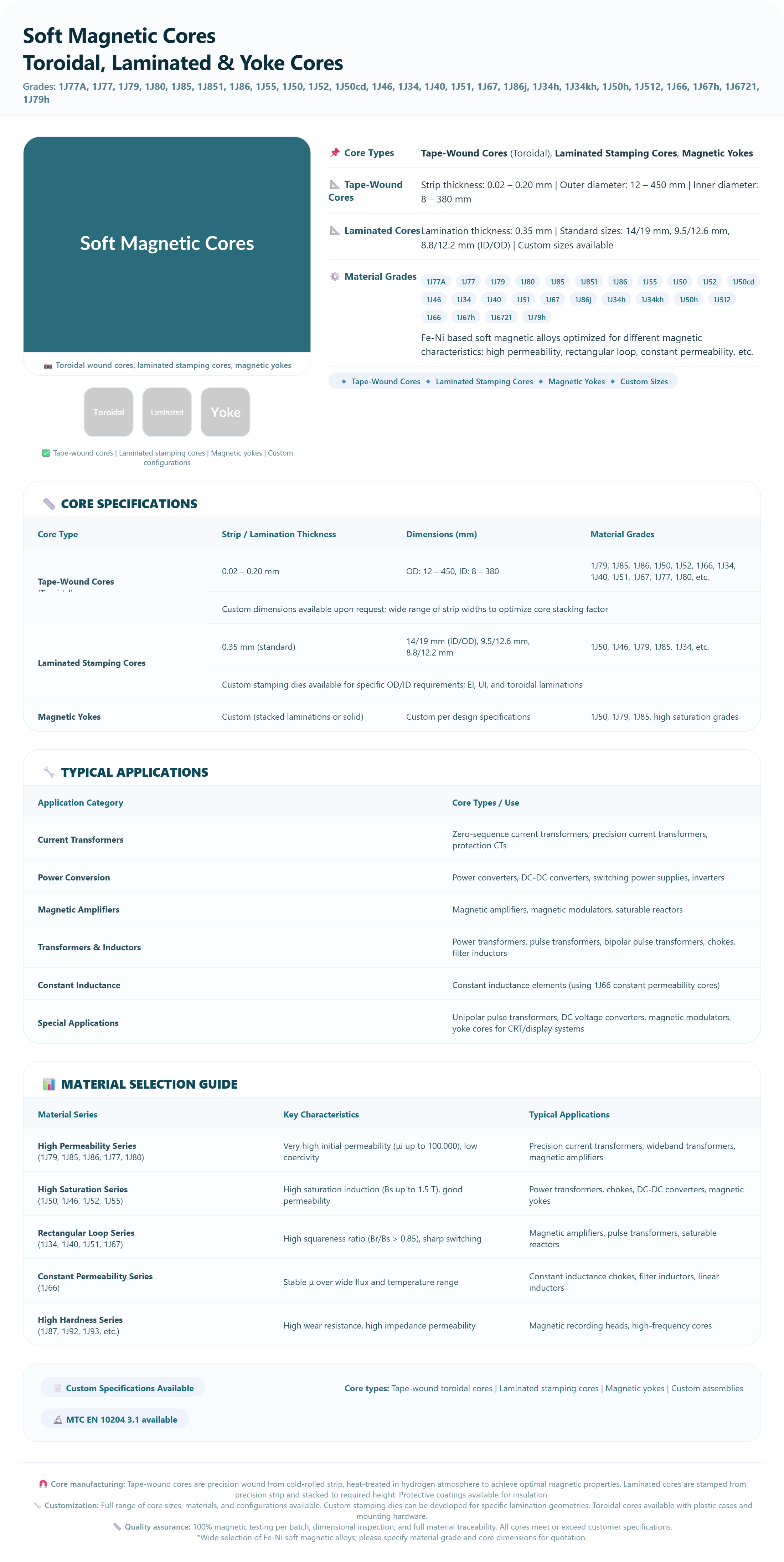
Fe-Ni based soft magnetic cores (toroidal, laminated, yoke) in high permeability, high saturation, rectangular loop, and constant permeability grades. Ideal for current transformers, power conversion, and magnetic amplifiers. Custom sizes available.
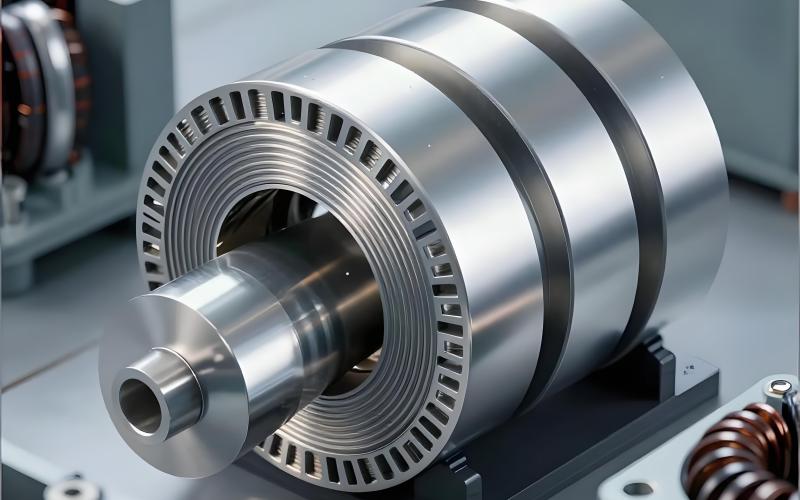
Soft Magnetic Cores for Transformers, Inductors & Magnetic Components
Greenergy Materials supplies soft magnetic cores for transformers, inductors, chokes, current transformers and other electromagnetic components. Available core structures include toroidal, laminated, yoke and other customized magnetic core configurations, with material selection based on frequency, magnetic flux density, core loss, saturation performance and operating temperature.
We support customized magnetic core dimensions, materials, shapes and performance requirements for industrial and electronic applications.
What Are Soft Magnetic Cores?
A soft magnetic core is a magnetic component designed to provide a low-reluctance path for magnetic flux while minimizing undesirable residual magnetism and magnetic losses.
Soft magnetic cores are widely used in:
Transformers
Inductors
Chokes
Current transformers
Voltage transformers
Electromagnetic actuators
Magnetic amplifiers
Filters
Power electronics
Industrial control equipment
The core material and core geometry directly affect magnetic performance.
For this reason, selecting a magnetic core requires consideration of both material properties and core structure.
Soft Magnetic Core Types
Greenergy Materials can evaluate different soft magnetic core structures according to the customer's application.
Toroidal Magnetic Cores
Toroidal cores have a closed ring-shaped magnetic path.
Their continuous magnetic path can help reduce magnetic leakage and provide compact magnetic construction.
Typical applications include:
Toroidal transformers
Toroidal inductors
Current transformers
Common-mode chokes
EMI filters
Power electronics
Audio transformers
Toroidal structures can be manufactured from wound magnetic strip, powder materials or other magnetic materials depending on the operating frequency and required magnetic properties.
Laminated Magnetic Cores
Laminated cores are constructed from multiple thin magnetic sheets separated by electrical insulation.
The lamination structure reduces the effective area available for eddy-current circulation and is widely used in lower-frequency magnetic equipment.
Typical configurations include:
EI cores
UI cores
EE cores
Stacked laminations
Custom punched laminations
Laminated silicon-steel cores are widely used in power-frequency transformers and inductors, while other soft magnetic materials can be selected for different frequency and magnetic-performance requirements.
Yoke Cores
A yoke core forms part of a magnetic circuit and provides a low-reluctance path connecting magnetic limbs or poles.
Yoke structures are commonly used in:
Transformers
Electromagnetic devices
Magnetic actuators
Relays
Current transformers
Custom magnetic circuits
The yoke geometry can be optimized according to magnetic flux distribution, mechanical dimensions and assembly requirements.
Tape-Wound / Strip-Wound Cores
Tape-wound cores are produced by winding thin magnetic strip into a controlled core geometry.
The winding process can provide a continuous magnetic path and is particularly useful for selected high-permeability and low-loss magnetic materials.
Potential applications include:
Current transformers
Precision transformers
Inductors
Chokes
Power electronics
High-efficiency magnetic components
Strip-wound construction is used with materials such as silicon steel, amorphous alloys and other soft magnetic ribbons depending on the application.
Soft Magnetic Core Materials
Core geometry is only one part of magnetic core selection.
The magnetic material determines important characteristics such as:
Permeability
Saturation flux density
Coercivity
Core loss
Electrical resistivity
Temperature stability
Frequency capability
Different applications require different combinations of these properties.
Fe-Ni Soft Magnetic Alloy Cores
Nickel-iron soft magnetic alloys are suitable for applications requiring high permeability and specialized magnetic characteristics.
Potential applications include:
Precision transformers
Current transformers
Magnetic sensors
Magnetic shielding
Audio transformers
Inductors
Electromagnetic components
Greenergy Materials supplies multiple Fe-Ni soft magnetic alloy grades for different performance requirements.
Related materials include:
1J66 constant permeability alloy
1J46 / 1J50 / 1J54 high-permeability alloys
1J79 / 1J85 high-initial-permeability alloys
Fe-Co Soft Magnetic Alloy Cores
Fe-Co soft magnetic alloys are used when high saturation magnetic induction is a major design requirement.
For example, 1J22 is positioned as a high-saturation-induction Fe-Co-V soft magnetic alloy.
Potential applications include:
High-flux magnetic circuits
Electromagnetic actuators
Motors
Generators
Transformers
High-field magnetic components
See also:
1J22 High Saturation Induction Soft Magnetic Alloy
Silicon Steel Magnetic Cores
Silicon steel is widely used in laminated magnetic cores for power-frequency transformers and related electrical equipment.
Its lamination structure helps control eddy-current losses, making it suitable for lower-frequency transformer applications.
Common structures include:
EI cores
UI cores
EE cores
Laminated yoke cores
Stacked transformer cores
Amorphous and Nanocrystalline Magnetic Cores
Amorphous and nanocrystalline magnetic materials can provide attractive combinations of magnetic permeability, low loss and frequency performance for selected power and electronic applications.
They may be considered for:
High-efficiency transformers
Current transformers
Chokes
Power inductors
High-frequency magnetic components
The appropriate material depends on operating frequency, flux density, temperature and loss requirements.
Soft Magnetic Cores for Transformers
The transformer core provides the magnetic path that couples the primary and secondary windings.
Core selection affects:
Magnetizing current
Core loss
Saturation behavior
Temperature rise
Efficiency
Frequency response
For power-frequency transformers, laminated magnetic cores are widely used.
For other transformer designs, toroidal, tape-wound, ferrite, amorphous or nanocrystalline cores may be more appropriate depending on the operating frequency and performance requirements.
Soft Magnetic Cores for Inductors
An inductor stores energy in its magnetic field and uses the core to increase inductance and control magnetic flux.
Important core-selection factors include:
Inductance
Saturation current
Core loss
DC bias
Frequency
Temperature
Air-gap requirements
For power inductors, common material families include ferrite, powdered metal, strip-wound alloys and laminated materials. Their performance differs significantly in core loss, saturation behavior, DC-bias performance and cost.
Soft Magnetic Cores for Current Transformers
Current transformer cores require controlled magnetic behavior because the core directly influences:
Transformation accuracy
Excitation current
Saturation characteristics
Phase error
Measurement accuracy
Depending on the application, high-permeability Fe-Ni alloys, nanocrystalline materials, amorphous alloys or other soft magnetic materials may be considered.
For precision current transformers, the material grade, annealing condition, core dimensions and magnetic test conditions should be specified together.
Soft Magnetic Cores for Chokes and Filters
Magnetic chokes are used to limit or filter unwanted current components.
Core selection depends on:
AC frequency
DC bias
Required inductance
Saturation behavior
Core loss
Temperature rise
For power inductors and chokes, the choice between ferrite, powdered metal, strip-wound material and laminated cores depends strongly on frequency and DC-bias conditions.
How to Choose the Right Soft Magnetic Core
Choosing a magnetic core based only on its shape is not sufficient.
A better selection process includes six steps.
Step 1: Define the Application
Determine whether the core will be used for:
Transformer
Inductor
Choke
Current transformer
Magnetic sensor
Actuator
Filter
Magnetic amplifier
Step 2: Define the Operating Frequency
Frequency is one of the most important material-selection factors.
Typical applications may range from:
Power frequency
Audio frequency
Intermediate frequency
Switching frequency
High-frequency applications
Higher frequency generally increases the importance of electrical resistivity and core-loss behavior.
Step 3: Define the Flux Density
Determine:
Maximum flux density
Peak flux density
AC flux density
DC bias
Required saturation margin
A material with high saturation induction may be preferred when the magnetic circuit operates at high flux density.
Step 4: Define Core Loss
Core loss can include:
Hysteresis loss
Eddy-current loss
Other frequency-dependent magnetic losses
The required material should therefore be selected according to the operating frequency and waveform.
Step 5: Define Core Geometry
Select the appropriate structure:
Toroidal
EI
EE
UI
Yoke
E-core
U-core
Tape-wound
Custom geometry
Step 6: Define Mechanical and Dimensional Requirements
Specify:
Outer diameter
Inner diameter
Core height
Window dimensions
Thickness
Magnetic path length
Cross-sectional area
Tolerances
Surface condition
Toroidal vs Laminated Magnetic Cores
| Feature | Toroidal Core | Laminated Core |
|---|---|---|
| Magnetic path | Closed | Laminated magnetic circuit |
| Leakage flux | Generally low | Application dependent |
| Construction | Wound / ring-shaped | Stacked laminations |
| Typical applications | Transformers, inductors, CTs, chokes | Power transformers, inductors |
| Compactness | High | Application dependent |
| Manufacturing | Winding / forming | Punching + stacking |
| Frequency suitability | Material dependent | Commonly low-frequency |
| Custom geometry | High | High |
A toroidal core is not automatically better than a laminated core. The appropriate geometry depends on frequency, power, flux density, winding requirements, thermal constraints and cost.
Magnetic Core Material Selection by Application
| Application | Possible Core Materials | Important Parameters |
|---|---|---|
| Power transformer | Silicon steel, amorphous alloy | Core loss, saturation, permeability |
| Current transformer | Fe-Ni, nanocrystalline, amorphous | Permeability, accuracy, saturation |
| Power inductor | Ferrite, powder, strip-wound alloy | DC bias, saturation, core loss |
| High-frequency transformer | Ferrite, nanocrystalline, selected alloys | Frequency, loss, permeability |
| Choke | Ferrite, powder, strip-wound alloy | Inductance, DC bias, loss |
| Precision transformer | Fe-Ni, nanocrystalline | Permeability, loss, stability |
| Magnetic actuator | Fe-Co, Fe-Ni, iron-based alloys | Saturation, permeability, mechanical properties |
This table should be treated as a material-selection starting point rather than a universal rule because the optimum material depends on operating conditions.
Core Geometry and Magnetic Performance
Core geometry affects the magnetic circuit.
Important geometric parameters include:
Magnetic path length
Effective cross-sectional area
Window area
Air gap
Core volume
Winding area
For example, toroidal cores provide a continuous magnetic path, while laminated E-I structures provide a practical assembly configuration for many transformer designs.
The geometry should therefore be optimized together with the selected material.
Air Gap in Soft Magnetic Cores
An air gap can be deliberately introduced into a magnetic core when the application requires controlled inductance and improved tolerance to DC bias.
Air gaps are particularly relevant to many inductor designs.
However, an air gap can also introduce:
Fringing flux
Additional magnetic reluctance
Localized loss
Winding-related effects
The appropriate gap should therefore be determined from the required inductance, current and saturation characteristics.
Magnetic Core Manufacturing
Depending on the material and core type, manufacturing processes may include:
Material Preparation
Selection and inspection of the magnetic strip, sheet or other raw material.
Cutting and Forming
Materials may be:
Slit
Cut
Stamped
Laminated
Wound
Formed
Core Assembly
Depending on the design:
Stacking
Winding
Bonding
Clamping
Annealing
Gap formation
Heat Treatment
Heat treatment may be required to achieve the required magnetic properties, especially for specialized soft magnetic alloys.
Final Inspection
Finished cores can be evaluated for:
Dimensions
Magnetic properties
Surface condition
Core loss
Inductance
Permeability
Insulation where applicable
Quality Control for Soft Magnetic Cores
A reliable magnetic core supplier should evaluate both the material and the finished core.
Material Inspection
Check:
Chemical composition
Material grade
Thickness
Width
Electrical resistivity
Mechanical properties
Magnetic Testing
Depending on application:
Initial permeability
Maximum permeability
Saturation flux density
Coercive force
Core loss
AC magnetic properties
DC bias performance
Dimensional Inspection
Check:
Outer diameter
Inner diameter
Height
Thickness
Window dimensions
Air gap
Tolerances
Finished Core Testing
For selected products:
Inductance
AL value
Core loss
Temperature rise
Insulation
Mechanical integrity
Custom Soft Magnetic Core Manufacturing
Greenergy Materials can evaluate customized soft magnetic core requirements according to:
Core material
Core shape
Core dimensions
Magnetic properties
Operating frequency
Flux density
DC bias
Core loss
Air gap
Heat treatment
Surface treatment
Quantity
Custom core geometries may include:
Toroidal cores
Laminated cores
EI cores
EE cores
UI cores
Yoke cores
Tape-wound cores
Custom magnetic circuits
For a technical quotation, provide the application, operating frequency, core dimensions, magnetic requirements and quantity.
Soft Magnetic Core Specification Checklist
Before requesting a quotation, prepare the following information:
| Requirement | Example Information |
|---|---|
| Application | Transformer / Inductor / CT / Choke |
| Core type | Toroidal / EI / EE / Yoke / Custom |
| Material | Fe-Ni / Fe-Co / Silicon Steel / Amorphous |
| Frequency | Required operating frequency |
| Flux density | Maximum or operating flux density |
| Current | AC / DC / peak current |
| Core dimensions | OD / ID / height / thickness |
| Air gap | Required gap or AL value |
| Magnetic target | Permeability / loss / saturation |
| Quantity | Prototype / production quantity |
| Inspection | Required test and documentation |
The more complete the specification, the easier it is to select the appropriate material and core geometry.
Why Choose Greenergy Materials for Soft Magnetic Cores?
Greenergy Materials specializes in high-performance special alloys, magnetic materials and electronic components, with customized solutions for industrial customers.
For soft magnetic core projects, customers can discuss:
Material selection
Core geometry
Magnetic performance
Dimensional requirements
Heat treatment
Inspection requirements
Custom production
Our product portfolio also includes specialized soft magnetic alloys that can be evaluated for different core applications.
Frequently Asked Questions
What is a soft magnetic core?
A soft magnetic core is a magnetic component made from a material that can be magnetized and demagnetized relatively easily. It provides a controlled magnetic path in transformers, inductors, chokes and other electromagnetic devices.
What are soft magnetic cores used for?
Common applications include transformers, inductors, chokes, current transformers, magnetic sensors, electromagnetic actuators and filters.
What is the difference between a toroidal and laminated core?
A toroidal core has a ring-shaped continuous magnetic path, while a laminated core is assembled from stacked insulated magnetic sheets. The appropriate design depends on application, frequency, power, flux density and manufacturing requirements.
Which magnetic core is best for transformers?
There is no single best core type for every transformer. Silicon-steel laminations are widely used for power-frequency applications, while ferrite, amorphous, nanocrystalline, Fe-Ni and other materials may be appropriate for different frequency and performance requirements.
Which magnetic core is best for inductors?
The choice depends on frequency, DC bias, inductance, saturation current and core loss. Ferrite, powdered metal, strip-wound alloys and laminated cores are all used in different inductor designs.
What is a toroidal magnetic core?
A toroidal magnetic core is a ring-shaped core around which a winding can be placed. Its closed magnetic path can help reduce leakage flux and provide a compact magnetic structure.
What is a laminated magnetic core?
A laminated magnetic core consists of thin magnetic sheets stacked together with insulation between laminations. This construction helps reduce eddy-current losses and is widely used in lower-frequency magnetic applications.
Can soft magnetic cores be customized?
Yes. Core material, geometry, dimensions, air gap, magnetic properties and inspection requirements can be customized subject to technical evaluation.
Can you supply the magnetic material and finished core?
Depending on the project, material selection and finished-core requirements can be evaluated together. Customers should provide the application, dimensions and magnetic specifications.
What information is required for a quotation?
At minimum, provide the application, core type, dimensions, operating frequency, flux density or current, material preference, quantity and required magnetic performance.
Request a Custom Soft Magnetic Core
Looking for toroidal, laminated, yoke or custom soft magnetic cores for transformers, inductors, chokes or current transformers?
Send us:
Application + Core Type + Material + Dimensions + Frequency + Flux Density/Current + Quantity
Greenergy Materials can help evaluate the appropriate soft magnetic core material, geometry and manufacturing specification for your application.
Contact us for technical support, custom core development and quotation.