



Previous
Next
0Cr16Ni14 Non-Magnetic Stainless Steel | Ultra-Low Permeability
- 0Cr16Ni14 non-magnetic stainless steel
- 0Cr16Ni14 stainless steel
- 0Cr16Ni14 stainless steel supplier
- 0Cr16Ni14 stainless steel manufacturer
- 0Cr16Ni14 austenitic stainless steel
- 0Cr16Ni14 material
Description
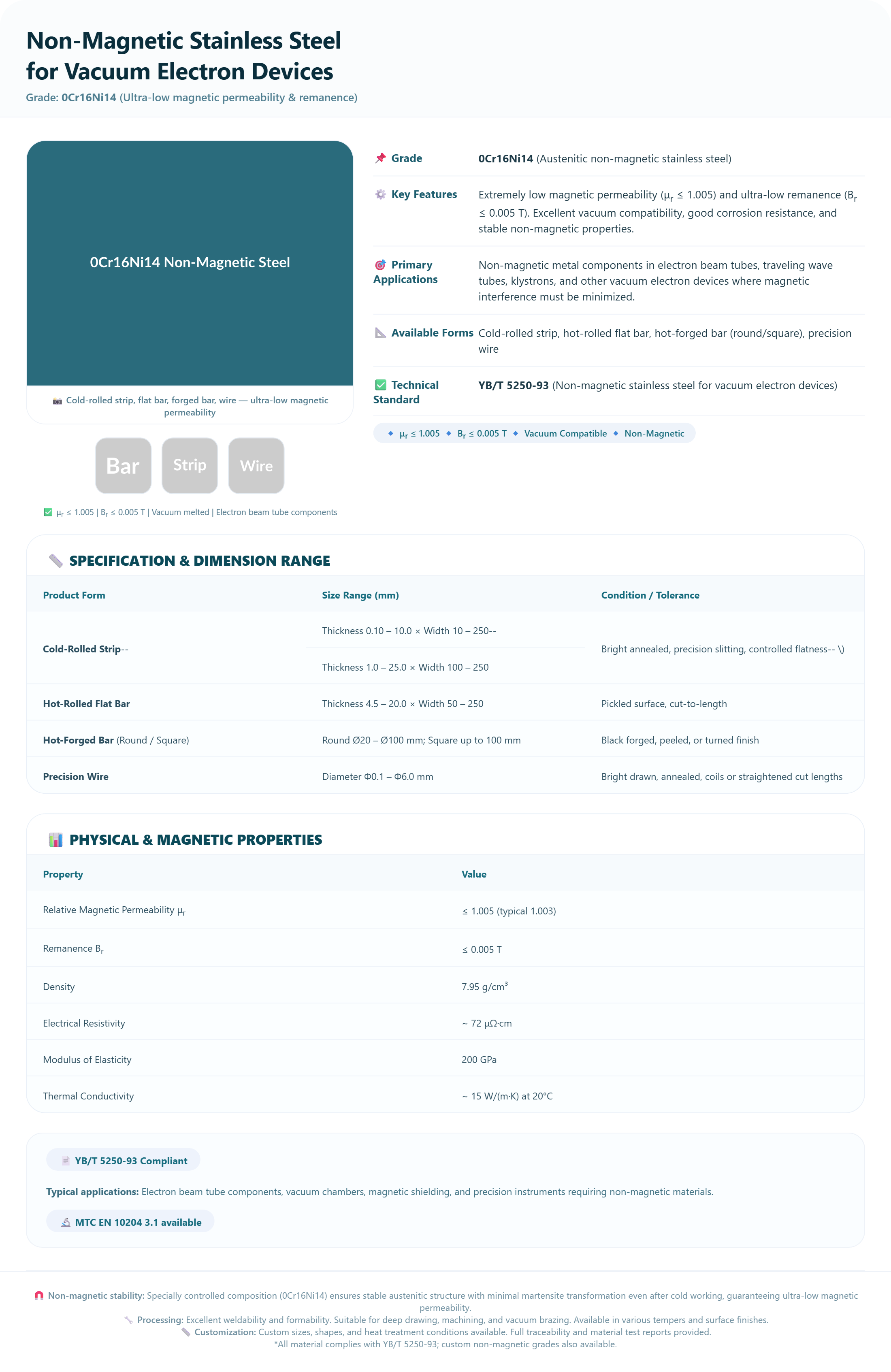
0Cr16Ni14 austenitic non-magnetic stainless steel offers ultra-low permeability (μᵣ ≤ 1.005), vacuum compatibility, and corrosion resistance. Ideal for electron beam tubes, vacuum chambers, and precision instruments. YB/T 5250-93 compliant.
0Cr16Ni14 Non-Magnetic Stainless Steel
Ultra-Low Permeability Stainless Steel for Vacuum Electron Devices, Vacuum Chambers and Precision Instruments
Hefei Ke Ningman New Energy Materials Technology Co., Ltd. supplies 0Cr16Ni14 non-magnetic stainless steel for applications requiring very low magnetic permeability, corrosion resistance and stable performance in precision and vacuum-related environments.
0Cr16Ni14 is an austenitic non-magnetic stainless steel designed for applications where minimizing magnetic interference is important. The material can provide ultra-low relative permeability of μᵣ ≤ 1.005 under the applicable material requirements.
It is suitable for selected vacuum electronic devices, electron beam tubes, vacuum chambers, precision instruments and other non-magnetic engineering applications.
The material is supplied according to applicable specifications, including YB/T 5250-93, with dimensions and documentation available according to project requirements.
Request a 0Cr16Ni14 Stainless Steel Quote
What Is 0Cr16Ni14 Non-Magnetic Stainless Steel?
0Cr16Ni14 stainless steel is an austenitic stainless steel designed for applications where very low magnetic permeability is required.
Unlike conventional stainless steel materials that may exhibit measurable magnetic response depending on composition, processing and cold working, 0Cr16Ni14 is selected for applications where minimizing magnetic interference is an important material requirement.
Its combination of:
Ultra-low magnetic permeability
Austenitic structure
Corrosion resistance
Vacuum compatibility for suitable applications
Dimensional stability
Precision material performance
makes it suitable for specialized electronic, vacuum and instrumentation applications.
The actual magnetic properties of stainless steel depend on chemical composition, processing history, heat treatment, cold working and test conditions. For critical applications, the required permeability value and test method should be specified before procurement.
Key Properties of 0Cr16Ni14 Stainless Steel
Ultra-Low Magnetic Permeability
0Cr16Ni14 can provide a relative permeability of μᵣ ≤ 1.005 according to the applicable material requirements.
This makes the material suitable for applications where magnetic interference must be minimized.
Typical applications may include:
Vacuum electron devices
Electron beam tubes
Precision instruments
Non-magnetic equipment
Specialized electronic components
Vacuum-related components
Non-Magnetic Performance
0Cr16Ni14 is designed for non-magnetic applications where conventional magnetic stainless steel or ferromagnetic materials may interfere with sensitive equipment.
When selecting a non-magnetic stainless steel, buyers should consider not only the alloy designation but also:
Material condition
Cold deformation
Welding
Forming
Machining
Heat treatment
Magnetic test method
These factors can influence the measured magnetic permeability.
Corrosion Resistance
As an austenitic stainless steel, 0Cr16Ni14 provides corrosion resistance for suitable industrial environments.
Its corrosion performance should be evaluated according to the actual service environment, including:
Humidity
Chemical exposure
Temperature
Vacuum conditions
Surface condition
Contamination requirements
For demanding environments, material selection should be based on the complete application specification rather than the alloy designation alone.
Vacuum Compatibility
0Cr16Ni14 can be considered for selected vacuum-related components where low magnetic permeability and stainless steel corrosion resistance are required.
For vacuum applications, material selection should also consider:
Surface cleanliness
Outgassing requirements
Surface finish
Welding quality
Degreasing and cleaning procedures
Operating temperature
Vacuum level
The required vacuum grade and cleanliness specification should be confirmed before production.
0Cr16Ni14 Material Specification
| Property | 0Cr16Ni14 |
|---|---|
| Material Type | Austenitic non-magnetic stainless steel |
| Main Requirement | Ultra-low magnetic permeability |
| Relative Permeability | μᵣ ≤ 1.005* |
| Applicable Standard | YB/T 5250-93 |
| Magnetic Performance | Non-magnetic / ultra-low permeability |
| Corrosion Resistance | Suitable for applicable industrial environments |
| Typical Applications | Vacuum electronic devices, electron beam tubes, precision instruments |
* Actual values should be verified according to the applicable specification, material condition and test method.
0Cr16Ni14 for Vacuum Electron Devices
Vacuum electronic devices can require materials with carefully controlled magnetic properties because external or material-generated magnetic fields may affect electron trajectories and device performance.
0Cr16Ni14 can be considered for selected components used in:
Electron beam tubes
Vacuum electronic devices
Electronic instrumentation
Precision vacuum components
Non-magnetic structural parts
When purchasing material for these applications, engineers should specify the required magnetic permeability, dimensions, surface condition and applicable standard.
0Cr16Ni14 for Vacuum Chambers
For selected vacuum chamber components, material properties beyond corrosion resistance may be important.
Depending on the application, procurement specifications may include:
Low magnetic permeability
Surface finish
Dimensional tolerance
Vacuum cleanliness
Welding requirements
Leak-tightness requirements
Material certification
Chemical composition
0Cr16Ni14 can be considered when both stainless steel corrosion resistance and low magnetic permeability are required.
0Cr16Ni14 for Precision Instruments
Sensitive precision instruments can be affected by magnetic fields and magnetic materials.
For these applications, non-magnetic stainless steel can be used for selected structural and mechanical components where minimizing magnetic interference is important.
Potential applications include:
Precision measurement equipment
Electronic instruments
Scientific instruments
Vacuum instrumentation
Specialized laboratory equipment
Non-magnetic mechanical components
The final material selection should be based on the instrument's magnetic, mechanical, dimensional and environmental requirements.
Why Choose 0Cr16Ni14 Instead of Conventional Stainless Steel?
The key reason to select 0Cr16Ni14 is not simply corrosion resistance.
It is the combination of stainless steel properties and controlled low magnetic permeability.
For applications involving sensitive electromagnetic environments, engineers may need to evaluate:
| Requirement | Conventional Stainless Steel | 0Cr16Ni14 |
| Corrosion Resistance | Depends on grade | Suitable for applicable environments |
| Magnetic Response | Depends on grade and processing | Designed for ultra-low permeability |
| Vacuum Applications | Application dependent | Suitable for selected applications |
| Precision Instrumentation | Application dependent | Suitable for selected applications |
| Magnetic Interference Control | May require additional material evaluation | Primary material consideration |
This comparison is intended as a material-selection guide. Actual performance depends on grade, processing, material condition and service environment.
Magnetic Permeability of Stainless Steel
Magnetic permeability is an important consideration when selecting materials for non-magnetic applications.
Relative magnetic permeability is commonly expressed as μᵣ, comparing the magnetic permeability of a material with that of free space.
For applications requiring ultra-low permeability, buyers should not rely only on terms such as “non-magnetic.”
Instead, procurement specifications should identify:
Maximum relative permeability
Test method
Material condition
Test location
Product form
Acceptance criteria
For 0Cr16Ni14 applications, the required permeability level should be confirmed against the applicable specification.
Factors That Can Affect Non-Magnetic Stainless Steel Performance
The magnetic behavior of stainless steel can be affected by manufacturing and processing.
Important factors include:
Cold Working
Bending, rolling, drawing and other deformation processes may influence magnetic response in some austenitic stainless steels.
Welding
Welding can create local changes in microstructure and may affect magnetic properties in the heat-affected region.
Machining
Machining conditions and deformation can influence the surface and near-surface material condition.
Heat Treatment
The final material condition and heat-treatment process can influence microstructure and magnetic performance.
Testing Conditions
Measured permeability can depend on the test method, equipment and material condition.
For critical non-magnetic applications, these factors should be controlled according to the project specification.
Available Stainless Steel Product Forms
Depending on the required specification and manufacturing route, 0Cr16Ni14 stainless steel can be discussed for different product forms.
0Cr16Ni14 Stainless Steel Sheet
Suitable for fabricated panels, precision components and selected vacuum equipment.
0Cr16Ni14 Stainless Steel Plate
Used for structural and fabricated components requiring low magnetic permeability.
0Cr16Ni14 Stainless Steel Bar
Suitable for machining precision mechanical components.
0Cr16Ni14 Stainless Steel Rod
Used for selected precision components and mechanical parts.
Custom 0Cr16Ni14 Components
Custom dimensions and processing can be discussed according to engineering drawings, tolerances and material requirements.
Availability depends on the required product form, dimensions and applicable standard.
0Cr16Ni14 Stainless Steel Applications
Vacuum Electronic Devices
For selected components where ultra-low magnetic permeability is important.
Electron Beam Tubes
Suitable for selected structural and precision components where magnetic interference must be minimized.
Vacuum Chambers
For applications requiring stainless steel corrosion resistance together with controlled magnetic properties.
Precision Instruments
For selected measurement and scientific equipment where magnetic materials could affect instrument performance.
Electronic Equipment
For specialized components requiring low magnetic permeability.
Non-Magnetic Mechanical Components
For industrial applications where stainless steel strength, corrosion resistance and low magnetic response are required.
0Cr16Ni14 Material Standards
Our 0Cr16Ni14 stainless steel can be supplied according to applicable technical requirements, including YB/T 5250-93 where applicable.
Before placing an order, buyers should confirm:
Material designation
Applicable standard
Product form
Dimensions
Dimensional tolerance
Chemical composition
Magnetic permeability requirement
Mechanical properties
Surface finish
Heat-treatment condition
Inspection requirements
Material certification
For critical electronic and vacuum applications, the complete technical specification should be confirmed before production.
Quality Control for 0Cr16Ni14 Stainless Steel
For non-magnetic stainless steel, quality control should address both conventional material properties and magnetic performance.
Our inspection process can include:
Raw Material Inspection → Chemical Composition Verification → Dimensional Inspection → Surface Inspection → Magnetic Property Verification → Mechanical Testing → Final Inspection → Documentation
Depending on project requirements, documentation may include:
Material Test Report
Chemical composition
Mechanical test results
Dimensional inspection
Surface inspection
Magnetic permeability test results
Applicable quality certificate
For critical applications, customers should specify the required magnetic test method and acceptance value before production.
How to Specify 0Cr16Ni14 Stainless Steel When Buying
To avoid receiving material that does not meet the application's requirements, provide the following information when requesting a quotation:
1. Material Grade
Specify:
0Cr16Ni14
2. Magnetic Requirement
For example:
Relative permeability μᵣ ≤ 1.005
The exact acceptance value and test method should be confirmed according to the applicable specification.
3. Product Form
Specify whether you require:
Sheet
Plate
Bar
Rod
Tube
Custom component
4. Dimensions
Provide:
Thickness
Width
Length
Diameter
Tolerance
5. Surface Finish
Specify the required surface condition where applicable.
6. Standard
For example:
YB/T 5250-93
or another project-specific specification.
7. Quantity
Provide the required quantity and expected delivery schedule.
8. Certification
Specify whether you require:
MTR
Chemical composition report
Mechanical test report
Magnetic permeability test
Quality certificate
Third-party inspection
0Cr16Ni14 Stainless Steel Supplier
Hefei Ke Ningman New Energy Materials Technology Co., Ltd. supplies 0Cr16Ni14 non-magnetic stainless steel for specialized industrial, electronic, vacuum and precision applications.
We support:
0Cr16Ni14 material supply
Non-magnetic stainless steel sourcing
Custom dimensions
Bulk orders
Technical specification review
Quality inspection
Material documentation
International industrial supply
If you are sourcing 0Cr16Ni14 stainless steel for vacuum electronic devices, electron beam tubes, precision instruments or other low-permeability applications, provide your required dimensions, quantity, magnetic permeability specification and applicable standard.
Request a 0Cr16Ni14 Stainless Steel Quote →
Frequently Asked Questions
What is 0Cr16Ni14 stainless steel?
0Cr16Ni14 is an austenitic non-magnetic stainless steel designed for applications requiring very low magnetic permeability together with stainless steel corrosion resistance.
Is 0Cr16Ni14 non-magnetic?
0Cr16Ni14 is designed for non-magnetic applications and can meet an ultra-low relative permeability requirement of μᵣ ≤ 1.005 under the applicable specification and test conditions.
What is the permeability of 0Cr16Ni14 stainless steel?
The current product specification identifies a relative permeability of μᵣ ≤ 1.005. The applicable test method and material condition should be confirmed for critical applications.
What is 0Cr16Ni14 used for?
Typical applications include selected vacuum electronic devices, electron beam tubes, vacuum chambers, precision instruments and other applications where low magnetic permeability is required.
Is 0Cr16Ni14 suitable for vacuum applications?
It can be suitable for selected vacuum applications. However, vacuum cleanliness, outgassing, surface condition, welding and leak-tightness requirements should be evaluated separately according to the vacuum system specification.
What standard does 0Cr16Ni14 comply with?
The current product information specifies YB/T 5250-93. Customers should confirm the required edition and applicable specification before ordering.
Can you provide custom 0Cr16Ni14 stainless steel?
Yes. Custom dimensions and processing requirements can be evaluated according to drawings, product form, tolerances and technical specifications.
Can you provide magnetic permeability test reports?
Magnetic property documentation can be discussed according to the order specification and required test method.
Request a 0Cr16Ni14 Stainless Steel Quote
Need ultra-low permeability stainless steel for a vacuum, electronic or precision application?
Send us:
Grade: 0Cr16Ni14
Product form
Dimensions
Quantity
Required relative permeability
Test method
Applicable standard
Surface finish
Application
Inspection requirements
Get a Quote → Contact Us