



Previous
Next
A286 Stainless Steel | High-Strength Non-Magnetic Alloy
- A286 stainless steel
- A286 stainless steel alloy
- A286 stainless steel supplier
- A286 stainless steel manufacturer
- non-magnetic A286 stainless steel
- high strength stainless steel
Description
C286 high-strength austenitic non-magnetic stainless steel offers ultra-low permeability (μᵣ ≤ 1.003), high tensile strength (≥750 MPa), and crack-free forging. Ideal for motor shaft sleeves and non-magnetic structural components.
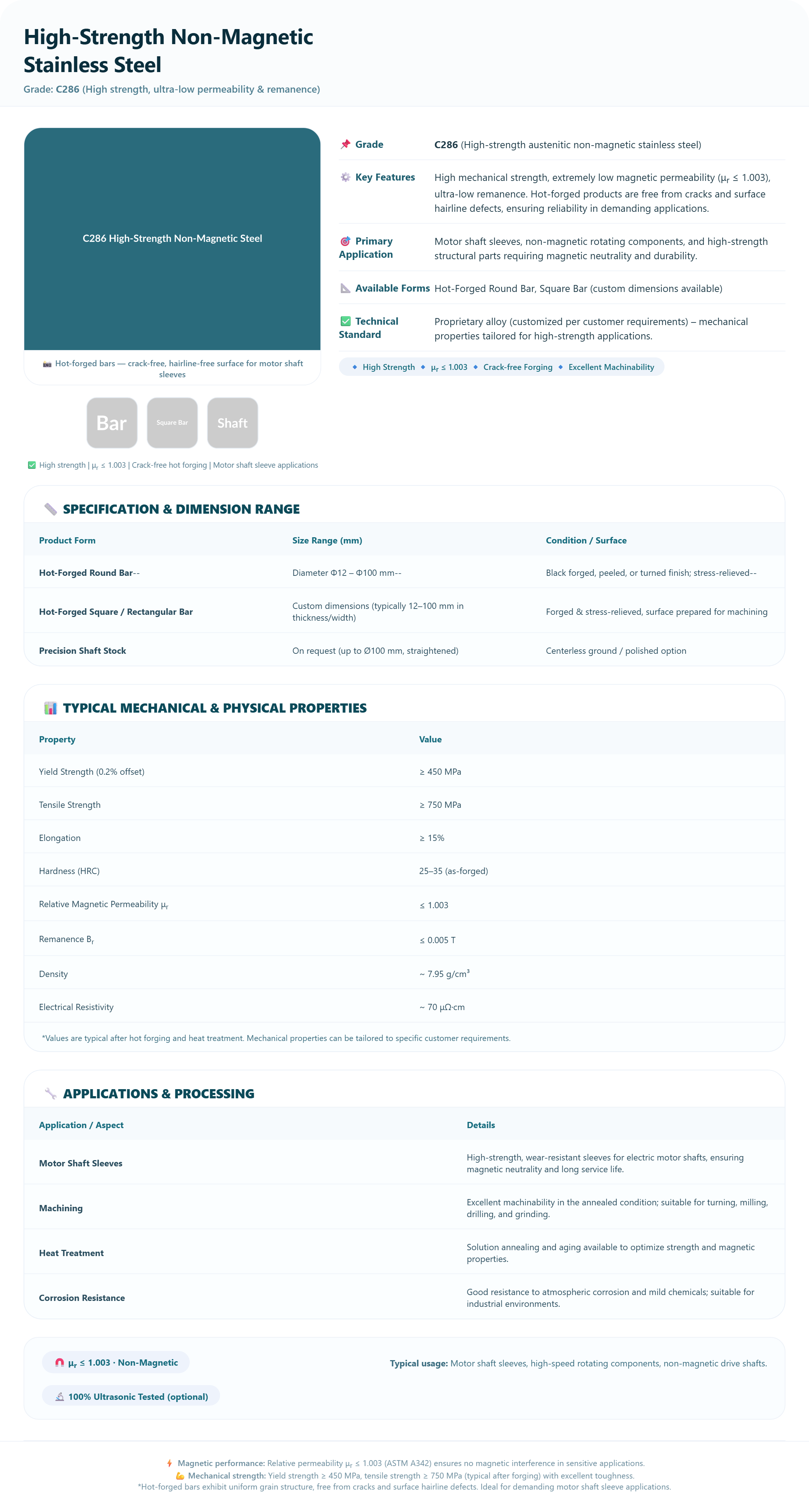
A286 Stainless Steel (UNS S66286)
High-Strength, Non-Magnetic Precipitation-Hardening Alloy for Aerospace, Motor, Cryogenic and Industrial Applications
Hefei Ke Ningman New Energy Materials Technology Co., Ltd. supplies A286 stainless steel, also known as A-286, Alloy A286, UNS S66286 and 1.4980, for engineering applications requiring a combination of high strength, corrosion resistance, oxidation resistance and non-magnetic performance.
A286 is an iron-based, nickel-chromium precipitation-hardening alloy that can be strengthened through controlled heat treatment. It is widely considered for demanding applications where mechanical strength, dimensional stability and corrosion resistance must be maintained across a wide temperature range.
Typical applications include aerospace components, high-temperature fasteners, springs, motor components, shaft sleeves, turbine equipment and non-magnetic cryogenic components.
Custom dimensions, product forms, technical documentation and bulk supply can be discussed according to project requirements.
Request an A286 Stainless Steel Quote
What Is A286 Stainless Steel?
A286 stainless steel is an age-hardenable, austenitic iron-based alloy with high nickel and chromium content.
It is commonly identified by:
A286
A-286
UNS S66286
W.Nr. 1.4980
Alloy 660
Iron Alloy 660
A286 is selected when engineers require a combination of:
High mechanical strength
Corrosion resistance
Oxidation resistance
Non-magnetic performance
Good low-temperature ductility
High-temperature strength
Precipitation-hardening capability
The final properties depend on the product form, heat-treatment condition, processing history and applicable specification.
A286 Stainless Steel Key Properties
High Strength
A286 can achieve high mechanical strength through solution treatment and age-hardening processes.
This makes it suitable for components subjected to significant mechanical loads where conventional austenitic stainless steel may not provide sufficient strength.
Potential applications include:
Shafts
Shaft sleeves
Fasteners
Springs
Turbine components
Aerospace components
Precision mechanical parts
The required tensile strength, yield strength and hardness should be specified together with the required heat-treatment condition.
Non-Magnetic Performance
A286 is an austenitic alloy and is widely used for applications requiring non-magnetic or low-magnetic-response material.
This characteristic can be important in:
Cryogenic equipment
Precision instruments
Motor components
Magnetic-sensitive assemblies
Aerospace systems
Specialized industrial equipment
Actual magnetic permeability can depend on material condition, cold work, processing and testing conditions.
For applications with a strict permeability limit, the buyer should specify the required maximum permeability and test method.
Corrosion Resistance
A286 provides useful corrosion resistance for many industrial environments.
Its corrosion performance makes it suitable for applications where both mechanical strength and environmental resistance are required.
However, corrosion resistance depends on:
Temperature
Chemical environment
Surface condition
Heat treatment
Stress state
Exposure duration
For aggressive chemical environments, material selection should be based on the actual service conditions and applicable engineering specification.
High-Temperature Performance
A286 is commonly selected for applications requiring strength and oxidation resistance at elevated temperatures.
Published material references describe A286 as suitable for high-strength service up to approximately 700°C / 1300°F, depending on the application, stress level, product form and specification.
It is therefore used in selected:
Jet engine components
Gas turbine hardware
High-temperature fasteners
Springs
Motor components
Turbocharger components
Power-generation equipment
Actual allowable operating temperature should always be determined from the engineering specification rather than using a single generic temperature limit.
A286 Stainless Steel Specifications
| Property | A286 |
|---|---|
| Common Designation | A286 / A-286 |
| UNS | S66286 |
| Werkstoff | 1.4980 |
| Common Reference | Alloy 660 / Iron Alloy 660 |
| Alloy Type | Precipitation-hardening austenitic iron-based alloy |
| Magnetic Behavior | Non-magnetic / low magnetic response |
| Strengthening Method | Solution treatment + age hardening |
| Main Features | High strength, corrosion resistance, oxidation resistance |
| Typical Applications | Aerospace, fasteners, springs, motor components, cryogenic equipment |
The applicable specification should be confirmed according to product form and end-use requirements.
A286 Chemical Composition
The exact chemical composition should be controlled according to the applicable specification.
For reference, published A286 specifications commonly control elements including:
Chromium
Nickel
Molybdenum
Titanium
Vanadium
Aluminum
Boron
Carbon
Manganese
Silicon
Phosphorus
Sulfur
For example, published AMS 5737 data specifies nickel at 24.0–27.0%, chromium at 13.5–16.0%, molybdenum at 1.00–1.50%, titanium at 1.90–2.35%, vanadium at 0.10–0.50% and boron at 0.003–0.010%.
Important: Use the exact chemical-composition limits from the standard specified for your supplied product rather than combining limits from different specifications.
A286 Heat Treatment
Heat treatment is an important part of A286 material selection because its mechanical properties depend strongly on the specified condition.
A typical material-processing sequence may include:
Solution Treatment → Cooling → Age Hardening → Mechanical Property Verification
The actual heat-treatment cycle depends on:
Product form
Applicable standard
Required strength
Required hardness
Dimensional requirements
Service temperature
Customer specification
Published information for A286 includes solution treatment and age-hardening conditions specified under different AMS standards. For example, one commonly referenced condition uses solution annealing around 980°C followed by aging, but the exact cycle must follow the applicable specification.
A286 vs Conventional Stainless Steel
A286 is not simply a general-purpose stainless steel substitute.
Its main advantage is the combination of high strength, corrosion resistance and precipitation-hardening capability, together with useful non-magnetic performance.
| Requirement | 304 Stainless Steel | 316 Stainless Steel | A286 |
| General Corrosion Resistance | Excellent | Excellent | Good to excellent depending on environment |
| Strength | Moderate | Moderate | High after aging |
| Precipitation Hardening | No | No | Yes |
| Non-Magnetic | Generally yes when fully austenitic | Generally yes when fully austenitic | Yes / low magnetic response |
| High-Temperature Strength | Limited compared with A286 | Limited compared with A286 | High |
| Aerospace Use | Limited | Selected applications | Widely used |
| High-Strength Fasteners | Limited | Selected | Excellent suitability |
| Cryogenic Applications | Application dependent | Application dependent | Suitable for selected non-magnetic applications |
The correct grade should be selected according to the actual combination of corrosion, temperature, strength, magnetic and fabrication requirements.
A286 for Motor Shaft Sleeves
A286 can be considered for motor shaft sleeves and other rotating components where high strength, corrosion resistance and non-magnetic performance are important.
For motor shaft sleeve applications, buyers should evaluate:
Shaft diameter
Sleeve wall thickness
Rotational speed
Operating temperature
Radial load
Friction conditions
Surface finish
Dimensional tolerance
Magnetic requirements
Heat-treatment condition
For rotating components, dimensional accuracy and surface condition can be as important as the nominal alloy grade.
A286 for Aerospace Applications
A286 is widely used in aerospace and aircraft-related applications where high strength, corrosion resistance and temperature capability are required.
Typical applications can include:
Jet engine components
High-temperature fasteners
Springs
Retaining components
Turbine-related hardware
Structural hardware
Precision aerospace components
Published industry sources identify A286 as a material for jet-engine components, high-temperature fasteners and springs.
For aerospace procurement, the applicable AMS specification, product form, heat-treatment condition and inspection requirements should be confirmed before production.
A286 for High-Temperature Fasteners
A286 is commonly selected for high-temperature fasteners because it can combine high strength with corrosion and oxidation resistance.
Potential applications include:
Bolts
Nuts
Studs
Washers
High-temperature fastening systems
Turbine fasteners
Engine hardware
Fastener selection should consider preload, temperature, creep, oxidation, thread geometry and applicable aerospace or industrial specifications.
A286 for Cryogenic Applications
A286 can also be used for selected low-temperature applications where high strength and non-magnetic performance are important.
Potential applications include:
Cryogenic equipment
Low-temperature mechanical components
Magnetic-sensitive assemblies
Specialized valves
Precision equipment
The suitability of A286 at cryogenic temperatures should be evaluated according to the required toughness, strength, magnetic properties and applicable specification.
A286 Product Forms
Depending on the applicable specification, A286 can be supplied in multiple product forms.
A286 Stainless Steel Bar
Suitable for:
Shafts
Shaft sleeves
Fasteners
Machined components
Precision mechanical parts
A286 Stainless Steel Sheet
Suitable for fabricated components, aerospace parts and industrial applications.
A286 Stainless Steel Plate
Used for heavier fabricated components and industrial equipment.
A286 Stainless Steel Wire
Suitable for selected springs, fasteners and precision applications.
A286 Tube
Available for selected applications according to specification and manufacturing capability.
A286 Forgings
Suitable for demanding aerospace and industrial components requiring controlled mechanical properties.
Published A286 suppliers list forms including bar, wire, sheet, plate, tubing, forgings and rings, although actual availability depends on the required specification and supplier capability.
A286 Stainless Steel Standards
A286 can be specified under different standards depending on the product form and application.
Commonly referenced specifications include:
ASTM A453 Grade 660
ASTM A638 Grade 660
ASTM B637
AMS 5525
AMS 5731
AMS 5732
AMS 5734
AMS 5737
AMS 5805
AMS 5853
AMS 5895
The correct specification must be selected according to the required product form and application. Published A286 references list multiple AMS and ASTM specifications rather than one universal specification.
A286 Quality Control
A286 requires control of both alloy composition and heat-treatment condition.
A typical quality-control workflow can include:
Raw Material Inspection → Chemical Composition Verification → Dimensional Inspection → Heat-Treatment Verification → Mechanical Testing → Surface Inspection → Magnetic Property Verification → Final Inspection → Documentation
Depending on project requirements, quality documentation may include:
Material Test Report
Chemical composition report
Tensile strength
Yield strength
Elongation
Hardness
Heat-treatment condition
Dimensional inspection
Surface inspection
Magnetic permeability test
Quality certificate
Third-party inspection
For aerospace and critical rotating applications, customers should provide the complete inspection specification before production.
How to Choose A286 Stainless Steel
When sourcing A286, do not specify only:
A286 stainless steel
A better procurement specification should include:
1. Alloy Designation
A286 / UNS S66286
2. Product Form
For example:
Bar
Sheet
Plate
Wire
Tube
Forging
3. Dimensions
Specify:
Diameter
Thickness
Width
Length
Tolerance
4. Heat-Treatment Condition
Specify the required solution-treated or age-hardened condition according to the applicable standard.
5. Mechanical Properties
Specify:
Tensile strength
Yield strength
Elongation
Hardness
6. Magnetic Requirement
If the component is magnetic-sensitive, specify the required permeability limit and test method.
7. Surface Finish
Specify the required surface condition and roughness where applicable.
8. Certification
Confirm whether you require:
MTR
Mill certificate
Heat-treatment record
Mechanical test report
Chemical composition
Magnetic test
Third-party inspection
A286 Stainless Steel Supplier
Hefei Ke Ningman New Energy Materials Technology Co., Ltd. supplies A286 stainless steel / UNS S66286 for industrial and engineering applications requiring high strength, corrosion resistance and non-magnetic performance.
Our supply and processing services can include:
A286 stainless steel material supply
A286 bar and wire
A286 sheet and plate
Custom dimensions
Precision machining
Heat-treatment requirements
Bulk orders
OEM material sourcing
Quality inspection
Material documentation
Whether you are sourcing A286 for motor shaft sleeves, aerospace components, high-temperature fasteners, springs, turbine components or cryogenic equipment, provide your grade, product form, dimensions, quantity, specification and required properties for a quotation.
Request an A286 Stainless Steel Quote →
Frequently Asked Questions
What is A286 stainless steel?
A286 is an iron-based, nickel-chromium precipitation-hardening alloy commonly identified as UNS S66286 and W.Nr. 1.4980. It is used where high strength, corrosion resistance, temperature capability and non-magnetic performance are required.
Is A286 stainless steel non-magnetic?
A286 is an austenitic alloy and is widely used for non-magnetic applications. Actual magnetic permeability depends on material condition, processing and test conditions.
What is the UNS number for A286?
The UNS designation for A286 is S66286. It is also commonly identified as W.Nr. 1.4980 and Alloy 660.
What is A286 used for?
Common applications include aerospace components, high-temperature fasteners, springs, turbine hardware, motor components and selected cryogenic or magnetic-sensitive equipment.
Is A286 precipitation hardenable?
Yes. A286 is an age-hardenable precipitation-hardening alloy. Controlled heat treatment is used to develop the required mechanical properties.
Can A286 be used at high temperatures?
A286 is used for high-temperature applications and can provide useful strength and oxidation resistance at elevated temperatures. The applicable operating limit depends on stress, exposure time, product condition and specification.
Is A286 suitable for motor shaft sleeves?
A286 can be considered for motor shaft sleeves where high strength, dimensional stability, corrosion resistance and non-magnetic performance are required. Final selection should be based on the shaft design, temperature, load, speed and surface requirements.
What is the difference between A286 and 17-4PH stainless steel?
A286 is an austenitic precipitation-hardening alloy with high nickel content and non-magnetic characteristics, while 17-4PH is a martensitic precipitation-hardening stainless steel with different magnetic and mechanical behavior. The appropriate grade depends on the application.
Can you supply custom A286 stainless steel?
Yes. Custom dimensions, product forms and processing requirements can be discussed according to engineering drawings and applicable specifications.
Can you provide A286 material certificates?
Material certificates and inspection documentation can be supplied according to the applicable specification and order requirements.
Request an A286 Stainless Steel Quote
Looking for high-strength, non-magnetic A286 stainless steel?
Send us:
A286 / UNS S66286
Product form
Dimensions
Quantity
Heat-treatment condition
Applicable ASTM / AMS specification
Mechanical requirements
Magnetic requirements
Surface finish
Inspection requirements
Our technical team can review your requirements and provide a suitable A286 stainless steel material solution.
Get a Quote → Contact Us